For businesses operating in Singapore and the Philippines, privacy compliance is no longer a legal side note. It is now a core operating requirement that affects marketing operations, analytics infrastructure, customer support workflows, vendor selection, and executive risk exposure. With the Personal Data Protection Act in Singapore and the Data Privacy Act of 2012 in the Philippines, organizations are expected to know where personal data lives, how it moves, who can access it, how long it is retained, and whether processing activity is supported by a lawful basis, contractual controls, and defensible governance. A privacy compliance auditor inside your tool stack gives you that visibility at the system level, not just the policy level, which is where most teams discover their blind spots.
Many companies already invest heavily in CRM platforms, marketing automation, cloud storage, analytics suites, consent tools, and endpoint security. The missing layer is often the auditor that checks whether those tools are configured in a way that actually aligns with privacy obligations. A privacy compliance auditor is not just a legal review tool. It is a technical control that continuously inspects consent states, data flows, retention settings, third-party integrations, access patterns, and cross-border transfer mechanisms. For B2B teams handling lead generation, account-based marketing, client portals, or employee data, that visibility is essential for reducing regulatory friction and operational surprises.
What a privacy compliance auditor actually does inside a modern tool stack
A privacy compliance auditor evaluates whether the technologies you use are collecting, processing, storing, transmitting, and deleting personal data in line with your internal policies and external obligations. It is different from a document repository or a legal checklist because it observes implementation behavior. That matters because most compliance failures happen not when policies are missing, but when tools drift away from the policy after configuration changes, plugin updates, new campaigns, or vendor onboarding.
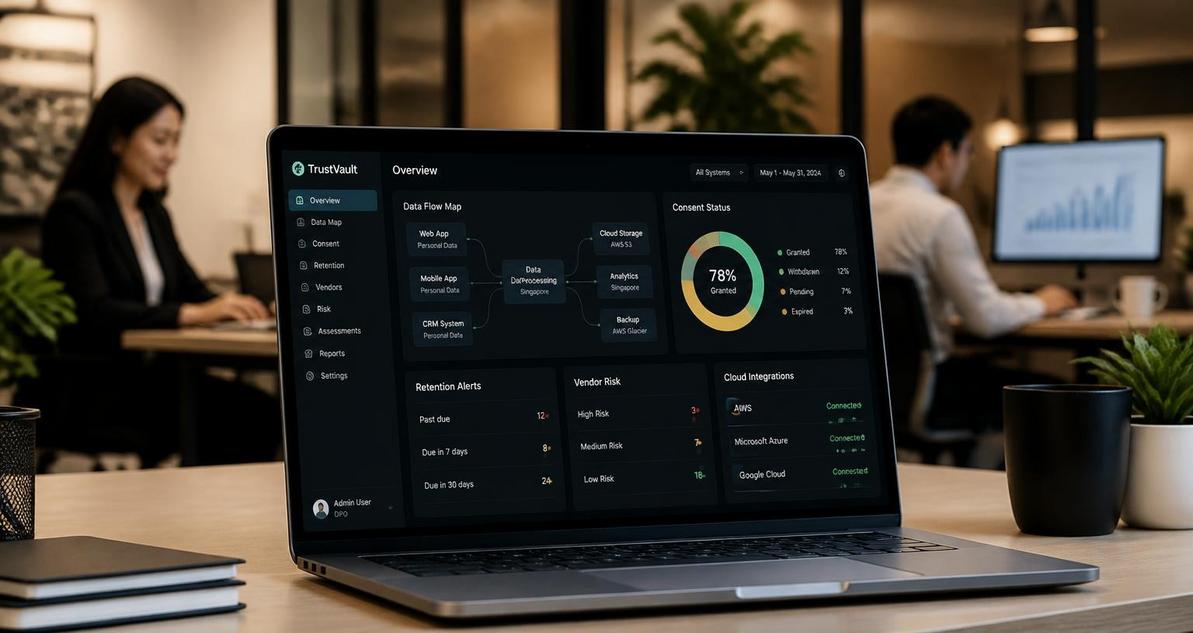
In practical terms, a mature privacy compliance auditor can map data categories across systems, detect shadow IT, flag unauthorized exports, verify cookie and tracking deployments, and reconcile consent records against active marketing segments. It can also identify stale records that exceed retention windows, broken deletion workflows, and systems that still process data after consent withdrawal. For technical teams, this is especially valuable because it turns privacy from a periodic audit project into a continuous control layer.
How it fits with governance, risk, and compliance workflows
Enterprises in Singapore and the Philippines often already maintain information security frameworks, vendor risk reviews, and internal audit processes. A privacy compliance auditor should connect to those workflows, not sit beside them as an isolated tool. It should feed evidence into governance, risk, and compliance platforms, and it should support audit trails that can be reviewed by legal, compliance, operations, and engineering teams without manual reconstruction.
This matters because privacy controls are rarely confined to one department. Marketing may deploy a tracking tag, sales may sync contacts into a CRM, HR may store candidate data in a recruitment system, and IT may provision cloud storage that contains personal information. A privacy compliance auditor helps answer the operational question: does this specific system behavior match the privacy rule we say we follow?
Why Singapore and Philippines businesses need continuous privacy monitoring
Both Singapore and the Philippines have active enforcement environments and a regulatory direction that favors accountability, documentation, and demonstrable control. Singapore’s PDPA places emphasis on consent, purpose limitation, notification, protection, retention limitation, and transfer limitation. The Philippines’ Data Privacy Act requires lawful processing, proportionality, security, transparency, and respect for data subject rights. In both markets, the challenge is not just knowing the rules. It is proving that your operational stack respects them across multiple tools and teams.
For B2B organizations, this is particularly important because customer acquisition and service delivery often depend on integrated systems. A form submission on a landing page may feed into a marketing automation platform, then sync to a CRM, then route to a sales enablement tool, then land in a support or ERP system. Without continuous auditing, one misconfigured connector can create unlawful retention, duplicate copies of personal data, or processing beyond the original purpose.
The cross-border and cloud reality
Many companies in Southeast Asia run on cloud services hosted in multiple regions. Data may pass through Singapore, the United States, or other jurisdictions depending on architecture, backup strategy, and vendor design. That makes transfer governance a technical problem as much as a legal one. A privacy compliance auditor can help verify where data resides, whether sub-processors are involved, and whether transfer safeguards are documented and operationally enforced.
In distributed environments, the greatest risk is often the mismatch between declared policy and actual system routing. A vendor may promise regional hosting, but logs, backups, or analytics events may still flow elsewhere. An auditor that inspects infrastructure and integration behavior provides evidence that policy statements reflect reality.
Where privacy failures actually happen in the stack
Privacy incidents usually emerge from ordinary operational decisions rather than dramatic breaches. A product team enables a new analytics script. A marketing manager uploads a contact list without validating lawful basis. A developer activates a third-party chatbot widget that transmits form fields to external servers. A sales team exports a CRM segment into a spreadsheet and stores it in an ungoverned drive. These are not rare scenarios. They are routine, which is why compliance must be automated at the tooling layer.
A privacy compliance auditor detects these issues earlier by comparing system behavior against expected rules. It can inspect whether cookie banners match the tags actually firing on the page, whether CRM fields are being used for purposes approved in your notices, or whether retention policies are being enforced after account closure. It can also identify whether access permissions are too broad, whether production data is being copied into test environments, and whether third-party apps have excessive permissions.
Marketing technology is a common risk zone
Marketing stacks are among the most privacy-sensitive environments in B2B operations because they combine tracking, profiling, segmentation, enrichment, and automated outreach. Consent mismatches are common when teams run multiple landing pages, regional campaigns, or cloned forms with different scripts. A privacy compliance auditor should verify that consent language, cookie categories, pixel activation rules, and downstream sync logic are aligned. If a lead withdraws consent, the auditor should be able to confirm that marketing systems stop processing that data for the affected purpose, not just remove it from one interface.
In practice, the most effective teams test this with scenario-based validation. They submit a controlled test record, record the consent choices, inspect every downstream system that receives the event, and verify what happens when the consent changes. This kind of workflow is difficult to maintain manually at scale, but it is exactly what a technical privacy auditor is designed to automate.
Cloud storage, collaboration tools, and shadow data
Privacy risk does not stop at customer-facing systems. Collaboration platforms, file shares, backup tools, and messaging systems frequently contain sensitive personal data. Employees may store scans of identification documents, HR records, contract attachments, or support screenshots in locations that were never designed as authoritative records repositories. A privacy compliance auditor can discover these storage paths, classify the data, and flag when retention or access rules are missing.
This is especially useful for organizations that move quickly and adopt tools without central oversight. Shadow data builds up fast, and when it does, subject access requests and deletion requests become difficult to complete accurately. An auditor gives your team a map of where data likely exists, which is critical for response readiness.
How a privacy compliance auditor supports measurable business outcomes
A privacy compliance auditor is not just a defensive control. It improves operational discipline in ways that affect revenue, delivery speed, and vendor trust. When privacy checks are built into the stack, teams spend less time chasing down compliance exceptions and more time shipping campaigns, onboarding customers, and closing deals with enterprise buyers who ask detailed security and privacy questions.
For sales-led B2B businesses, privacy readiness can shorten procurement cycles. Enterprise prospects often require evidence of retention controls, access logging, vendor management, and incident response maturity before they approve contracts. If your team can produce audit evidence from the systems themselves, rather than assembling it manually from multiple departments, you reduce review friction and improve trust.
For technical teams, the benefit is equally clear. An auditor embedded into DevOps or data operations can catch privacy regressions during deployment. If a developer adds a new event collector or a product manager enables a new analytics integration, the system can flag whether the change expands the data surface beyond approved processing. That lowers the chance of late-stage remediation and reduces the cost of rework.
Evidence quality matters more than policy volume
Many organizations have extensive privacy policies and long vendor agreements, yet still struggle to prove operational compliance. Regulators and enterprise clients care less about the number of documents you have and more about whether you can demonstrate control. A privacy compliance auditor improves evidence quality by generating logs, control attestations, configuration snapshots, and exception reports that show how systems behaved at specific points in time.
This is where automation becomes strategic. Manual spreadsheets age quickly and depend on memory, while audited system records remain traceable. In a real review, that difference can determine whether a control issue becomes a minor clarification or a major procurement blocker.
What to look for when selecting a privacy compliance auditor
Not every privacy tool deserves a place in the stack. The right one needs to support your architecture, your data flows, and your operating model. Start by checking whether the auditor can inventory systems across cloud, SaaS, on-premises, and hybrid environments. It should support APIs, event ingestion, and configuration scanning so it can inspect actual behavior rather than depend only on manual input.
Next, evaluate whether it can map processing activities to specific purposes, lawful bases, and retention rules. A useful auditor should help you connect technical events to policy obligations. It should also support role-based access, immutable logging, exception workflows, and exportable evidence that legal and compliance teams can review. If it cannot generate traceable proof, it will not carry much value during audits, client due diligence, or internal reviews.
Integration depth is the deciding factor
The best privacy compliance auditor is one that integrates deeply with the systems you already use. Look for connectors to CRM platforms, marketing automation tools, cloud storage, identity providers, ticketing systems, data warehouses, and web analytics. The more complete the integration layer, the less likely you are to miss data movement paths. If the tool only scans a narrow subset of your stack, you will still be forced to reconcile blind spots manually.
Also assess whether the auditor can support regional compliance requirements. For Singapore and the Philippines, that means clear data lineage, auditable consent handling, configurable retention rules, and transfer monitoring. The tool should help you operationalize controls across departments, not simply surface generic warnings.
Implementation checklist for adding a privacy compliance auditor to your stack
Before deployment, define the systems and data types in scope. Start with your highest-risk workflows: lead capture, customer onboarding, support intake, HR records, and any environment with third-party data enrichment or automated profiling. Then document which teams own each system, which vendor contracts apply, and which data categories are processed.
Use the auditor to build a baseline map of current state. Identify all integrations, scripts, storage locations, and permission sets. Compare that baseline against your privacy notices, retention schedule, consent model, and vendor register. Any mismatch should become a tracked remediation item with an owner and deadline.
- Inventory all systems that process personal data, including shadow tools and legacy platforms.
- Map data flows from collection to storage, transfer, use, retention, and deletion.
- Verify consent logic, lawful basis, and notice alignment across forms, cookies, and CRM fields.
- Check retention settings in every system that stores personal data, including backups where applicable.
- Review access controls, especially for admin accounts, contractors, and external vendors.
- Validate deletion and suppression workflows for withdrawal, objection, and account closure requests.
- Test cross-border transfer paths and confirm that documentation matches actual processing behavior.
- Schedule recurring audits after major releases, new integrations, and vendor changes.
Once the baseline is stable, connect the auditor to change management. Any new tracking script, API integration, or storage path should trigger a privacy review before production release. That turns compliance from a periodic scramble into an embedded technical control that protects your business as your stack evolves.

I am Tricia Huang Mei, an Advertising Partner in Sotavento Medios with over two decades of experience in the Singapore advertising and business sectors. My career is defined by a commitment to driving high-impact marketing campaigns and fostering sustainable growth for the diverse business portfolios I manage.