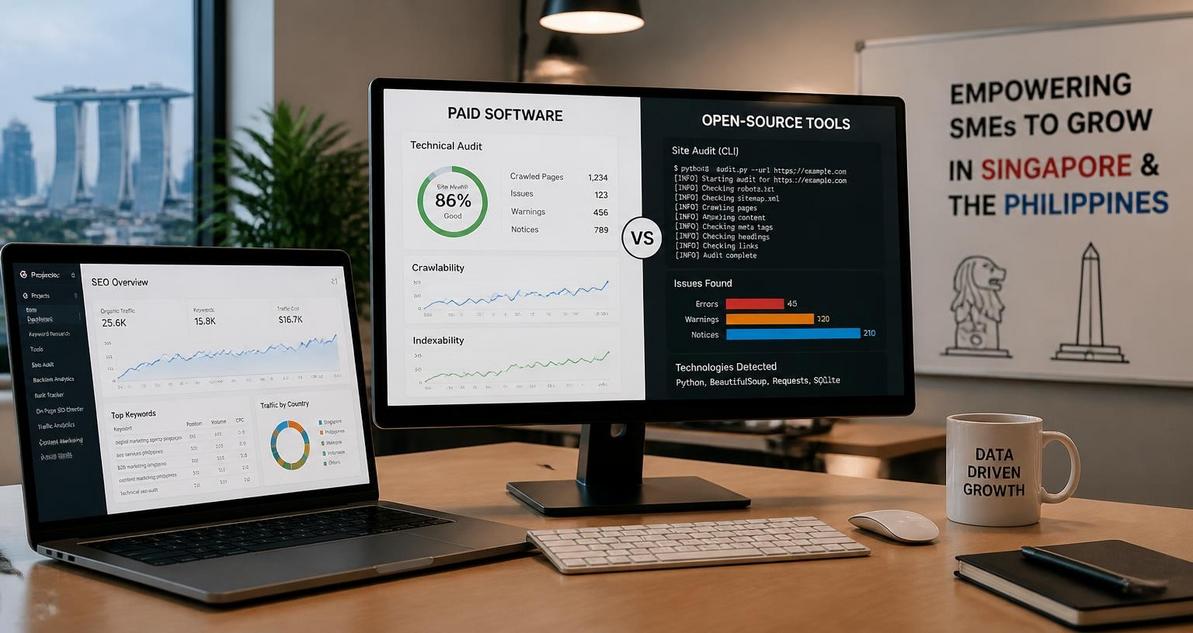
For small and medium enterprises in Singapore and the Philippines, SEO tool selection is not only a marketing decision. It affects technical operations, reporting quality, team productivity, and how quickly a business can compete in crowded local search results. SMEs in these markets often operate with lean teams, multilingual customer bases, and tight acquisition budgets, which makes the choice between paid and open-source SEO tools especially strategic. A tool stack that looks inexpensive on paper can become costly if it slows workflows, lacks accurate data, or creates gaps in technical diagnosis. At the same time, a premium SaaS platform may deliver features that exceed the requirements of a smaller team. The best choice depends on whether the business needs speed, scalability, integration depth, or maximum cost control.
How SEO tool categories differ in practical SME use
Paid SEO tools are commercial platforms that package data collection, analysis, and reporting into a managed interface. They usually include crawlers, keyword databases, backlink indexes, rank tracking, content research modules, and scheduled reporting. Open-source SEO tools are typically self-hosted or community-maintained utilities that require more technical setup but offer more control over data flow and customization. For SMEs, the main trade-off is not just license cost versus zero license cost. The real difference lies in implementation effort, data reliability, and the internal capability needed to operate the stack effectively.
In Singapore, where many SMEs compete in high-value B2B, SaaS, finance, logistics, and professional services sectors, the technical SEO requirement is often more advanced than basic keyword tracking. In the Philippines, many SMEs depend on local search visibility, multi-location presence, and content marketing efficiency, especially in retail, services, outsourcing, education, and hospitality. These market conditions make features such as site auditing, schema validation, log analysis, and competitor benchmarking more valuable than generic vanity metrics.
What paid tools usually centralize
Paid platforms tend to package multiple SEO functions into a single commercial workflow. That matters because the cost of switching between tools is not only financial. It also creates data fragmentation across dashboards, export files, and manual reporting processes. A paid suite often reduces operational drag by connecting rank tracking, crawl diagnostics, keyword discovery, and backlink analysis inside one interface. For SMEs without dedicated SEO engineers, this can shorten the time from issue detection to implementation.
Common benefits include faster onboarding, vendor support, API access, scheduled crawls, and standardized reporting templates. For agencies and in-house teams managing multiple domains, those features reduce the risk of inconsistent data definitions and reporting drift. They also help when leadership wants recurring performance updates without asking a technical specialist to build custom dashboards from scratch.
What open-source tools usually require
Open-source SEO tools often excel in flexibility, transparency, and cost control. A technically capable team can use them for crawling, parsing server logs, checking metadata, extracting structured data, and automating repetitive audits. The issue is that the team must own setup, maintenance, and troubleshooting. That includes installation, updates, server resources, script management, and data storage. If internal capability is limited, the initial cost savings can be offset by hidden labor costs.
This matters for SMEs that run on generalist teams. A marketing manager may not have the time to configure command-line utilities, manage dependencies, or validate output consistency. In such cases, open-source tools are most effective when paired with a technically confident analyst, developer, or agency partner. Without that support, the business may underuse the toolset and miss the primary advantage of open systems, which is adaptability.
Cost structure, total cost of ownership, and operational impact
When comparing paid and open-source SEO tools, SMEs should calculate total cost of ownership rather than subscription price alone. Total cost includes software licensing, implementation time, training, maintenance, data storage, and opportunity cost from delayed execution. This is especially important for businesses in Singapore and the Philippines, where teams often manage performance marketing, web operations, and analytics simultaneously. A tool with no monthly fee can still be expensive if it requires hours of engineering time every week.
Paid tools are easier to budget because costs are predictable. That predictability helps finance teams, especially in organizations that need monthly operating expense control. Open-source tools can look attractive when a business wants to reduce recurring SaaS commitments, but they may shift costs into technical labor. The decision becomes more favorable for open-source when the organization already has in-house developers or an agency arrangement that can absorb maintenance tasks efficiently.
Where paid tools create measurable efficiency
Paid SEO tools usually compress the research-to-action cycle. For example, a regional SME can review crawl errors, keyword cannibalization, backlink profile changes, and competitor share of voice in one reporting session instead of pulling data from separate sources. This matters when a business needs fast decisions on landing page prioritization, internal linking, or technical cleanup. In a competitive SERP, speed matters because technical issues can suppress rankings for weeks if they are discovered late.
Paid platforms also help with governance. Standardized dashboards reduce the risk that different stakeholders interpret the same metric differently. That is useful in organizations where marketing, IT, and management all need visibility but do not share the same technical background. The platform becomes a shared language for decision-making.
Where open-source tools reduce dependency
Open-source tools are especially strong when a business wants full control over data pipelines or needs a custom workflow that commercial tools do not support. For example, an SME with a bespoke CMS can build automated checks for canonical tags, hreflang implementation, structured data compliance, and redirect mapping. A business with a multilingual website can also create custom scripts to monitor page templates across English, Tagalog, and other localized versions without waiting for vendor feature releases.
In technically mature teams, open-source systems also reduce platform lock-in. If a business decides to migrate analytics infrastructure, change crawl logic, or integrate with a proprietary warehouse, open tools can be adapted more freely. That flexibility is valuable for growth-stage companies that expect their stack to evolve quickly.
SEO capability comparison across the tasks that matter most
SMEs rarely evaluate SEO tools in the abstract. They need answers for specific workflows, such as technical audits, keyword research, backlink analysis, content optimization, and reporting. The right comparison depends on how each tool class performs in those tasks under real operating conditions. A tool is only useful if the team can translate data into implementation within a reasonable time frame.
Technical auditing and crawl depth
Paid crawlers often provide polished dashboards, error grouping, prioritization logic, and automated issue detection. They are efficient for identifying broken links, missing metadata, duplicate content, redirect chains, and indexability problems. Open-source crawlers can match much of this capability, but they usually require more configuration and interpretation. For SMEs with many page templates, a paid interface can reduce complexity and help surface patterns faster.
However, open-source auditing tools can be superior when the business needs custom checks. If a site uses a complex URL architecture, localized subdirectories, or dynamic rendering, a technical team may prefer a scriptable crawler that can be tuned precisely. This is relevant for businesses that already treat SEO as part of their engineering process rather than only a marketing function.
Keyword research and search intent mapping
Paid tools typically have larger keyword databases, trend overlays, and competitive analysis modules. That makes them useful for identifying commercial intent, question-based queries, and local modifiers. For SMEs targeting city-level demand in Singapore or province-based searches in the Philippines, these features help prioritize terms that match revenue potential. They are also useful for mapping content clusters and estimating the relative difficulty of ranking pages.
Open-source approaches can support keyword analysis, but they often require combining multiple data sources. A team may need to pull from search console exports, third-party datasets, and custom scripts to approximate the same insight. That can still work well for mature teams that prefer precise segmentation, but it usually demands more manual effort.
Backlink analysis and competitive intelligence
Paid backlink tools remain stronger for fast competitor intelligence. They provide broader link indexes, anchor text analysis, domain comparisons, and historical trend data. That visibility is useful when SMEs want to evaluate authority gaps or discover link opportunities from relevant industry publications. For businesses trying to compete with larger brands, this matters because link profile quality often influences ranking resilience.
Open-source tools can help audit a site’s own link profile if the team combines server data, crawls, and external exports. They are less effective for broad market visibility unless the organization builds a more advanced data process. For most SMEs, paid backlink intelligence is the more practical option unless the use case is highly specialized.
Best-fit scenarios for Singapore and Philippines SMEs
Different business models require different SEO operating models. A professional services firm in Singapore with a small content team may need fast reporting, executive dashboards, and reliable issue prioritization more than deep technical customization. In that case, a paid suite often delivers better value because it reduces internal workload. A B2B software company with in-house developers may prefer a hybrid approach that uses paid tools for market intelligence and open-source utilities for technical monitoring and automation.
In the Philippines, many SMEs operate with lean digital teams and strong dependence on content marketing, social traffic, and local search. For these organizations, the biggest risk is not tool sophistication. It is execution consistency. A paid tool can improve consistency by automating reporting and reducing training overhead. A more technical e-commerce or publishing business, however, may benefit from open-source utilities for custom tracking, automated QA, and integration with internal dashboards.
Scenario 1: Agency-led SME growth
When an SME works with a digital marketing agency, paid tools are often easier to deploy because the agency already owns the process, interpretation layer, and reporting cadence. The client gets actionable insights without having to maintain the stack internally. This is particularly efficient when campaigns need coordinated SEO, PPC, and analytics reporting. In that setting, tool access is less important than the agency’s ability to convert findings into prioritized actions.
Scenario 2: In-house technical marketing team
If an SME has an in-house technical marketer or SEO analyst, open-source tools become more viable. The team can customize crawls, automate alerts, and build internal data pipelines that reflect exact business rules. This is useful when SEO sits close to product, development, or data engineering. The trade-off is that leadership must accept more operational ownership and more variability in setup time.
Implementation checklist for selecting the right SEO stack
Before choosing between paid and open-source SEO tools, SMEs should evaluate workflow maturity, internal technical capability, and reporting requirements. The right stack is the one that your team can actually operate consistently, not the one with the longest feature list. Use the following checklist to align the decision with business needs:
- Define the primary SEO objective, such as technical health, content growth, local visibility, or backlink acquisition.
- Map the team structure and identify who will use the tool daily, who will interpret the data, and who will execute fixes.
- Estimate total cost of ownership, including subscriptions, setup time, training, server resources, and maintenance.
- Review integration requirements for analytics, CRM, content management systems, and reporting dashboards.
- Assess data quality needs, especially for keyword databases, backlink coverage, crawl depth, and export reliability.
- Determine whether the business needs standard reporting or custom workflow automation.
- Check whether the team can manage updates, script changes, or troubleshooting without slowing campaigns.
- Run a limited pilot on one site section, one location, or one content cluster before committing to a full rollout.
- Document ownership for audits, issue triage, and recurring reporting so the tool does not become underused.
- Reassess the stack every quarter as traffic mix, website architecture, and growth priorities change.

I am Tricia Huang Mei, an Advertising Partner in Sotavento Medios with over two decades of experience in the Singapore advertising and business sectors. My career is defined by a commitment to driving high-impact marketing campaigns and fostering sustainable growth for the diverse business portfolios I manage.