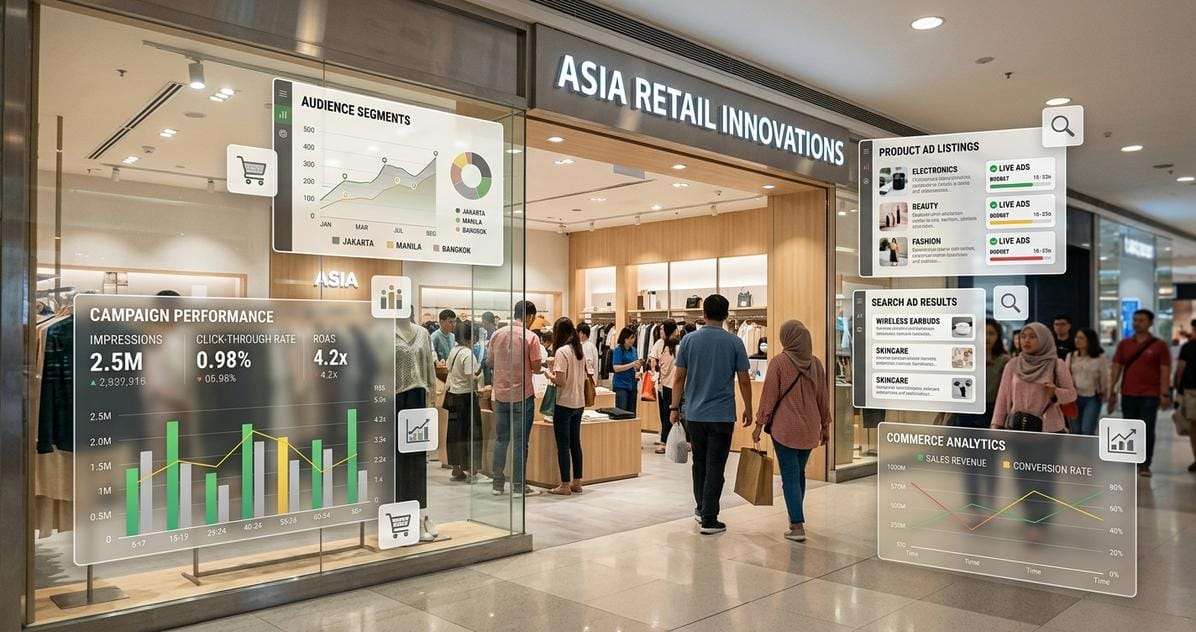
Retail media networks have moved from a niche ecommerce monetization tactic to one of the most strategic shifts in digital advertising. For brands operating in Singapore and the Philippines, the trend is especially relevant because shopping behavior is increasingly hybrid: discovery happens on social and search, but conversion often happens on retailer platforms, marketplaces, and super-app ecosystems. That means the retailer is no longer just a distribution channel. It is also a high-intent media owner with first-party data, closed-loop measurement, and direct influence over purchase decisions. For business leaders, retail media is not simply another budget line. It is a structural change in how media inventory is created, sold, and measured across the commerce funnel.
The timing matters. Cookie deprecation, fragmented attribution, and pressure on return on ad spend have made first-party data more valuable than ever. Retailers and marketplaces can connect exposure to transaction in ways that open-web media often cannot. In Southeast Asia, where platform ecosystems such as Lazada, Shopee, Zalora, Grab, and other commerce-led services influence buying behavior, brands need a sharper strategy for where and how to activate retail media. The companies that treat retail media as an extension of search, social, and trade marketing will gain efficiency. The ones that ignore it will lose visibility at the exact moment shoppers are closest to purchase.
Why Retail Media Networks Became a Core Growth Channel
Retail media networks, often shortened to RMNs, are advertising businesses built on a retailer’s owned digital properties and shopper data. These properties can include ecommerce websites, mobile apps, on-site search pages, category pages, email placements, in-store digital screens, and connected off-site audiences. The core value proposition is simple: retailers know what shoppers browse, what they add to cart, and what they buy. That creates a much tighter link between media exposure and commercial outcomes than traditional upper-funnel channels.
The rise of RMNs is tied to three technical and commercial shifts. First, the loss of third-party cookies has reduced the precision of cross-site audience targeting. Second, programmatic advertising has become more complex and less transparent, especially for marketers seeking measurable incrementality. Third, retailers have realized that their traffic and purchase intent are monetizable assets, not just operational byproducts. As a result, many big brands are effectively buying media from the same companies that already control product placement, merchandising, and transaction data.
First-party data changes the economics
Retailers can build audience segments from shopper behavior such as repeat purchases, category affinity, price sensitivity, basket composition, and recency. These segments are usually activated in privacy-safe environments using hashed identifiers, clean room integrations, or platform-native targeting tools. For advertisers, that means targeting can occur near the point of purchase without depending on probabilistic identity graphs. In practical terms, this often produces stronger conversion efficiency for categories like FMCG, beauty, consumer electronics, baby care, and household essentials.
In markets like Singapore and the Philippines, where e-commerce adoption and marketplace dependency are both high, this data advantage is significant. Brands want less wasted impression spend and more visibility into whether media influenced actual sales. RMNs answer that demand by pairing ad exposure with purchase events, often within the same retailer ecosystem.
Why Every Big Brand is Now Treating Retailers as Media Owners
Large brands are shifting budget into retail media because the buying model aligns with business goals across revenue, margin, and inventory management. A consumer packaged goods brand may use search placements to defend a branded keyword. A beauty brand may use sponsored product ads to win category consideration. A consumer electronics company may use display inventory to push premium SKUs during promotional periods. Each of these tactics is not just media optimization. It is commercial steering.
Retail media also fits into the growing need for closed-loop measurement. In many legacy channels, marketers can measure clicks, video completion rates, or engagement, but not always direct sales in a retailer environment. RMNs increasingly provide transaction-level reporting, allowing teams to compare ROAS, new-to-brand sales, category lift, and share of shelf influence. This makes retail media especially attractive to CFOs and commercial leaders who want spend tied to measurable outcomes rather than soft proxies.
The shift from media buying to commerce buying
Traditionally, media planning separated awareness, consideration, and conversion into distinct channels. Retail media collapses that structure. Sponsored search results, product listing ads, and on-site placements can influence a shopper at the exact moment of intent. That means campaign design must account for item-level economics, not just audience reach. Marketers need to evaluate gross margin, basket uplift, repeat purchase probability, and incrementality by SKU or category, not only by campaign line item.
For big brands, this also changes internal governance. Media teams, ecommerce teams, trade marketing teams, and sales teams must coordinate on promotions, pricing, assortment, and retail partner priorities. Retail media becomes a shared commercial platform rather than a siloed advertising tactic. Brands that still manage it as an isolated channel usually underperform because they fail to connect media with retail execution.
How Retail Media Networks Work Technically
RMNs are built on a combination of ad serving, audience segmentation, bid logic, and attribution pipelines. The retailer controls the environment, which gives it a strong position in the value chain. Advertisers may buy directly through a retailer’s self-service platform, through a managed-service team, or via an external ad tech integration. The most mature networks support sponsored products, sponsored brands, display ads, video inventory, and increasingly off-site activation using retailer audiences.
The operational stack usually includes product catalog ingestion, search relevance ranking, campaign management, budget pacing, reporting dashboards, and measurement layers. Some retailers expose APIs or integrate with demand-side platforms to make buying more scalable. Others keep the environment more closed, which can limit flexibility but improve control over data governance and placement quality. For enterprise advertisers, the key question is not only where the ad appears, but how much transparency exists around auction mechanics, ranking logic, and reporting methodology.
Sponsored search is the core revenue engine
On-site search inventory is typically the highest-intent and highest-converting placement inside an RMN. When a shopper searches for a category or brand, sponsored results can capture demand at the moment of decision. The mechanics are similar to paid search, but the signal is closer to purchase because the search occurs inside a retail environment. This is why many advertisers now view retail search as a direct competitor to generic search spend for certain product categories.
To manage this effectively, brands need keyword taxonomies, product feed optimization, and bid strategies that account for conversion rate, margin, and stock availability. If a product is out of stock, aggressive bidding wastes budget and harms shopper experience. Advanced teams connect retail media systems to inventory feeds so bids can be paused or reduced dynamically when availability falls below a threshold.
Measurement depends on clean data architecture
Retail media analytics only work when product identifiers, campaign identifiers, and transaction events are mapped consistently. This requires strong data hygiene across SKU codes, catalog metadata, attribution windows, and reporting hierarchies. A campaign that reports strong sales uplift is only meaningful if the underlying attribution model is understood. Was the sale last-click attributed, view-through attributed, or incrementality tested through holdout methodology? Each method answers a different question.
Leading brands now insist on triangulating retailer-reported metrics with their own analytics stack. That can include media mix modeling, matched-market tests, causal lift studies, or clean room-based analysis. The point is to avoid overreliance on a single dashboard. Retail media can be highly performant, but only if marketers understand the limits of platform-reported ROAS and build validation into the measurement framework.
What This Means for Singapore and Philippines Market Leaders
Singapore and the Philippines are both compelling environments for retail media growth, but for different reasons. Singapore has a mature digital commerce infrastructure, high smartphone penetration, and a sophisticated buyer base that expects seamless omnichannel execution. The Philippines has a fast-growing digital consumer population, strong marketplace usage, and increasing mobile commerce activity. In both markets, retail platforms are becoming important intermediaries in the purchase journey.
For multinational brands, this creates a localization challenge. Media strategy cannot be copied and pasted from the US or Europe. Retailer assortment, promotional cadence, fulfillment speed, and consumer trust differ by market. A campaign that works on a mature marketplace in Singapore may not translate to the same return in the Philippines if logistics, payment options, or retailer share of search differ. Local market conditions should drive the media mix, not global templates.
Marketplace concentration changes competitive pressure
When a small number of commerce platforms capture a large share of product discovery, retail media becomes even more strategic. Brands compete not only for clicks, but for digital shelf visibility, search prominence, and category leadership. This can create a winner-takes-most dynamic, especially in categories where shoppers do not browse far beyond the first few results. In such environments, ad relevance, catalog quality, and promotional readiness become critical operational advantages.
For example, consumer electronics advertisers must coordinate bids with price competitiveness and stock depth. FMCG advertisers must align retail media with trade promotions and pack-size strategy. Beauty and personal care advertisers need rich creative assets, strong ratings, and retailer content optimization. In each case, the media team cannot operate independently from the commercial team.
How to Build a High-Performance Retail Media Strategy
Brands that want to use RMNs effectively need a structured operating model. The strategy should begin with clear objectives such as share growth, new-to-brand acquisition, basket expansion, or promotional support. From there, teams can map the right inventory types, bidding tactics, and measurement methods. Without this discipline, retail media can become a collection of disconnected placements with little strategic value.
Start with category economics
Not every category should be approached with the same KPIs. High-frequency essentials may prioritize repeat purchase and efficiency. Premium or discretionary categories may prioritize reach among high-intent audiences and assisted conversion. Margin structure also matters. If a category has thin gross margin, aggressive bidding can create volume without profitable growth. The right model must account for contribution margin after media, not only ROAS.
Align product content with media execution
Retail media performance depends heavily on the quality of the product detail page. Images, titles, bullet points, ratings, reviews, pricing, and availability all influence conversion rate. If these elements are weak, even strong bidding cannot fully recover performance. Brands should treat content operations as part of the media stack. Feed optimization, A plus style content, and localized copy can materially affect campaign efficiency.
Use incrementality testing, not just platform ROAS
Platform reporting often overstates impact when it attributes sales that would have happened organically. Incrementality testing helps distinguish true lift from captured demand. Common methods include geo-based holdouts, audience suppression tests, and time-bound exposure tests. These methods require planning, but they give leadership teams a much clearer view of whether retail media is expanding demand or simply reallocating existing sales.
Technical Implementation Checklist for Enterprise Teams
Before scaling retail media investment, enterprise teams should validate the operational foundation across data, merchandising, and governance. The following checklist helps prevent common implementation errors:
- Map every SKU to a consistent product identifier across retailer feeds, internal ERP systems, and analytics dashboards.
- Define campaign objectives by category, margin profile, and lifecycle stage.
- Connect stock availability signals to bid management so spend does not continue on unavailable products.
- Build a taxonomy for sponsored search, display, video, and off-site audience activation.
- Align media reporting windows with finance and commercial reporting periods.
- Use clean room workflows or privacy-safe data collaboration where retailers support them.
- Test incrementality with holdouts or geo experiments before scaling budgets.
- Track new-to-brand sales, repeat rate, basket size, and category share alongside ROAS.
- Review content quality on product pages before launching high-spend campaigns.
- Set governance rules for who owns bidding, pricing coordination, and promotion approval.
Brands that execute these steps with discipline will treat retail media as a real growth platform rather than a tactical experiment. The retailers that win will not just sell inventory. They will provide measurement, audience intelligence, and commerce infrastructure that brands can use to influence demand more precisely than ever before.

I am Tricia Huang Mei, an Advertising Partner in Sotavento Medios with over two decades of experience in the Singapore advertising and business sectors. My career is defined by a commitment to driving high-impact marketing campaigns and fostering sustainable growth for the diverse business portfolios I manage.