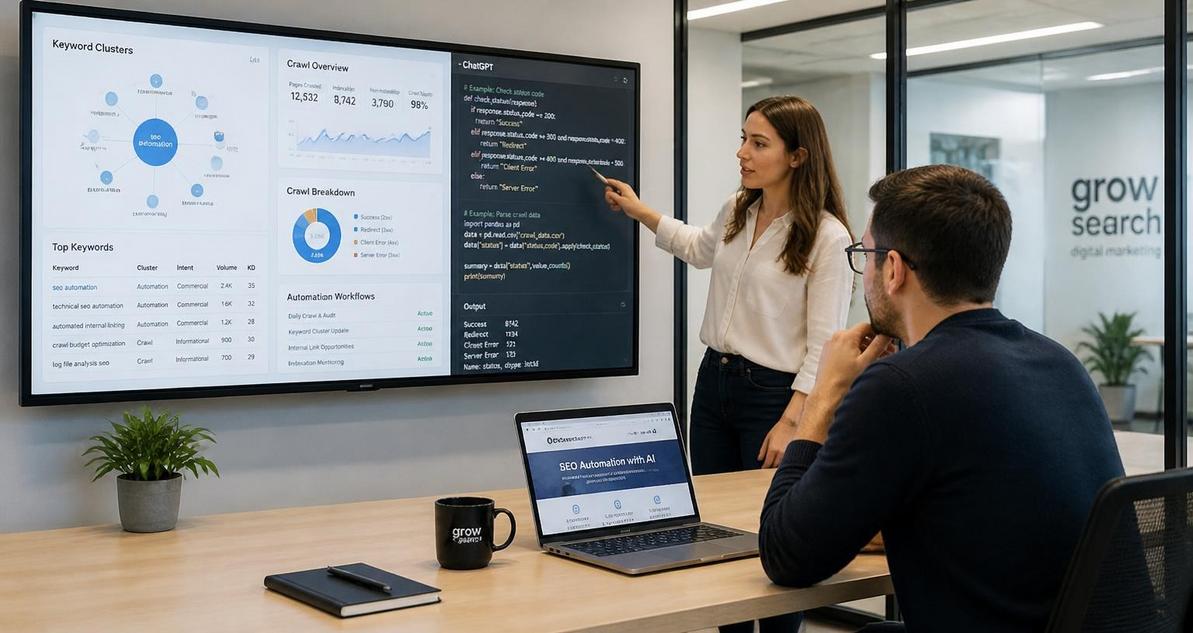
For businesses in Singapore and the Philippines, SEO has become less about publishing more content and more about building reliable systems that can analyze search demand, diagnose technical issues, and generate repeatable outputs. That shift matters in markets where multilingual queries, competitive local SERPs, and fast-moving digital teams create constant pressure to produce accurate SEO work at scale. ChatGPT can now support that workflow not as a replacement for SEO expertise, but as a code-aware assistant that helps professionals build custom tools, validate assumptions, and automate repetitive analysis. When used properly, it becomes a practical bridge between SEO strategy and lightweight engineering, especially for agencies, in-house marketing teams, and technical founders who need faster workflows without sacrificing quality.
Why ChatGPT works well as an SEO code interpreter
Traditional SEO work often involves a fragmented stack: keyword exports, crawl data, log files, analytics reports, and competitor snapshots. ChatGPT becomes valuable when you use it to interpret this data in a structured way, then convert the output into usable logic for custom tools. It can help generate Python scripts, spreadsheet formulas, regex patterns, SQL queries, API request templates, and validation rules that support SEO operations. The key is to treat the model as a technical collaborator that drafts code and explains logic, while you retain control over data quality, implementation decisions, and final verification.
For teams in Singapore and the Philippines, this matters because many organizations run lean marketing operations. A single SEO specialist may be responsible for auditing site architecture, reviewing content performance, coordinating with developers, and reporting results to leadership. ChatGPT can reduce the manual burden by helping with task-specific utilities such as page title analysis, internal link mapping, content gap clustering, hreflang checks, or structured data inspection. The more specific the task definition, the more reliable the generated code and the more useful the output becomes for operational SEO.
What the model can and cannot do
ChatGPT can reason about data, generate code patterns, and help debug scripts, but it should not be treated as an authoritative source of truth. It does not replace a crawler, an analytics platform, or a search engine API. Instead, it accelerates the creation of tools that operate on trusted inputs. For example, it can draft a script that reads a CSV export from Screaming Frog, calculates missing title tag lengths, and flags duplicates. It can also help produce a Streamlit dashboard, a Google Apps Script automation, or a BigQuery query for SEO reporting. The quality of the result depends on your ability to define schemas, expected field names, edge cases, and output requirements before asking for code.
A good mental model is to use ChatGPT as an interpreter between business requirements and executable logic. If you ask for “an SEO tool,” the output will usually be vague. If you ask for “a Python script that compares 10,000 URLs against Google Search Console exports and identifies pages with impressions but no clicks over the last 28 days,” the response becomes much more actionable. This level of specificity is what separates generic AI use from advanced SEO operations.
Building custom SEO tools with ChatGPT
The fastest way to use ChatGPT for SEO engineering is to start with a narrow, measurable problem. Focus on one workflow, one input source, and one output format. That discipline helps you avoid bloated prototypes and gives you something that can be tested against real data. Common use cases include keyword clustering, title tag auditing, content cannibalization detection, internal linking suggestions, schema generation, and page performance triage.
When you define the tool, include the data source, the logic rules, and the deliverable. For instance, a content strategist might need a tool that reads keyword data from Ahrefs or Semrush exports, groups terms by intent, and returns a table of cluster names, primary keywords, and supporting terms. A technical SEO specialist may want a log analysis script that identifies Googlebot crawl frequency by directory. A developer-focused marketer could ask for a utility that checks whether JSON-LD markup matches the visible page content. ChatGPT can produce the initial code, but the strongest results come when you specify data types and acceptance criteria.
Example: keyword clustering for service pages
A service-based company targeting both Singapore and the Philippines often needs market-specific landing pages. If a business sells payroll software, the keyword set may include “payroll system Singapore,” “salary management software PH,” and “automated payroll compliance.” ChatGPT can help build a clustering workflow that normalizes those keywords, strips modifiers, groups by semantic similarity, and assigns one cluster per search intent. The tool can be implemented in Python using pandas and simple text preprocessing, or in JavaScript if it needs to run in a browser-based environment. The important part is not the language, but the structure of the logic.
A practical prompt would ask for a script that reads a CSV with columns for keyword, volume, and difficulty, then outputs clusters based on shared stems and intent modifiers such as “pricing,” “best,” “software,” or “service.” You can instruct the model to keep branded terms separate, preserve location-based modifiers, and generate a summary sheet for content planning. Once the first version is generated, ask ChatGPT to optimize it for speed, add error handling, and document the functions. This is where it behaves like an efficient code pair partner rather than just a text generator.
Example: title tag and meta description QA
Title tag and meta description issues remain common across enterprise sites, especially after CMS migrations. ChatGPT can help create a QA tool that checks title length, duplicate patterns, missing brand terms, and malformed punctuation. If you export a list of URLs, titles, and descriptions from a crawler, the model can write a script that flags pages with titles under 30 characters or over 60 characters, descriptions outside a target range, and pages with identical title templates across too many URLs.
This is useful for agencies managing multilingual or multi-region websites because small templating mistakes can create widespread quality problems. For example, a region-specific service page may accidentally use a generic title that does not include the target city or service line. ChatGPT can also help build a rules engine that distinguishes acceptable template repetition from harmful duplication. This gives the SEO team a scalable method for prioritizing fixes instead of manually scanning hundreds of pages.
Using ChatGPT to connect SEO data sources and automate analysis
The strongest value comes when ChatGPT helps you combine multiple sources of SEO data into one workflow. Search Console, Google Analytics, server logs, crawl exports, CMS fields, and backlink reports each answer a different question. A custom tool becomes useful when it merges them into a single decision framework. ChatGPT can draft the glue code that connects APIs, cleans inputs, and standardizes outputs across these systems.
For instance, a technical team might want to correlate Google Search Console clicks with landing page metadata and crawl status. ChatGPT can draft a Python script that joins GSC export data with a Screaming Frog crawl file on URL, then identifies pages that receive impressions but have missing canonical tags, duplicate meta descriptions, or thin content indicators. Another useful workflow is building a content decay monitor. The model can help create logic that detects pages with declining clicks over multiple reporting periods and surfaces candidate pages for refresh, consolidation, or internal linking updates.
Recommended implementation stack
A practical stack for SEO automation usually includes:
- Python for data wrangling, API calls, and lightweight automation.
- pandas for structured analysis of CSV and Excel exports.
- Google Sheets or BigQuery for shared reporting and scalable joins.
- Streamlit for internal dashboards with simple UI components.
- Requests or httpx for API integrations.
- Beautiful Soup or lxml for HTML parsing when validating on-page elements.
ChatGPT can help generate each layer of this stack. It can create the data transformation logic, write functions for handling missing fields, and suggest error handling patterns that reduce script failures. It can also help define naming conventions for columns, which is critical when multiple team members share the same file outputs. Consistency in schema design often determines whether an SEO tool survives past the prototype stage.
Prompt design, validation, and guardrails for reliable output
Using ChatGPT as an SEO code interpreter requires strong prompt discipline. You need to define the task, expected input format, transformation logic, and desired output structure. Include examples of column names, sample rows, edge cases, and performance requirements when possible. If the script should support multiple locales, mention those upfront. If the output needs to be compatible with Excel, Google Sheets, or a database table, say so directly. The model performs better when constraints are explicit.
Validation is equally important. Treat every generated script as an initial draft that must be tested against real data. Run small samples first, compare output against manual checks, and inspect whether the logic matches the business rule. For SEO tasks, this matters because a script that incorrectly filters URLs or misclassifies keyword intent can distort reporting and decision-making. Technical teams should keep an audit trail of assumptions, version the script in Git, and document any manual adjustments required before production use.
Useful guardrails for technical SEO teams
Teams should establish a few standard practices when building custom tools with AI assistance. First, do not paste sensitive customer or account data into prompts unless your policy allows it and your legal team has reviewed the workflow. Second, separate logic generation from data execution, so ChatGPT drafts the code but the final data processing happens in your controlled environment. Third, require code comments and function-level documentation so future editors can maintain the tool. Fourth, use unit-style checks where possible, especially for regex parsing, URL normalization, and schema validation.
In multilingual markets, guardrails should also include language handling. Singapore and the Philippines often require English-first SEO operations, but many businesses also support local-language content or mixed-language landing pages. A custom tool should preserve diacritics, correctly normalize UTF-8 text, and avoid collapsing location-specific variants into a single cluster unless that is part of the strategic design. ChatGPT can help write those normalization rules, but the SEO lead should approve the final logic.
Technical implementation checklist for SEO teams
Use the following checklist when turning ChatGPT into a practical SEO code interpreter for custom tools:
- Define one SEO problem, such as clustering, auditing, or reporting.
- List the exact inputs, including file type, column names, API source, or database table.
- Specify the output, such as CSV, spreadsheet tabs, JSON, or a dashboard table.
- State the business rule, for example duplicate detection, intent grouping, or performance thresholding.
- Ask for commented code so the logic is easier to review and maintain.
- Test on a small sample before running the script on a full dataset.
- Compare results manually to confirm the script matches SEO expectations.
- Version control the script in Git or another repository.
- Document assumptions for location handling, language normalization, and data freshness.
- Review for compliance before using any sensitive data or publishing output to stakeholders.
Teams that adopt this workflow can move from one-off SEO analysis to repeatable internal tooling. That is where ChatGPT becomes strategically useful: not as a shortcut around expertise, but as a practical layer that helps marketing and technical teams build faster, test smarter, and operationalize SEO knowledge across multiple markets and platforms.

I am Tricia Huang Mei, an Advertising Partner in Sotavento Medios with over two decades of experience in the Singapore advertising and business sectors. My career is defined by a commitment to driving high-impact marketing campaigns and fostering sustainable growth for the diverse business portfolios I manage.