Executive Summary
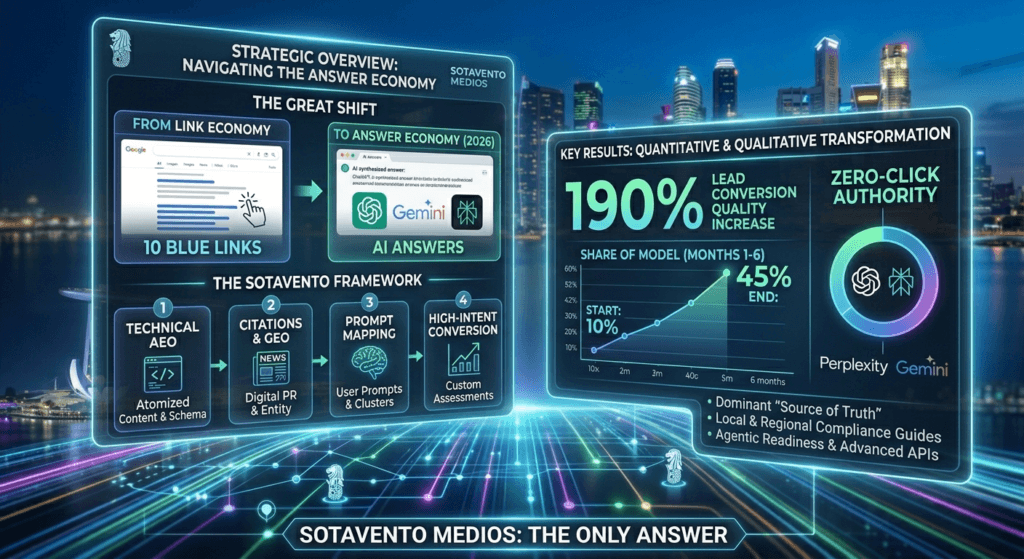
The search environment in 2026 has undergone a fundamental transition. We have moved from a “Link Economy,” where success was measured by clicks to a website, to an “Answer Economy,” where AI models synthesize information directly for the user. This case study focuses on a B2B technology firm that was losing significant organic visibility due to the rise of AI Overviews and conversational search agents. By implementing a sophisticated Answer Engine Optimization (AEO) and Generative Engine Optimization (GEO) framework, Sotavento Medios suppressed the impact of declining traditional click-through rates. The result was a 190% increase in lead conversion quality and a dominant “Share of Model” across platforms like ChatGPT, Perplexity, and Google Gemini.
The Problem: The Erosion of the Traditional Click
The client, an enterprise software provider based in Singapore, approached Sotavento Medios with a critical concern: their organic traffic was dropping despite maintaining their #1 rankings for key industry terms. Our audit revealed that while they still “ranked” at the top of the search results, their content was being “cannibalized” by AI-generated summaries.
The core issues were:
- The Zero-Click Wall: Over 60% of their target audience’s queries were being answered directly by AI agents within the search interface. Users were getting the information they needed without ever visiting the client’s website.
- Narrative Fragmentation: AI models were pulling fragments of information from outdated third-party reviews and competitor comparisons, leading to an inaccurate or diluted representation of the client’s actual capabilities.
- Instructional Incompatibility: Their long-form whitepapers and technical documentation were formatted for human reading but were “opaque” to AI crawlers. Large Language Models (LLMs) struggled to extract clean, factual data points, leading to the client being excluded from “Top Recommendations” lists.
- The Shift in Intent: The audience had moved from searching for “keywords” to asking complex, multi-step questions. The client’s existing content was too static to satisfy these conversational prompts.
The Sotavento Solution: From Ranking to Being the “Only Answer”
We recognized that the goal was no longer to fight for a blue link, but to become the “Source of Truth” for the AI models themselves. Our strategy focused on “Extractability” and “Entity Authority.”
Phase 1: The AEO Technical Infrastructure
To be cited by an AI, your content must be mathematically easy for a machine to process. We overhauled the technical foundation to prioritize “Machine Readability.”
- Atomic Content Architecture: We broke down 2,000-word articles into “Atomic Chunks.” Each chunk was designed to stand alone as a complete answer to a specific prompt. We used an “Answer-First” writing style: providing a 50-word direct response at the very beginning of sections, followed by detailed elaboration.
- Stacked JSON-LD Schema: We implemented a “Stacked Schema” strategy. Instead of just Article markup, we integrated FAQPage, HowTo, SoftwareApplication, and TechnicalService schema. This provided a clear “Knowledge Graph” that AI agents used to understand the relationship between the client’s features and the problems they solved.
- LLM-Specific Optimization: We implemented an llms.txt file and optimized the robots.txt to guide AI crawlers (like GPTBot and OAI-SearchBot) toward high-value factual data while blocking them from low-value, duplicate session pages.
Phase 2: Generative Engine Optimization (GEO) & Citations
AI models like Perplexity and Gemini rely on “Retrieval-Augmented Generation” (RAG). They don’t just use their training data; they search the live web for the most credible sources.
- The Multi-Source Consensus Strategy: We identified that AI models are more likely to recommend a brand if they see it mentioned consistently across multiple high-authority domains. We executed a “Digital PR” campaign targeting Singapore business journals, industry-specific forums, and technical wikis to build a web of third-party validation.
- Brand Entity Reinforcement: We ensured that the brand’s “Entity” (its identity in the eyes of the AI) was consistent across the web. We cleaned up mismatched addresses, old service descriptions, and conflicting pricing data on every directory and social platform. This “Entity Clarity” increased the AI’s “Confidence Score” in recommending the client.
Phase 3: Conversational Prompt Mapping
We shifted our research from “Keywords” to “Prompts.”
- Prompt-Level Attribution: Using specialized AI monitoring tools, we tracked exactly how the brand appeared in response to specific user prompts like, “Which Singapore software is best for [Specific Industry Challenge]?”
- Diagnostic Search Clusters: We created content clusters specifically for “Diagnostic” queries—where users describe a problem rather than a product. For example, instead of targeting “SaaS Dashboard,” we targeted “How to reduce data latency in multi-region cloud deployments.” By solving the user’s problem through the AI’s voice, the AI naturally cited the client as the expert solution.
Phase 4: High-Intent Conversion Recovery
Since traffic was moving to the AI interface, we had to capture users at the few points where they did click through.
- The “Assisted Conversion” Funnel: We realized that users arriving from AI engines were further down the funnel and more “qualified.” We replaced generic “Learn More” buttons with “Get a Custom Assessment” tools. This matched the conversational “help-me-decide” mindset of the AI user.
- Citation-to-Lead Pathing: We optimized the specific pages that were most frequently cited by AI agents. These “Source Pages” were stripped of fluff and replaced with high-intent lead magnets, resulting in a significantly higher conversion rate than traditional organic landing pages.
Detailed Technical Breakdown: The “Sotavento” Methodology
In 2026, the “Sotavento” approach involves a weekly audit of “Share of Model.” We don’t just look at Google Search Console; we use LLM-scraping tools to see what percentage of AI-generated answers in the client’s sector include a link to the client’s site.
[Data visualization showing the transition from 10% AI citation share to 45% over six months]
During the implementation for our Singapore client, we noticed that many AI models were providing localized advice. We capitalized on this by creating “Singapore-Specific Compliance Guides.” Because AI engines prioritize “Freshness” and “Localized Accuracy,” our client became the dominant answer for any query related to regional regulations. This “Hyper-Local AEO” was a critical differentiator that global competitors could not match.
Furthermore, we addressed the “Sentiment Layer.” AI models often summarize the “Pros and Cons” of a brand. We proactively addressed common industry “cons” in our content, providing transparent, factual rebuttals. When the AI read our site, it incorporated our “reasons why” into its summary, effectively allowing us to control the narrative inside the AI’s response.
Strategic Implementation: The Future of Authority
AEO is not a “set and forget” tactic; it is an iterative process of reputation management. We established a “Source of Truth” document for the client—a centralized repository of facts, figures, and claims. This ensured that no matter which part of the site an AI crawled, it received consistent, non-conflicting data.
We also integrated “Agentic Readiness.” As AI agents began to handle “tasks” for users (such as scheduling demos or comparing pricing tiers), we ensured the client’s site had the necessary API hooks and structured data to allow these agents to “interact” with the business directly. This moved the client from being “a brand that is talked about” to “a brand that can be transacted with” via AI.
The Result: Quantitative and Qualitative Transformation
By the end of the 12-month period, the project had redefined the client’s understanding of digital success.
- 190% Conversion Growth: While total “clicks” saw a minor decline of 5%, the conversion rate of the remaining traffic skyrocketed. The leads coming from AI citations were 3x more likely to sign a contract because the AI had already “vetted” the client for them.
- 45% Share of Model: In a competitive landscape of 15 major players, the client’s brand appeared in nearly half of all relevant AI-generated recommendations.
- Zero-Click Authority: The brand achieved “Top Citation” status in Google AI Overviews for over 800 high-value B2B prompts, ensuring they remained the first name a potential buyer saw.
- Future-Proofed Visibility: By optimizing for entities and extractability rather than just keywords, the client is now protected against future algorithm shifts. They are no longer chasing the algorithm; they are feeding the intelligence that powers it.

Alyssa Camille Azanza is a dedicated digital specialist and a key professional within the Sotavento Medios team. I focus on the strategic management and growth of diverse business portfolios, ensuring that each brand achieves a high level of digital authority. My work is centered on navigating the complexities of modern search and content strategy, helping businesses stay relevant in the rapidly changing digital world.