GEO, AIO, and AEO: Decrypting the AI-Driven Search Optimization Strategy
The web environment is not just about traditional Search Engine Optimization (SEO) anymore. The rise of Large Language Models (LLMs) and a generative search world—such as Google’s AI Overviews, Perplexity, and conversational AI tools—has changed the way users find information. B2B marketing managers and technical specialists who wonder what is the best way to deal with the alphabet soup of GEO, AIO, and AEO should know that it is essential for them to keep, and increase, the brand’s authoritative visibility.
As a Technical SEO Expert at Sotavento Medios, I believe that these new acronyms should not be understood as the new ways of doing SEO but as strategic specializations that deal with the changing aspects of the AI-driven information retrieval. Those who will win the next stage of search are the ones who will be able to
Mastering the New Factors Behind Search Visibility: What Do the Acronyms Mean?
We should not confuse these words in the first place. The industry treats these words as synonyms but in reality, they each mean a specific goal in the AI-powered search ecosystem.
Generative Engine Optimization (GEO)
GEO stands for the activity of making content easy to be located, referenced, and correctly summarized by Large Language Models (LLMs) and generative AI systems (e.g., ChatGPT, Gemini, Perplexity) through optimization.
| Focus | Goal | Key Metric |
| Authority & Citation | To become the trusted source that AI systems quote when generating answers. | Citation Frequency in AI responses and AI-generated summaries. |
| Content Style | Comprehensive, fact-checked, structured with clear entities and supporting data. |
Answer Engine Optimization (AEO)
AEO focuses on optimizing content to provide the most direct, concise, and definitive answer to a user query, primarily targeting “zero-click” results. This applies to classic features like Google’s Featured Snippets and People Also Ask (PAA), as well as AI Overviews.
| Focus | Goal | Key Metric |
| Direct Answer & Snippet Capture | To appear as the one authoritative answer immediately visible to the user, bypassing the need for a click. | Featured Snippet/Answer Box Appearances and visibility in AI Overviews. |
| Content Style | Question-first, conversational, and highly structured with bullet points and clear definitions. |
Artificial Intelligence Optimization (AIO)
AIO is best understood as the umbrella strategy—the integration of AI technology into the SEO process and the optimization for AI systems across the board. The term is sometimes used synonymously with GEO/AEO but technically encompasses a broader scope.
| Focus | Goal | Key Metric |
| Systemic Integration & Efficiency | To use AI tools to scale content production, improve personalization, and ensure all content assets are machine-readable. | Content Production Velocity, Improved Data Accuracy, and overall brand share of voice in AI results. |
| Content Style | Optimization of structured data, semantic relevance, and content clarity for LLM ingestion. |
Current Trends and Actionable Optimization Strategies
The root change is that AI systems reward content that is clear, factual, and authoritative rather than being based on the number of times a keyword is used. Our team at Sotavento Medios is committed to embodying these principles in our strategies, creating a collaborative framework.
1. Mastering Generative Engine Optimization (GEO)
The main movement in generative search is the AI’s demand for source corroboration. In the case of B2B companies, this equates to becoming topically authoritative beyond any doubt.
• Upgrade E-E-A-T (Experience, Expertise, Authoritativeness, and Trust): E-E-A-T is by far the most important factor for GEO. Make sure that all technical manuals, white papers, and research articles are very clearly and directly linked to real and authentic subject matter experts (SMEs).
Prepare for Citation: Computers should be able to understand what you are writing about. Be sure that the paragraphs are descriptive, complete, and explain entities (people, products, concepts) and the relationships between them. AI systems usually cite short, accurate pieces of texts.
Go beyond simpler Technical Schemas: Don’t just use the basic Article Schema. Utilize the in-depth markups such as HowTo, FactCheck, and QAPage to give the exact context that the AI machines can get and merge right away.
2. Implementing Answer Engine Optimization (AEO)
With the rise of the AI Overviews in Google, the “answer-first” model gains even more support. Now, AEO is indispensable if one wants to be visible in those spaces with zero-clicks.
Rewriting Content: The ‘Direct Answer Block’: For every question-based header the paragraph that immediately follows (the first 40–50 words) has to provide the direct, brief answer. The detailed, explanatory content should come after that.
Ready for Conversational Search: Now people use natural language for their searches. The content on your site should respond to complex, multi-faceted questions (long-tail queries) and use a conversational style that is similar to the way a user talks or addresses an AI.
Use FAQ and PAA to Boost: Employ tools to find qualified People Also Ask and related questions for your keywords. Address each of these in dedicated FAQ sections, optimizing them with FAQ Schema.
3. Strategic Deployment of AI Optimization (AIO)
The main benefit of AIO is in the areas of performance and competitive intelligence. Essentially, it is about using AI as a tool in your optimization process.
AI-Powered Competitive Analysis: Leverage LLMs to dive deep into competitors’ content and find not only the keywords they use but also those topics they haven’t covered. AIO gives you the power to spot complex, interrelated entities that may be absent from your content.
Content Strategy That Is Expandable And Well Organized: Take advantage of AI applications for quickly coming up with and reviewing the implementation of structured data over large site inventories thereby making sure that the technical part is done correctly for both GEO and AEO.
Keep an Eye on AI Visibility KPIs: AIO needs a change in the set of metrics that measure progress. Put in place instrumentation that shows the location of your brand or the instances where your brand is being referred to by other AI search platforms (e.g., Perplexity sources, AI Overview citations), thus going further than mere organic traffic reports
The Strategic Choice: Which Strategy Should You Prioritize?
The present tendency is that choosing one option is not necessary; instead, you should create a joint strategy whereby each level is the support of the next. Conventional SEO still is the ground-work- no fast, crawlable, and authoritative website, then all the AI strategies will be of no use.
| Strategic Goal | Primary Focus | Best Acronym to Lead With |
| Goal: Maximize Brand Authority and Inclusion in AI Summaries. | Focus: Content Depth, Trust Signals, and Entity-Based Structure. | GEO |
| Goal: Dominate Zero-Click Results, Featured Snippets, and AI Overviews. | Focus: Concise Answers, Question-Based Headers, and Structured Data. | AEO |
| Goal: Accelerate Content Production and Maintain Strategic Control in the AI Era. | Focus: Process Automation, Semantic Consistency, and AI Tool Integration. | AIO |
Sotavento Medios Recommendation: The Hybrid Approach
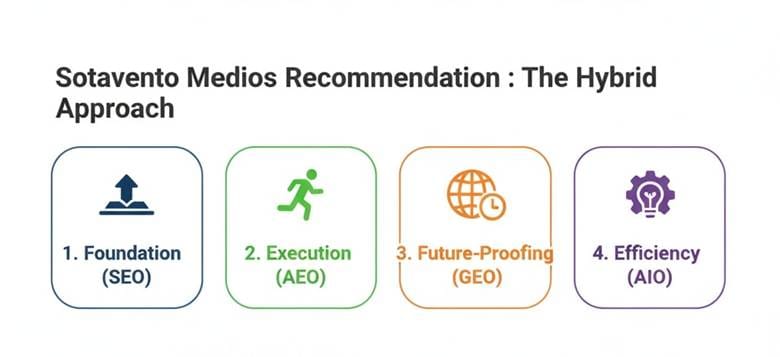
For B2B marketers with good knowledge and skills, the most effective strategy would be a GEO-AEO Hybrid supported by AIO:
1. Foundation (SEO): Make sure that the technical side is healthy, the core E-E-A-T signals are present, and there are strong organic rankings.
2. Execution (AEO): Change the top-performing, high-intent content of your account to be able to capture Featured Snippets and AI Overview answers. It results in immediate, high-quality visibility.
3. Future-Proofing (GEO): Gradually expand the topical authority of your content clusters so that your brand becomes the verifiable, cited source of complex, industry-specific knowledge in generative search.
4. Efficiency (AIO): Implement AI tools to ease the technical part of the AEO and the data analysis that is required for GEO.
By concentrating on these intersecting specializations, you do not just go one step further by attracting clicks; you actually become the one who owns the answer, thus making your brand’s presence stable in the era of generative search.
Strategic B2B Call-to-Action (CTA)
The difficulty of simultaneously optimizing for ranking algorithms and generative LLMs is something that requires specialized, data-driven expertise. Our team at Sotavento Medios is great at performing technical audits that measure your current content against the strict citation requirements of GEO and AEO.
Don’t let the rise of AI Overviews be the reason for your organic traffic to drop. Reach out to Sotavento Medios for an exclusive AI Visibility Audit if you want to be the one who’s cited—not silenced—by generative search.

Jeremy Lee is a seasoned digital marketing director and strategist with over two decades of experience in the industry. As the founder of Sotavento Medios, I manage a diverse portfolio of over 50 businesses, helping brands grow through advanced search strategies and digital innovation. My work focuses on bridging the gap between traditional search engine optimisation and the evolving world of AI-driven answer engines.