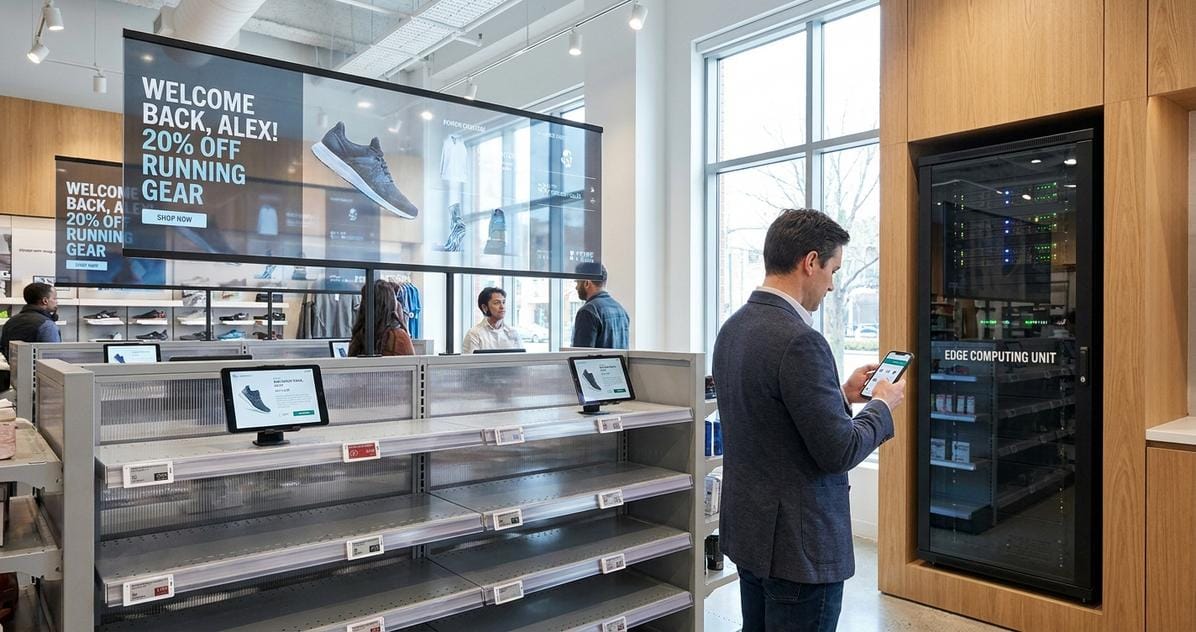
Retail personalisation has moved from static segmentation to real-time decisioning, and the shift is especially relevant in Singapore and the Philippines, where shoppers move fluidly between mobile, in-store, and social commerce touchpoints. In dense urban retail districts, customers expect pricing, product recommendations, and service responses to adapt instantly to context such as location, device, loyalty status, and current store conditions. Edge computing is the infrastructure layer that makes that responsiveness practical, because it processes data close to the point of interaction instead of sending every signal to a distant cloud region first. For retail leaders, this is not only a customer experience upgrade. It is also a latency, bandwidth, privacy, and operational resilience strategy that supports measurable business outcomes across stores, kiosks, connected shelves, and associate applications.
Why Retail Personalisation Needs to Happen at the Edge
Traditional cloud-centric architectures can support analytics and campaign orchestration, but they often struggle to meet the timing requirements of in-store personalisation. If a shopper walks past a digital screen, scans a QR code, or interacts with a mobile app, the system may have only a few hundred milliseconds to detect intent and respond with a relevant offer. That response window becomes even tighter when multiple systems must coordinate, including point of sale, inventory, loyalty, fraud checks, and recommendation engines. When the round trip to the cloud introduces avoidable latency, the moment for influence is lost.
Edge computing reduces this delay by moving inference, event processing, and local decisioning closer to the store environment. A store gateway, micro edge server, or on-premises appliance can evaluate rules and machine learning models locally, then sync only the necessary events to centralized systems. This architecture is especially useful in high-footfall retail settings where network congestion, intermittent connectivity, or redundant traffic can degrade performance. In practice, edge deployments improve the consistency of customer-facing experiences while lowering the dependency on constant wide-area network availability.
Latency Is a Business Constraint, Not Only a Technical Metric
Retail teams often discuss latency as an engineering measure, but in personalisation it directly affects conversion. A recommendation that arrives after the customer has already moved on has no commercial value. The same logic applies to contextual promotions on digital signage, queue management prompts, and associate assist tools. When timing matters, edge architecture changes the economics of personalisation by preserving the relevance window.
Why Singapore and the Philippines Are Strong Edge Use Cases
Singapore’s compact retail footprint, advanced connectivity, and emphasis on omnichannel efficiency make it a strong environment for distributed decisioning. Retailers there can use edge nodes to support flagship stores, transit-linked retail, and high-density mall environments where visitor flow changes by hour. In the Philippines, where store networks may span urban centers, provincial branches, and islands with variable connectivity, edge systems can maintain local autonomy and synchronize to the cloud when bandwidth allows. That operational flexibility matters for retail formats that need to deliver consistent customer experiences across uneven infrastructure conditions.
How Edge-Powered Personalisation Works in a Modern Retail Stack
Edge personalisation is not a single application. It is an architecture that combines identity resolution, event ingestion, inference, and content delivery at multiple layers. The most effective implementations define clear processing boundaries between the cloud, the store edge, and the customer device. Cloud platforms usually remain responsible for model training, customer data platform orchestration, long-horizon analytics, and cross-channel campaign logic. The edge handles immediate context, low-latency inference, and local fallback logic.
Data Ingestion and Event Processing at the Store Level
Store edge platforms typically ingest signals from mobile apps, beacon interactions, Wi-Fi analytics, POS terminals, cameras, RFID readers, smart shelves, and kiosk sessions. These signals feed a local event stream, often through a message bus or lightweight broker that supports near-real-time processing. The edge layer can enrich events with store-specific context, such as current stock levels, store hours, regional promotions, and queue length. That enrichment is important because personalisation without operational context can create mismatched recommendations, such as promoting products that are unavailable in that location.
Retail teams should pay attention to event schema design and data governance. A poorly defined schema creates noisy downstream logic and fragmented identity profiles. A well-designed event model supports deterministic triggers, such as “customer in loyalty tier X entered zone Y near category Z,” and probabilistic triggers, such as “likely interest in accessories based on dwell time and prior purchases.” The edge does not replace the cloud data foundation. It makes the most time-sensitive slice of that foundation usable in the moment.
On-Device and On-Edge Model Inference
Machine learning models for recommendations, propensity scoring, offer ranking, or computer vision can be deployed at the edge for real-time inference. This is particularly valuable when the model must react to short-lived signals, such as shelf engagement or in-store pathing. Smaller models, quantized models, or distilled versions of larger cloud-trained models are often suitable for edge execution. Retailers can also use hybrid approaches, where a central model is trained on richer historical data and then pushed to local nodes for inference with occasional retraining cycles.
The advantage of this design is not only speed. It also allows stores to operate even when connectivity is constrained. If the WAN link is degraded, the edge node can still trigger rule-based offers, surface local promotions, and log events for later synchronization. That resilience is essential for retail environments that cannot afford to lose personalization logic during peak hours.
Use Cases That Turn Edge Computing Into Measurable Retail Value
Edge-enabled personalisation shows up in multiple retail workflows, each with different technical requirements. The strongest implementations avoid “technology for technology’s sake” and instead align the edge function with a high-value customer moment. In the retail sector, the most practical use cases usually involve decisioning under time pressure, local context awareness, or privacy-sensitive interaction data.
Real-Time Offer Personalisation at the Shelf or Screen
A customer who approaches a shelf, scans a product, or pauses near a digital display can receive a tailored offer based on local inventory, loyalty profile, and recent behavior. The edge system evaluates the offer locally, then renders content to the screen or app without waiting on a cloud round trip. If the customer is already in a category funnel, the system can prioritize accessory bundles, replenishment prompts, or limited-time incentives. This works particularly well in categories where consideration time is short and context matters, such as convenience retail, beauty, consumer electronics, and quick-service adjacent retail formats.
Retailers should design offer logic carefully so that local relevance does not become intrusive. Personalisation should be governed by frequency caps, consent settings, and content eligibility rules. The edge layer is capable of making these decisions in milliseconds, but governance still needs to define what should be shown, to whom, and under what conditions.
Associate Assist and Clienteling
Store associates benefit from edge systems that provide instant product recommendations, customer history summaries, and next-best-action prompts on handheld devices. In clienteling scenarios, the edge node can retrieve context from the local store, customer profile, and inventory system, then deliver a concise assist card to the associate. This keeps the interaction human and consultative while reducing the cognitive load on staff. For retailers with premium categories or appointment-based selling, this can materially improve the quality of assisted selling.
The most effective associate tools are built with operational simplicity. They should be fast, offline-tolerant, and aligned to role-based permissions. When associates trust the system and it responds instantly, adoption rises. When the interface is slow or inconsistent, the workflow gets abandoned.
Dynamic Digital Signage and Queue-Aware Messaging
Digital signage is one of the clearest demonstrations of edge value because the content can change based on live conditions. A store can alter messaging by time of day, weather, traffic pattern, queue length, event schedules, or category demand. If a register queue is building, signage can shift from promotional content to self-checkout guidance or impulse cross-sell messages. If foot traffic is low in a particular zone, the system can emphasize discovery content for that area.
This requires local content orchestration, because a cloud-delivered campaign may not update fast enough to match the moment. Edge rendering engines can cache approved content packs and switch rules dynamically. That reduces bandwidth usage and gives marketing teams a more responsive channel without compromising brand control.
Technical Architecture and Governance Considerations
Edge computing only creates value when the architecture is built with operational discipline. Retail environments are complex, with many devices, stakeholders, and data sources. A sustainable design must account for device management, observability, security, privacy, and model lifecycle controls. Otherwise, the edge layer becomes another source of fragmentation.
Security by Design and Data Minimization
Retail edge systems often handle identity-linked data, location data, and behavioral signals. That makes security a core design requirement. Teams should use encrypted transport, secure boot, device attestation, role-based access controls, and signed model artifacts. Network segmentation is also important, particularly when store systems share infrastructure with guest Wi-Fi or IoT devices. Local processing helps reduce the amount of personal data transmitted externally, which supports data minimization principles and can simplify privacy compliance when implemented correctly.
Retailers in Singapore and the Philippines should align deployments with applicable privacy obligations, internal retention policies, and consent management rules. Personalisation systems should only collect the data needed for the defined use case, and they should clearly separate anonymous behavioral telemetry from identifiable profile data wherever possible. Edge does not remove compliance responsibilities. It gives teams more control over where sensitive decisions happen.
Observability, Model Drift, and Store-Level Consistency
Distributed inference introduces new operational risks. A model may perform well centrally but underperform in specific store formats or neighborhoods. Edge teams need observability for model latency, inference success rates, content delivery performance, and fallback triggers. They also need mechanisms to detect model drift, especially if local customer behavior shifts due to seasonality, promotions, or merchandising changes. Monitoring should include both technical telemetry and business metrics, such as offer acceptance, dwell time, basket attach rate, and redemption by store cluster.
Consistency across stores is another challenge. A controlled rollout process should define how models, content rules, and feature flags move from staging to pilot stores, then to the broader network. Retailers can use blue-green deployment patterns, canary releases, and centralized policy management to reduce risk. This is standard practice in mature distributed systems, and it applies just as much to retail personalisation as it does to other edge workloads.
Implementation Checklist for Retail Teams Planning Edge Personalisation
Retail organizations that want to deploy instant personalisation should start with use cases that have clear timing constraints, measurable conversion impact, and manageable data complexity. The objective is to prove business value without creating unnecessary architectural sprawl. A focused rollout also helps teams learn where edge belongs in the broader commerce stack.
- Map the customer journey and identify the moments where a response delay reduces conversion or service quality.
- Classify data sources by latency sensitivity, privacy sensitivity, and dependency on cloud connectivity.
- Define which decisions must be made locally, which can be deferred to the cloud, and which require human approval.
- Build a store-level event model that includes identity, context, inventory, and campaign eligibility fields.
- Select edge hardware or managed edge platforms that support containerized workloads, remote updates, and local failover.
- Deploy a lightweight inference layer for recommendations, propensity scoring, or content selection at the edge node.
- Implement security controls, including encryption, segmentation, signed updates, and access logging.
- Set up observability for latency, uptime, model performance, redemption rates, and fallback frequency.
- Run canary deployments in a small set of stores before scaling to additional locations.
- Review consent, retention, and data minimization controls with legal, IT, and customer experience stakeholders.
Retail teams that treat edge as part of a broader customer intelligence architecture can move beyond generic segmentation and deliver decisions that feel immediate, relevant, and operationally grounded. The practical advantage is clear: when the system can understand context at the store level and respond without waiting on the cloud, personalisation becomes a live capability rather than a delayed marketing tactic.

I am Tricia Huang Mei, an Advertising Partner in Sotavento Medios with over two decades of experience in the Singapore advertising and business sectors. My career is defined by a commitment to driving high-impact marketing campaigns and fostering sustainable growth for the diverse business portfolios I manage.