On page SEO is everything you control on a page itself the content, the title, the headings, the URL, the internal links, and the markup that together tell a search engine what the page is about and who it’s for. It’s the most reliable part of SEO to work on, because you don’t have to wait on anyone else. You can open a page you already own today, apply on page SEO, and improve its odds of ranking without chasing a single backlink.
This guide gives you the plain-English definition, the difference between on-page and off-page work, the tools that actually help, and a checklist you can run on any page. No hype, no guarantees just the levers that move rankings and how to use them.
What is on page SEO?
On page SEO is the practice of optimizing an individual page so it clearly matches a search and makes that match easy for both people and search engines to confirm. It breaks into two halves. Content is whether the page answers the search depth, relevance, and intent match. On-page signals are the structural elements that help a crawler read the page: the title tag, headings, URL, internal links, image alt text, and meta description.
Both matter, in that order. The best-tagged page won’t rank if the content doesn’t satisfy the search, but genuinely useful content can rank even with imperfect tags. So the goal of on page SEO isn’t to sprinkle keywords it’s to make one page the clearest, most complete answer to one search.
On page and off page SEO: what’s the difference?
The simplest way to separate them: on-page SEO is what you do on your page; off-page SEO is what happens off it.
- On-page SEO covers the content and signals you control directly titles, headings, internal links, page speed contributors, and the quality of the writing itself. You can change these whenever you like.
- Off-page SEO covers the signals other sites and users send about your page backlinks, brand mentions, and reputation. You influence these but don’t control them, and they take longer to build.
Neither replaces the other. A page with strong links but poor intent match won’t rank well, and a perfectly optimized page with zero authority struggles in competitive niches. The practical order for most sites is on-page first it’s faster, fully in your hands, and often the reason a page is stuck then earn off-page authority over time. For the deeper page-by-page workflow behind all of this, see our on-page SEO guide.
The best on page SEO tools
You don’t need expensive software to do on page SEO well, but a few categories of tool make the work faster and more accurate. Choose by the job you need done, not by brand hype:
- A search analytics tool (Google Search Console is free and essential): shows the exact queries a page already ranks for, its position, and its click-through rate the ground truth for what to optimize.
- A crawler (site auditors that scan your pages): flags missing titles, thin content, broken internal links, and duplicate tags across the whole site at once.
- A keyword and SERP tool: reveals what searchers actually type and what kind of page currently ranks, so you can match intent before writing.
- A readability or content-grading tool: helps you check structure, heading hierarchy, and clarity, though treat its scores as a guide, not a rule.
The honest caveat: no tool guarantees rankings, and a tool’s “SEO score” is a checklist, not a verdict. Use tools to find problems and confirm data the judgment about intent and quality stays with you.
An on page SEO checklist you can run on any page
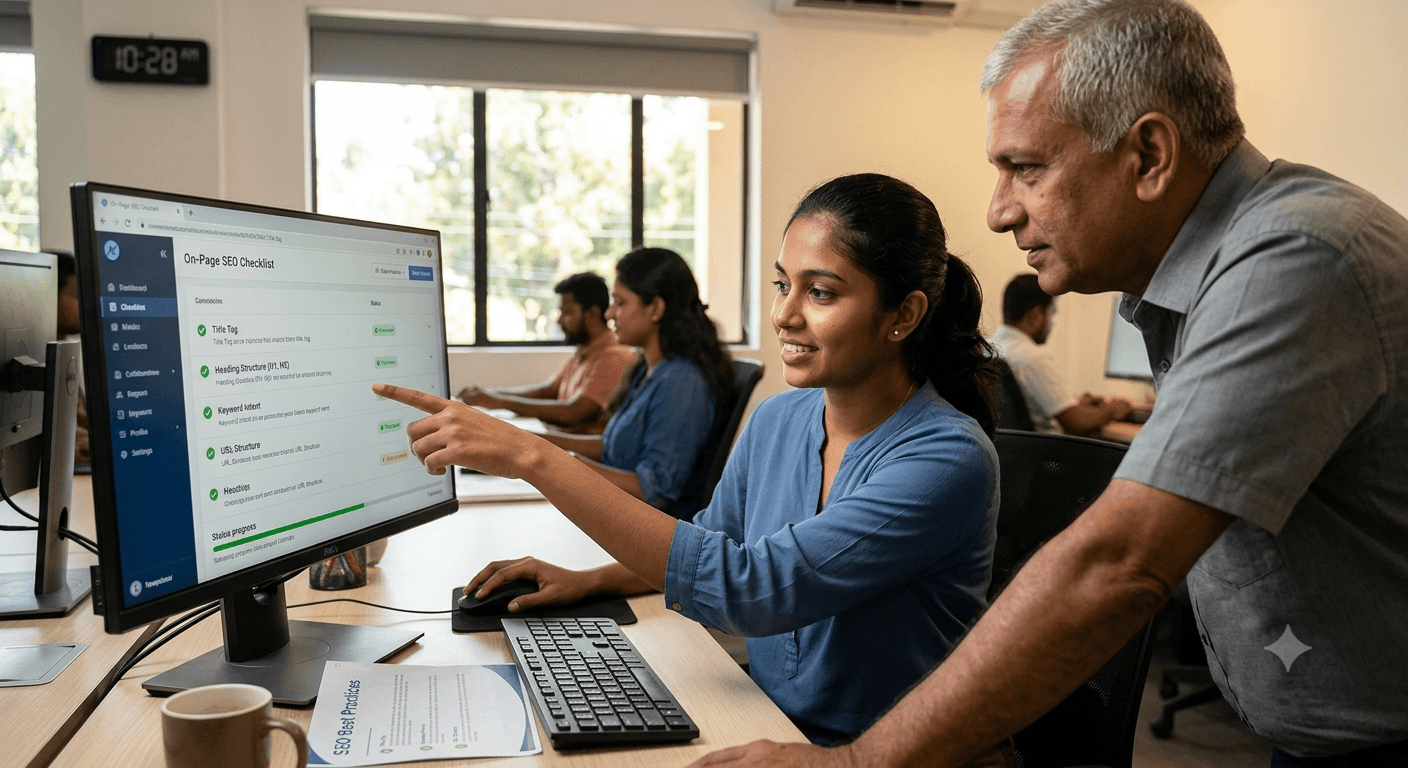
Here’s the on page SEO checklist to work through, top to bottom, on any page you want to improve:
- Confirm the target search and intent. Pick one primary query per page. Look at what already ranks for it guide, comparison, or product page and match that format first.
- Write a compelling title tag. Put the primary term near the front, keep it readable, and make it specific. The title both signals the topic and earns the click, so it’s the highest-leverage element on the page.
- Write a click-worthy meta description. It doesn’t directly affect rankings, but it affects clicks. Describe the page’s value in a sentence or two and include the term naturally.
- Structure with clean headings. One clear H1 stating the topic, H2s written as the real questions readers ask, H3s for detail. This helps scanning and helps crawlers understand the page.
- Set a short, descriptive URL.
/on-page-seo
beats
/blog/post?id=4471
. You set it once, so set it cleanly.
- Cover the topic completely. Answer the obvious follow-up questions on the same page, front-load the key takeaway, and write in natural language. Depth that serves the reader is your strongest content signal.
- Add internal links in and out. Link related pages to this one with descriptive anchor text, and link out to its pillar and siblings. Internal links spread relevance and help discovery.
- Add alt text to meaningful images. Describe them plainly; it aids accessibility and image search.
- Re-check rankings and traffic in a few weeks. Note the position before you change anything, then measure. Give a page time to be recrawled before judging the result.
Run this on a page already sitting on page two first those pages have proven relevance and often need only a tighter intent match and a better title to break onto page one. That’s the fastest payoff in SEO.
Does an “on page SEO checklist 2026” differ from earlier ones?
Not really — and be wary of any checklist that leans on the year as a selling point. The fundamentals of on page SEO have been stable for years: match intent, write clearly, structure well, link internally, and cover the topic. What changes at the edges is emphasis. Search engines keep getting better at understanding language, which makes old tricks like keyword-density targeting more useless every year, and rewards genuinely helpful, well-structured content more. So the durable advice isn’t “the new 2026 rules” it’s the same checklist above, executed honestly, with keyword stuffing and thin content retired for good.
What about “best content for YouTube”?
This one shows up alongside on-page searches because video is part of many content strategies, and the on-page principles transfer directly. A YouTube video ranks on the same logic as a web page: a clear, specific title with the search term near the front, a description that explains the value and includes relevant terms, and content that fully satisfies what the viewer searched for. The “page” is just the video’s title, description, and thumbnail instead of an HTML tag. If you publish video, treat each one like a page: one target search, an intent-matched format, and a title written for a human first.
And “best strategy games”?
You’ll sometimes see unrelated queries like this surface near “on page SEO” in related searches it’s a reminder that surface-level keyword overlap (“best… SEO,” “best… games”) doesn’t equal shared intent. It’s also a small lesson in on page SEO itself: a single page can’t credibly rank for genuinely different intents, so don’t try to stretch one article across unrelated searches. Keep each page to one search and one intent, and let separate topics live on separate pages.
FAQ
Is on page SEO still important?
Yes. It’s the part of SEO you fully control, and it’s how a search engine confirms a page matches a search. Links matter too, but a page that doesn’t match intent won’t rank no matter how many point at it.
What’s the single most impactful on-page element?
The title tag, because it both signals the topic to a search engine and decides whether a human clicks. A clear, specific, intent-matched title is the highest-leverage change on most pages.
How long until on page SEO changes show results?
Improvements to a page already ranking can show within a few weeks once it’s recrawled. New pages targeting competitive terms take longer, so set expectations and measure rather than expecting instant movement.
Do I need paid tools to do on page SEO?
No. Google Search Console is free and covers the most important job showing what a page ranks for and how it’s clicked. Paid crawlers and keyword tools speed the work up but don’t replace judgment about intent and quality.

Sandamalee is a dedicated digital marketing professional and a core member of the Sotavento Medios team. I work closely with my colleagues to manage daily digital operations, ensuring that every project meets the high standards our clients expect. My focus is on maintaining the technical and editorial integrity of our diverse business portfolios, helping brands stay consistent and impactful in their online presence.