Given that you’ve been spending years improving your position in Google’s search results, wouldn’t you expect that position to transfer over to ChatGPT, Gemini, and Google’s other AI responses? Does it?
We carried out the test in a single industry; with the help of Semrush One we obtained the organic keyword data and AI visibility data for 10 laptop brands and then compared the data across seven search queries that a laptop buyer actually makes.
TLDR:
The fact that a brand ranks on Google and appears in AI responses is related but not identical. In our data, those brands which performed best in both Google search keywords and in response to AI prompts were more likely to do better in general. Yet a high position on Google does not mean that a brand will also rank or be recommended on ChatGPT (or on answers generated by other large language models). Some brands that had strong Google rankings had very poor AI visibility when it came to the same buyer questions, while others were the case the opposite way. This provides clear evidence for what I have been saying over the last year: SEO and AI visibility must be developed together.
The Market Backdrop: Buyers Are Searching and Asking at Scale
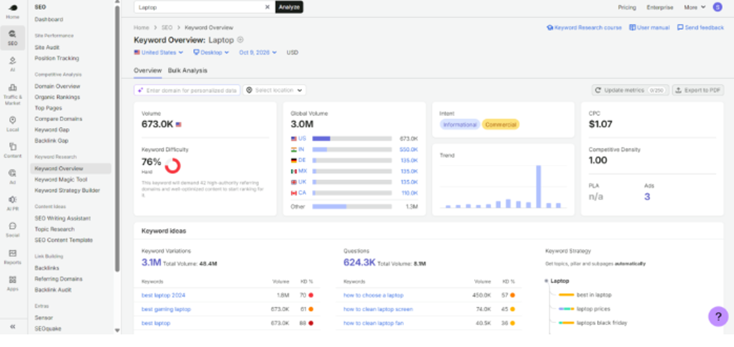
Laptop research is not limited to a single location anymore. A customer can begin by using Google, watch YouTube reviews, check out the threads on Reddit, compare the product pages, and then ask ChatGPT or Gemini for advice on which laptop is best suited to their particular situation. This kind of buying behaviour is now standard.
For all the themes that we studied, Semrush provided both a large number of Google keywords and a large number of AI prompts.
| Theme | Google keywords in the pool | Google search volume | Avg. keyword difficulty | AI prompts | AI volume |
| “laptop” | 260.5K | 16.7M | 44% | 52.2K | 13.5M |
| “best laptop” | 234.6K | 16.6M | 49% | 47.7K | 13.4M |
| “laptop comparison” | 238.7K | 14.7M | 43% | 51.7K | 14.6M |
| “laptop for work” | 264.6K | 17.6M | 43% | 47.7K | 12.8M |
| “laptop for remote work” | 224.5K | 18.4M | 42% | 46.2K | 12.6M |
| “laptop for student” | 281.4K | 18.3M | 46% | 47.4K | 13.1M |
| “laptop for gaming” | 272.7K | 20.7M | 43% | 46.4K | 12.8M |
From the data, three points immediately appeared.
First, Use-Case Searches Are Big Markets, Not Tiny Long Tails
Many people still believe that use-case searches are small. They aren’t.
The search query “laptop for gaming” had the highest Google volume of all the themes that we examined, with 20.7 million searches, followed by “laptop for remote work” at 18.4 million and “laptop for student” at 18.3 million. These are not rare searches lurking at the fringe of the market; they represent major buying categories.
Even if you look at specific keywords, the figures remain significant. For example, “Best laptops for students” had about 135 thousand searches per month, while “Best laptops for work” and “best laptops for gaming” each had about 40 thousand. This is important since these aren’t merely opportunities for traffic; they are decision-making opportunities.
Second, AI Prompts Look More Like Decisions Than Keywords
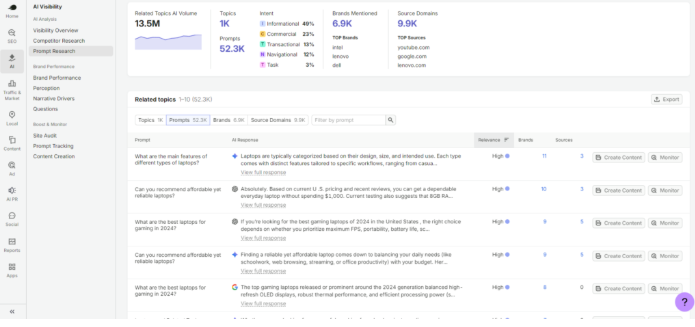
It represents one of the most significant changes since keywords are generally brief whereas AI prompts are usually more complete and include more context. For example, a buyer might search on Google for “best laptop for work”, but in ChatGPT or Gemini that buyer might ask, “What is the best laptop for remote work, Zoom calls, spreadsheets, and travel?”
This represents a different type of search behavior. In the various AI prompt sets that we studied, about 46 to 49 percent of the prompts were of an informational nature, approximately a quarter were commercial for most topics, and an additional 12 to 14 percent were transactional. However, the problem is that a great many of the so-called informational AI prompts were still questions at the decision-making stage.
Questions such as “Is ASUS or MSI better for gaming?”, “Should I get a MacBook or a Windows laptop for work?”, “What laptop brand is best for students?”, “Which laptop is better for remote work?”, and “Is Lenovo better than Dell for business use?” might seem to be purely informational in theory, but in reality they have a commercial purpose. Even if the user isn’t typing ‘buy now’, they are obviously progressing towards a shortlist.
That is to say that achieving a high ranking for “laptop comparison” on Google and being included in an AI response that compares laptops are related but not the same thing; Google might give a credit to a page that well targets the phrase, while the AI might reward the brand which is consistently described on the web as being the better choice for that particular use case.
AI Answers Pull From More Than Brand Websites
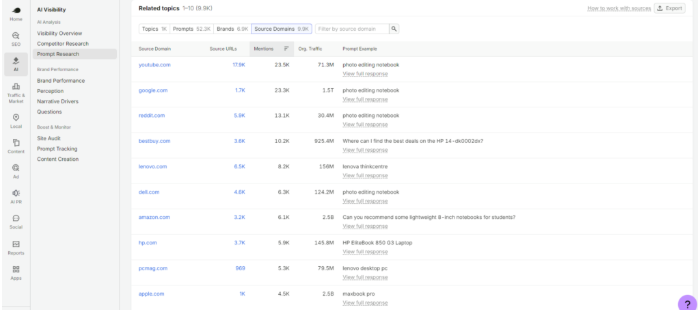
The examples given by the AI also include a range of sources beyond those found on brand websites. In Semrush’s prompt research, the brands most frequently mentioned in connection with ‘best laptop’ searches were Intel, Lenovo and HP, while the repeatedly cited sources were YouTube, Google and Lenovo’s own website, with Reddit appearing in the context of gaming. Manufacturers of computer chips, video reviewers and online forums all compete with laptop brands for inclusion in the answers.
That is precisely why merely adding FAQs as part of AEO and GEO won’t do the trick. Of course, FAQs are of some help, structured content is helpful, schema is useful and clean HTML is beneficial. But if the wider internet doesn’t link your brand with the correct buying decision, the AI might still pick someone else.
How We Compared Google Rankings and AI Visibility
The brands are Apple, Lenovo, HP, Dell, ASUS, Acer, MSI, Samsung, LG, and Razer.
The seven searches, starting with the most general and becoming more specific, were: “laptop”, “best laptop”, “laptop comparison”, “laptop for work”, “laptop for remote work”, “laptop for student” and “laptop for gaming”.
For each brand and search, we recorded two things:
- SEO visibility: the number of keywords containing that phrase for which the brand’s website appears in Google’s organic results (Semrush Organic Rankings).
- The level of AI visibility (that is, AEO and GEO) is measured by the number of AI prompts containing that phrase which refer to the brand in the response, mention it, or cite it, across ChatGPT, Google AI Overviews, AI Mode, and Gemini (Semrush AI Visibility, Topics & Sources).
Keywords and prompts are distinct units, which is why we determine who ranks higher and who ranks lower rather than looking at the raw numbers. That said, the patterns do have their usefulness, and frankly in the areas of SEO, AEO, and GEO it is usually the directional patterns that yield the best returns. You don’t wait for perfect information; instead, you spot the signal and then take the appropriate strategic action.
The Big Picture: Domain Totals Say One Thing
The following are the figures for the entire domain.
| Brand | Worldwide organic keywords | Worldwide AI mentions | AI mentions as % of keywords | AI Visibility score (/100) |
| Apple | 114.6M | 7.4M | 6.5% | 79 |
| Samsung | 11.7M | 1.6M | 13.7% | 84 |
| HP | 6.4M | 426.7K | 6.7% | 71 |
| Lenovo | 4.4M | 302.8K | 6.9% | 67 |
| Dell | 3.9M | 343.5K | 8.8% | 63 |
| ASUS | 3.6M | 334.6K | 9.3% | 66 |
| LG | 3.3M | 412K | 12.5% | 64 |
| MSI | 1.1M | 25.2K | 11.4% | 50 |
| Acer | 941.8K | 103K | 10.9% | 52 |
| Razer | 474.1K | 96.7K | 20.4% | 51 |
At this high level the Google footprint and the AI footprint appear to be closely linked. Apple and Samsung are at the top of both columns, whereas Acer, MSI and Razer are lagging in both cases. Apple has alone about 76% of the keywords and about 66% of the AI mentions among these 10 brands.
However, the figures refer to the entire company and therefore conceal a great deal. Both Apple, Samsung, and LG sell phones, TVs, and appliances, and when we examined the topics associated with each brand’s AI references, we found that many of them were not in fact buying questions.
These were support topics: Apple laptop chargers, ASUS laptops failing to turn on, Acer warranty and registration, MSI screen replacement, and Samsung drivers together with troubleshooting.
References of that kind count, but they aren’t recommendations; for the question which decides a sale you must consider the individual buying searches.
The Evidence: A comparison of SEO Keywords and AI Prompts, question by question
The Google keywords / AI prompts are shown in each cell of the table below.
| Brand | “laptop” | “best laptop” | “laptop comparison” | “laptop for work” | “laptop for remote work” | “laptop for student” | “laptop for gaming” |
| Apple | 38.8K / 50.7K | 355 / 2.7K | 15 / 53 | 4 / 80 | 0 / 13 | 94 / 105 | 5 / 14 |
| Lenovo | 133.5K / 91.5K | 3.9K / 3.2K | 44 / 79 | 226 / 154 | 2 / 20 | 251 / 187 | 272 / 156 |
| HP | 308.1K / 93.4K | 2K / 1.9K | 46 / 46 | 113 / 98 | 0 / 9 | 257 / 99 | 287 / 117 |
| Dell | 267 / 68.3K | 2.4K / 1.9K | 76 / 49 | 189 / 64 | 5 / 15 | 240 / 88 | 268 / 73 |
| ASUS | 62.3K / 58.7K | 539 / 2.3K | 31 / 52 | 14 / 54 | 0 / 1 | 126 / 92 | 177 / 169 |
| Acer | 22.8K / 170 | 64 / 1.2K | 19 / 0 | 2 / 31 | 2 / 2 | 32 / 102 | 48 / 91 |
| MSI | 11.3K / 12.2K | 10 / 376 | 0 / 10 | 0 / 0 | 0 / 0 | 0 / 1 | 48 / 0 |
| Samsung | 3.3K / 9.7K | 9 / 145 | 0 / 7 | 1 / 8 | 0 / 0 | 54 / 0 | 0 / 0 |
| LG | 2K / 628 | 6 / 39 | 0 / 4 | 2 / 3 | 0 / 0 | 0 / 1 | 0 / 0 |
| Razer | 2.6K / 5.5K | 17 / 208 | 0 / 5 | 0 / 7 | 0 / 0 | 0 / 1 | 9 / 1 |
Our Findings
Five patterns emerged from the table. A few of them were predictable, others were surprising, and a number of them are precisely the kind of insight that brands should take notice of since they indicate the point at which SEO performance and AI visibility begin to diverge.
Finding 1: Where Google Strength Carries Into AI, the Brands Win Both
We looked at each brand’s position in the Google keywords in relation to its position in the AI prompts for each search and found that, in every category, there was a positive relationship. This strong relationship was observed in the cases where buyers are choosing a product.
- “best laptop”: rank correlation of 0.88
- “laptop for work”: 0.83
- “laptop for gaming”: 0.76
- “laptop” (the head term): 0.65
- “laptop for student”: 0.60
- “laptop comparison”: 0.54
A Google ranking does actually predict AI visibility, but only imprecisely, in the case of comparisons and searches by students. This is in agreement with earlier studies, which found that LLMs such as ChatGPT had about 10-15% of the websites cited that also appeared in Google’s results.
Lenovo is the obvious double winner since it comes first when it comes to Google searches for “best laptop” (3.9K, the figure that indicates the highest estimated traffic of all the brands) and also ranks first in AI prompts for that query (3.2K).
For the search query “laptop for gaming” it ranks first in Google keywords (272) and second in AI prompts (156); for the head term “laptop” it comes in second place in Google keywords (133.5K) and is also second in AI prompts (91.5K). It is also the leading result in AI prompts for searches relating to comparison, work, remote work, and for students. Its own website is one of the most frequently cited sources in the data concerning the “best laptop” prompt.
Strong SEO combined with strong AI visibility is shown by a brand’s own website appearing as a cited source.
HP has the top position in both markets. It ranks for 308.1 thousand “laptop” keywords and appears in 93.4 thousand “laptop” AI prompts, which is more than any other brand, indicating a very extensive presence. This shows that HP has strong visibility across the broad category.
HP is consistently there when people search for or generally ask about laptops, and this is valuable for a brand since it keeps you in the running before the buyer narrows down their search.
Yet the fact that something is widely visible doesn’t always mean it works perfectly in every particular situation where purchases are made. We will come across this lesson later on.
ASUS leads in the number of AI prompts related to gaming (169) and is third in the number of Google keywords for this topic (177), and it is among the top three in both categories for “best laptop.”
It is important strategically since ASUS has a well-defined association with particular use cases. People who buy products, write reviews, and take part in online communities frequently link the ASUS brand with gaming and high performance. AI systems appear to pick up on this association. Once the question becomes more specific for example, “laptop for gaming” the brand’s identity in terms of its use cases becomes very significant.
One reason why use case ownership is so effective is that a brand which is famous for a particular thing stands to gain when AI has to suggest options for that specific requirement. Even in the case of traditional SEO you could still achieve a good ranking. However, in the context of AI visibility it is also necessary for the wider market to know what the brand is known for.
What Double Winners Usually Have
The brands which achieve a good ranking on Google and are frequently included in AI responses have a number of features in common. These include having useful pages that answer actual questions asked by buyers, covering a wide range of keywords throughout the buyer journey, possessing strong brand recognition, enjoying consistent discussion from third parties, and having a clear link to specific use cases.
That is the reason why SEO and AEO should not be treated as two separate services. SEO establishes the foundation, while AEO and GEO add the recommendation layer upon that foundation. Only when these layers work together does the brand have a better opportunity of ranking, being cited, and being selected.
Finding 2: Strong SEO Does Not Guarantee Equal AI Visibility
Here’s where things become interesting: the same table includes brands for which their Google strength did not fully transfer to AI responses.
It is here that many companies will be surprised. They will argue, “But we are already ranked.” And that may be the case. However, the more pertinent question at this point is whether or not they are recommended?
Dell is the best example of this. Of all the brands listed, it has the highest number of “laptop for work” keywords (189) and the greatest number of “laptop comparison” keywords (76). It comes second in the number of “best laptop” keywords (2.4K) and is also second in the number of “laptop for gaming” keywords (268).
In theory, that is excellent SEO. If the only criterion were Google keyword coverage, Dell would appear to be one of the best-positioned brands in the study.
When it comes to AI prompts, Lenovo comes fourth in the case of work (64) and fifth in the case of comparison (49), whereas it is not in the top three for ‘best laptop’ (1.9K) and fifth for gaming (73). On the matter of work, both Lenovo and HP outperform it, and with regard to comparison-related keywords, Lenovo and Apple do so as well.
Dell had the pages, it had the keyword coverage and it had visibility, but AI didn’t treat it the same way when it came to these decision-stage prompts.
Although HP comes out on top for the “laptop for student” keywords (257), it ranks fourth in the case of AI prompts (99). Lenovo (187), Apple (105), and Acer (102) all rank higher than it does. With respect to the “best laptop” search term, HP is third in the keywords but only tied for fourth in AI prompts.
HP is undoubtedly strong, but it does demonstrate that even well-established brands can have particular gaps in their AI visibility. Such gaps are important since AI recommendations often affect the shortlist; if a student asks an AI assistant for advice on which laptop to buy and HP is not consistently mentioned as one of the best options, then HP could be excluded before the user even gets to Google.
MSI provides a clear case in the specialist category since it ranks for 48 “laptop for gaming” keywords, drawing level with Acer, although it shows up in zero gaming prompts whereas Acer does so in 91. Yet, when considering MSI as a brand, it is mainly known for its high-performance gaming laptops.
Acer comes out in 22.8 thousand of the Google “laptop” searches but is not present in any of the 170 “laptop” prompts on AI search. Furthermore, although it ranks for 19 “laptop comparison” keywords, it does not appear in any of the comparison prompts that we examined. So what explains this discrepancy? The example seen with Dell, HP, and MSI regarding their visibility on AI search indicates that brand association by itself might be insufficient. It seems that AI would require stronger support in the form of answer-ready content, third-party comparisons, reliable reviews, and repeated references to specific use cases on the web. A study carried out by Profound found that most AI search engines primarily obtained their information from Reddit.
Finding 3: Some Brands Win AI With a Smaller SEO Footprint
The other way around is true as well: certain brands turned up more frequently in AI responses than their Google keyword presence would suggest.
Although it ranks for only four “laptop for work” keywords, fifteen “laptop comparison” keywords, and five “laptop for gaming” keywords, it is featured in 80 work-related prompts, 53 comparison prompts, and 14 gaming prompts. Its SEO strategy is efficient rather than extensive: the 355 “best laptop” keywords generate an estimated 24,000 visits, compared to 2,000 keywords producing 6,200 visits for HP.
That makes a significant difference; although Apple’s SEO presence in those particular keyword groups was not extensive, its AI visibility was considerably greater than the keyword figures alone indicate. This is probably due to Apple’s strong brand recognition, its consistent product positioning, its loyal customer base, and its wide representation in reviews and comparisons.
Although Acer comes in at number 32 for the “laptop for student” keywords it is third in terms of AI prompts for that search (102), beating both HP and Dell, which have many more keywords. In the gaming category it has 48 keywords compared to Dell’s 268, but 91 AI prompts as against Dell’s 73.
This shows that AI visibility is not merely a matter of how many keywords you rank for; it also has to do with whether the brand is seen as a suitable answer to the question in question. If both the market and the source layer regularly link your brand with a particular use case, then AI may include you even if your own keyword presence is not the greatest.
Although Dell only ranks for 267 “laptop” keywords it appears in 68.3 thousand “laptop” AI prompts, which is third highest; this indicates that strong brand recognition may be responsible for some of the effect that keyword rankings alone are not achieving for the head term.
There is another reason why raw SEO keyword counts can no longer be the only criterion for visibility. In the case of AI search, the brand can act as a signal; but this has a double effect. Should the brand be clearly linked to the appropriate use case, the AI will include it; but if the brand is vague, not well explained, or is mostly referenced in support situations, the AI will omit it when responding to buyer queries.
Finding 4: Big Brand Strength Doesn’t Automatically Transfer to a Product Category
A company may be enormous, it may be extremely well known it may even be a household name and it may have a generally high AI Visibility score and yet still not be strongly recommended for a particular product category.
Samsung has the highest AI Visibility score in the group (84) and a total of 1.6 million AI mentions. However, it almost vanishes when it comes to buyer prompts: it has eight prompts for “laptop for work”, seven for “laptop comparison”, and none at all for “laptop for student”, “laptop for remote work”, or “laptop for gaming”. Although it ranks for 54 student-related keywords on Google, it does not appear in any of the student prompts.
The risk involved in having domain-level AI visibility is that although Samsung may be highly visible in the area of AI, this visibility could be due to things such as phones, TVs, appliances, troubleshooting, software, or support queries. It does not therefore follow that Samsung will succeed in influencing laptop purchasing decisions.
Although LG is fourth in the number of AI mentions at the domain level, its presence regarding laptops is limited on both sides; it has 2K “laptop” keywords and 6 “best laptop” keywords on Google, shows no significant results in the other searches, and has 628 “laptop” prompts with fewer than 40 for any particular search in AI.
That means the mentions of LG’s AI are probably not coming from people who are asking about buying laptops. Once again, the lesson is clear: general AI visibility isn’t sufficient. You need visibility into AI queries aimed at buyers.
Razer is mentioned in 5.5K laptop prompts and 208 best laptop prompts, yet it only appears 7 times in the context of work, 5 times in comparisons, and once each for students and for gaming. This came as a surprise to us since Razer is the brand most closely linked with gaming, and its ratio of AI mentions to keywords at the domain level is the highest in the entire set. In the data relating to laptops for gaming, the leading brands were ASUS (169), Lenovo (156), HP (117), Acer (91), and Dell (73). Razer had only one mention.
That is a big gap in terms of categories. It doesn’t imply that Razer isn’t a gaming brand; of course it is. However, in this dataset, AI systems didn’t frequently name Razer when given ‘laptop for gaming’ prompts.
That is to say, being well known does not mean that a company is recommended for a specific purchase; which is the reason why domain-level totals can be misleading. These totals indicate how frequently a company is mentioned, including in the context of support questions, not how often it is recommended for a particular task.
Finding 5: The Biggest Gap Is Where Nobody Ranks
On Google the column headed ‘laptop for remote work’ is nearly blank, with only Dell (5 keywords), Lenovo (2) and Acer (2) appearing in the results for that phrase, even though the phrase is one of the largest in terms of search volume (18.4 million). Nevertheless, AI has already named the brands for it: Lenovo in 20 prompts, Dell in 15, Apple in 13 and HP in 9.
It is a significant opportunity since AI responses are already addressing the gap that exists where Google’s rankings are weak. Therefore, a brand could stand a chance of gaining both SEO exposure and AI visibility if it creates a strong ‘best laptop for remote work’ content hub, backs it up with comparison content, and obtains third-party validation before the area becomes highly competitive.
This is the point at which savvy brands should act promptly; they shouldn’t wait until the SERP is already crowded. A strategic opportunity exists if there is buyer demand, some AI prompt activity, and weak SEO competition.
Why SEO and AI Visibility Don’t Always Match
The pages that Google displays are determined by matching the query with relevant and authoritative sites; AI answers are created by combining information from a number of sources and then mentioning a few brands. This alteration affects what is considered helpful.
- Google places emphasis on keyword targeting, the relevance of the page, backlinks, the technical condition of the site, and how well the search intent is matched.
- The AI relies on consistent references to the brand across a number of websites, on there being a clear alignment between the brand and the use case, on the presence of comparison material and content that identifies the best option, on third-party validation, and on the pages being structured in a way that answers questions.
Google rankings help with AI visibility since the websites that appear at the top are often the ones that AI refers to. However, they do not take the place of the other signals that AI searches for.
What the Brands That Win Both Do Differently
When we compare Lenovo, HP, and ASUS with the brands having gaps, certain patterns emerge. This is our interpretation of the data and not necessarily the proven causes.
- The materials cover the entire buyer journey and rank as well as appear in broad, comparison, and use-case searches, not merely for the head term.
- They have their own particular use cases: Lenovo caters to the business user, the student, and those who work from home, while ASUS focuses on gaming. A brand that has a well-defined position in the buyer’s mind ends up being mentioned.
- Lenovo’s website is itself a reference and is one of the most frequently cited sources when it comes to “best laptop” search queries.
- They don’t base their success just on their brand name, as shown by Samsung, LG, and Razer, which demonstrate that brand recognition on its own is not enough to fill in the gaps within a category.
How to Run This Comparison in Semrush One
The workflow that we employed will work in any industry.
- Determine the size of the market by using the Keyword Magic Tool for the Google keyword range and the Prompt Research tool for the AI prompt range, for each topic.
- Obtain the SEO data. For each domain in the Organic Rankings, filter the keywords according to your target phrase (for example, ‘laptop for student’) and note the number of keywords.
- Obtain the AI side: in AI Visibility, for each domain click on Topics & Sources, switch to the Prompts view and filter using the same phrase, then note how many of the prompts mention the brand.
- Look at the rank rather than the size; place the two figures alongside each other and see which one has the higher or lower rank.
- Examine the gaps and look for brands that are leading in one column but lagging in the other, as well as those that currently have no rankings for any of the questions.
What to Do With This
Continue to invest in SEO since the brands which won both competitions began with genuine keyword coverage for a wide range of buyer searches.
Write with the question in mind, not just the keyword, and produce pages that directly respond to questions such as “What is the best laptop for remote work?” or “When it comes to business use, how does Dell compare with Lenovo?” by providing a quick answer, indicating who the laptop is suitable for, listing the key criteria, including a comparison, and adding frequently asked questions.
Have a specific use case in mind and clearly state what recommendations you want to make both on your website and elsewhere.
- Obtain references from outside of your own website. The kinds of references that AI uses for its recommendations include reviews, video coverage, discussions on forums, and comparisons.
- Tell the difference between buying visibility and support visibility. Find out which AI topics your brand is featured in and remember that troubleshooting mentions won’t result in a win on shortlists.
- Fill in the blank space; in cases where no ranking takes place (for example, with regard to remote work), a well-designed page can achieve success on both sides simultaneously.
- Keep an eye on your share of voice by measuring the number of times your brand is mentioned when people use a particular set of buyer-related search terms, together with your rankings and the amount of traffic. Since AI-generated answers frequently refer to a brand without resulting in a click, traffic alone fails to provide a complete picture.
I’d like to mention that in my AEO and GEO series I show you how to carry out all of the above (and additional things) for your website, beginning with the guide I’ve written on AI overviews, zero-click search, and how to deal with it.
Data Summary
In all the searches we examined the strength of the Google keywords and the presence of AI prompts moved together, showing the closest association with the queries ‘best laptop’, ‘laptop for work’ and ‘laptop for gaming’ and the weakest association with comparison and student searches.
- Lenovo, HP, and ASUS are in the lead since they carry out both actions: having broad keyword coverage and a wide presence of AI.
- Dell, HP, MSI and Acer have Google coverage in certain searches which does not extend to their AI services. MSI appears in search results for 48 gaming keywords but is not included in any gaming prompts.
- Apple and Acer receive greater AI visibility than their keyword counts suggest.
- Although Samsung, LG, and Razer have well-known or large brands, they offer little guidance regarding specific questions about buying laptops, and a great deal of the mention of their AI relates to support topics.
- The area that creates the least controversy is that of the items which have not yet been given any rank, for example ‘laptop for remote work’.
Key Takeaway
There is a connection between Google keyword strength and the presence of an AI prompt. In each of the searches we examined, this relationship was positive. Therefore, SEO still plays a very important role in determining AI visibility, particularly when the search is related to buying intent.
Yet carrying out Google rankings and having items recommended by AI are two separate tasks. The data indicates that there is some overlap between the two, and the brands which deal with both perform better. Those brands which only handle one of the two leave buyers without any opportunity.
SEO helps you to be found, clicked on, and trusted, while AI visibility ensures that you are mentioned when someone is looking for a recommendation. The brands that will succeed in the next stage of search are those that rank for the keywords and answer the questions.
If you want to find out whether your brand appears when people use AI to get recommendations and how that compares with your position in Google searches, SEO Hacker can measure both of these and draw up a plan to eliminate the gaps.
Frequently Asked Questions About Ranking on Google and AI Search
Do brands that appear in Google’s search results also appear in ChatGPT?
That’s true in many cases; in the data we have on laptops, those brands which had a more substantial presence in Google’s keyword rankings also tended to have greater AI visibility. However, the connection was not perfect since some brands performed well in Google searches yet were mentioned less frequently in AI responses for the same buyer-intent topics.
Can a brand have good SEO yet poor AI visibility?
Yes, Dell is an example from this dataset; it had good Google keyword coverage for a number of themes, such as ‘laptop for work’ and ‘laptop comparison’, but it did not achieve AI visibility for those same searches.
Can a brand achieve visibility through the use of AI without ranking well on Google?
Yes, although Apple appeared in only four of the “laptop for work” keywords in this dataset it was included in 80 AI prompts relating to the same search topic. This indicates that brand strength, third-party validation, and a clear association with the product can affect AI visibility beyond just the number of keywords.
Does the fact that a brand is famous ensure that AI will make recommendations?
Samsung had the highest AI Visibility score of all the brands that we studied, but it was mentioned in only a small number of laptop buyer prompts. The fact that a brand has high visibility does not mean that this will be the case for every product category or usage scenario.
Why do AI answers and Google rankings give different results?
Google normally orders web pages by taking into account relevance, authority, technical SEO, the quality of the content, the links involved, and the match with user intent. When AI generates answers, it draws on information from a variety of sources and might give more weight to brands that are consistently linked to a particular use case throughout the web.
Where does the information used in AI answers come from?
The answers generated by AI can draw upon brand websites, review sites, YouTube, forums, Reddit, comparison articles, publisher content, and other sources available to the public. In the case of this study involving laptops, the sources that were frequently used included YouTube, the Lenovo website, and Reddit for certain queries related to gaming.
What is the difference between SEO, AEO, and GEO?
SEO, which is known as Search Engine Optimization, is concerned with achieving a high ranking in search engines for specific keywords.
AEO, which is known as Answer Engine Optimization, is concerned with clearly answering user questions so that your content will be displayed in AI answers, featured snippets, and other answer-based features.
GEO, which stands for Generative Engine Optimization, is all about increasing the likelihood of your brand being cited, mentioned, or recommended by generative AI systems.
They work most effectively when used together.
Ought brands to stop carrying out SEO and concentrate solely on AI visibility?
SEO still forms the basis of the approach; Google remains important and good SEO can help with AI visibility. The right strategy is to continue investing in SEO while also incorporating AEO and GEO layers so that your brand can rank in search results and show up in AI-generated recommendations.
What is the correct way for brands to measure AI visibility?
Keep an eye on your share of voice with respect to a specific set of buyer-intent search queries. Check how frequently your brand is mentioned, how often your competitors are mentioned, whether your brand is cited, what sources are being used, and whether AI referrals appear in GA4. Also monitor branded search lift and assisted conversions.
What is it about traffic alone that makes it inadequate for measuring AI visibility?
A number of the AI-generated answers refer to brands without including any links. In this case, if the user spots your brand in an AI answer and then searches for you directly, that influence will not show up as an AI referral in the analytics. As a result, GA4 will display only part of the situation, even though it may underestimate the actual effect of AI exposure.
What kind of content is helpful for AEO and GEO?
The most effective content usually gives direct answers to the specific questions that buyers have. Useful formats are comparison pages, “best for” pages, use-case pages, alternatives pages, product decision guides, FAQs, pricing explainers, and proof-led service pages. These should feature clear answer blocks, decision criteria, examples, internal links, and structured data where appropriate.
What is the main opportunity that this study offers?
The greatest opportunity lies in identifying topics that show buyer interest since there is high demand but little existing content coverage; “laptop for remote work” was given as an example. In such a case, where few brands are ranked but AI prompts are already available, a substantial content asset has the potential to gain visibility in both Google and AI responses.

Sandamalee is a dedicated digital marketing professional and a core member of the Sotavento Medios team. I work closely with my colleagues to manage daily digital operations, ensuring that every project meets the high standards our clients expect. My focus is on maintaining the technical and editorial integrity of our diverse business portfolios, helping brands stay consistent and impactful in their online presence.