I have spent years building and running digital agencies in competitive global markets. In our industry, trust, authority, and genuine relationship-building form the backbone of sustained success. Yet, if you manage an agency, run a commercial website, or oversee corporate communications, your inbox has almost certainly been hit by the persistent, uninvited cold emails offering white-label SEO, web development, and digital marketing services.
Among the many entities that rely heavily on mass outreach across the globe, one name frequently surface in community discussions, forum threads, and professional inboxes: iMark Infotech (imarkinfotech.com).
While cold outreach itself is a recognized prospecting tactic, there is a fine line between targeted business development and high-volume, automated email distribution. When an enterprise deploys vast networks of outreach representatives often operating through generic domain aliases, generic names, and automated follow-up sequences the line between legitimate sales outreach and unsolicited mass spam becomes severely blurred.
In this deep dive, we will examine the mechanics behind iMark Infotech’s outreach machinery, explore how outsourced prospecting teams fuel this high-volume strategy, and analyze the broader impact these aggressive tactics have on digital agencies, potential clients, and the digital marketing industry as a whole.
1. The Anatomy of High-Volume Outreach: How iMark Infotech Operates
To understand why so many agency owners and webmasters label iMark Infotech’s communications as spam, one must look closely at how their outreach campaigns are structured and executed.
Unsolicited Bulk Inbound Targeting
The primary touchpoint usually begins with an unsolicited email sent to public business addresses, contact forms, or domain administrative contacts. These emails rarely show evidence of deep prior research into the recipient’s business. Instead, they utilize broad, generic templates designed to appeal to web administrators, agency directors, and small business owners alike.
Common pitch angles include:
- “White-Label SEO Support”: Pitching cheap backend fulfillment for established agencies.
- “Guaranteed Top Google Rankings”: Promising rapid organic growth through low-cost packages.
- “Website Redesign and Technical Audit”: Claiming to have identified critical technical errors on the recipient’s site that require immediate remediation.
The Illusion of Specificity
Many recipient site owners report receiving emails claiming that a technical audit or strategic evaluation was performed on their domain. However, when pressed for specifics, the response often reverts to generic pitch decks or standardized sales scripts. This indicates that initial contact is rarely driven by a real, manual review; rather, it is generated via automated scraping tools and large-scale email merge workflows.
2. The Network Effect: Multi-Layered Outreach Teams and Domain Networks
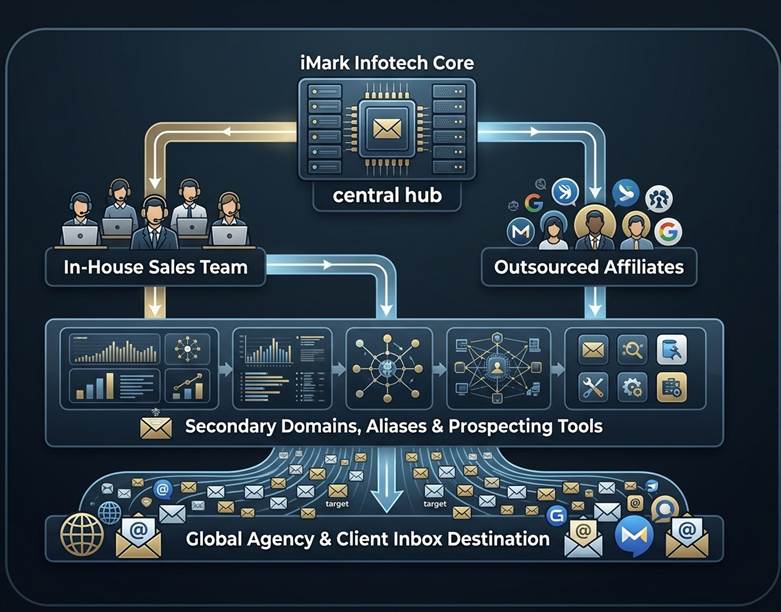
A core driver of iMark Infotech’s global email footprint is its reliance on distributed outreach teams and multiple domain infrastructures designed to bypass standard email filters.
1. Rotating Names and Domain Aliases
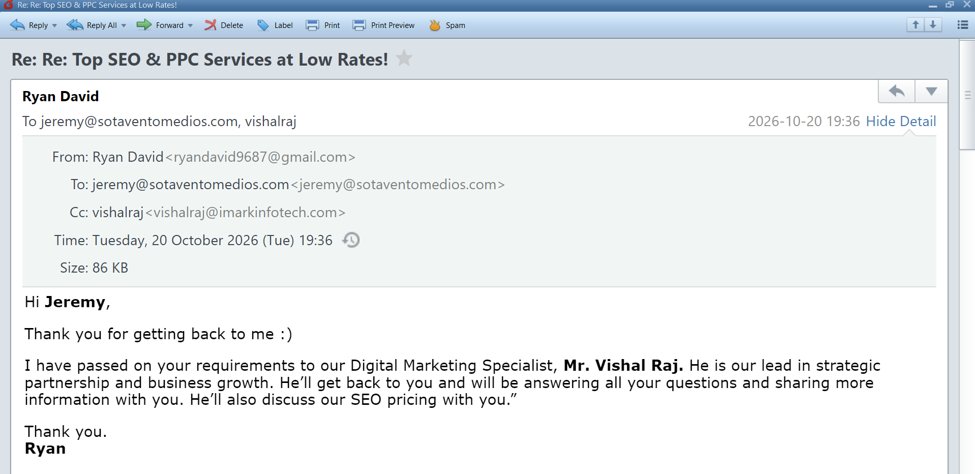
Recipients frequently note that emails offering iMark Infotech’s services do not always originate directly from imarkinfotech.com. Instead, campaigns often utilize secondary domains, lookalike web addresses, or free email service providers. Sales representatives use names like “Ryan,” “Alex,” or “David,” which frequently change depending on the thread or campaign cycle.
2. Automated Follow-Up Sequences
One of the most persistent aspects of this outreach model is the multi-stage follow-up funnel. If a prospect fails to respond to the initial pitch, automated drip systems trigger subsequent messages every few days. These follow-ups range from polite check-ins (“Just checking if you saw my last email”) to misleading assumptions (“I’ve passed your requirements to our lead specialist”).
This aggressive persistence creates significant friction for agency executives who must spend valuable administrative hours triaging, blocking, and reporting these incoming messages.
3. Subcontracted & Affiliate Lead Generators
Beyond their primary operations in India, evidence suggests that iMark Infotech leverages third-party lead generation firms, white-label sales brokers, and affiliate marketers to fuel their global client acquisition. These external teams are often compensated based on meeting bookings or lead sign-ups, incentivizing them to maximize volume over relevance, compliance, or brand etiquette.
3. The Impact on Digital Agencies Worldwide
For digital marketing agencies that operate with strict ethical standards, the proliferation of mass-scale outreach creates several industry-wide challenges.
Erosion of Industry Trust
When business owners are bombarded daily with low-quality, automated sales pitches offering “cheap SEO” or “guaranteed rankings,” it degrades public perception of the entire digital marketing field. Business leaders become skeptical of legitimate consultants and agencies, assuming that search engine optimization is merely a commodity driven by cold emails rather than a sophisticated engineering and strategic discipline.
Inundation of Agency Contact Forms and Inboxes
Digital marketing agencies themselves are primary targets for these campaigns. Prospecting networks routinely harvest agency directories and submit sales pitches through contact forms, forcing agency owners and client managers to continuously filter out spam instead of responding to legitimate client inquiries.
Misleading “Partnership” Angles
A particularly frustrating tactic used by these outreach networks is framing a sales pitch as a “collaboration” or “strategic partnership.” Agencies often receive messages asking to explore mutual synergies, only to discover upon replying that the outreach is simply a standardized effort to sell white-label execution services.
4. Comparing Prospecting Approaches: Spam vs. Strategic B2B Outreach
To evaluate why iMark Infotech’s methods draw widespread criticism, it is useful to compare high-volume automated prospecting against legitimate, compliant B2B business development practices.
| Outreach Dimension | High-Volume Outreach (e.g., Mass Campaigns) | Strategic B2B Outreach |
| Audience Selection | Scraped, bulk email databases with minimal filtering. | Scraped, bulk email databases with minimal filtering. |
| Personalisation | Automated merge tags (e.g., {First_Name}, {Website}). | Automated merge tags (e.g., {First_Name}, {Website}). |
| Domain Infrastructure | Multiple disposable secondary domains and aliases. | Primary or single dedicated, fully authenticated domain (SPF/DKIM/DMARC). |
| Value Proposition | Generic claims (“boost traffic”, “cheap white-label”). | Custom analysis, actionable insights, and transparent case studies. |
| Unsubscribe Respect | Follow-ups continue even when requested to stop or marked as spam. | Immediate, permanent removal upon first opt-out request. |
5. Regulatory Compliance and Ethical Considerations
The global regulatory landscape surrounding electronic communications has tightened significantly over recent years. Operating massive cold outreach campaigns crosses both legal and ethical parameters in several jurisdictions:
1. CAN-SPAM Act (United States)
Under the US CAN-SPAM Act, commercial emails must meet clear standards:
- Deceptive subject lines or misleading header info are explicitly prohibited.
- Messages must contain a clear physical postal address.
- The recipient must be provided with a straightforward mechanism to opt out of future mailings, and opt-out requests must be honored within 10 business days.
Mass outreach campaigns that rely on rotating domains or fail to honor immediate opt-out requests directly violate these requirements.
2. GDPR and PECR (Europe and UK)
Under the General Data Protection Regulation (GDPR) and the Privacy and Electronic Communications Regulations (PECR), sending unsolicited direct marketing emails to business contacts requires either prior consent or a verifiable “Legitimate Interest.” Mass harvesting of business email addresses without proving a legitimate, relevant interest fails to meet strict European data protection criteria.
3. Spam Control Regulations in Asia-Pacific
Countries across APAC including Singapore (Spam Control Act) and Australia (Spam Act) maintain strict statutory frameworks regarding unsolicited commercial electronic messages sent in bulk. Aggressive mass mailing strategies expose operating organizations to significant regulatory and deliverability risks.
6. How Agencies and Site Owners Can Protect Their Inboxes
If your organization is repeatedly targeted by unsolicited outreach campaigns from offshore agencies or white-label providers, here are practical steps to mitigate the disruption:
- Implement Stringent Server-Level Filtering: Configure your email security gateway (such as Google Workspace, Microsoft 365, or Cloudflare Email Routing) to filter out common cold pitch phrases, disposable domain extensions, and aggressive follow-up syntax.
- Use Form Protection and Captchas: Implement Google reCAPTCHA v3 or Turnstile on all public-facing contact forms to reduce automated form submissions.
- Issue Explicit Removal Instructions: Reply with a firm, unambiguous request: “Remove this email address permanently from your database and all associated domain networks immediately.”
- Report Deliverability Violations: If communications continue after an opt-out request, mark the messages as spam within your email client. This signals global inbox providers (Gmail, Outlook, Yahoo) to adjust domain reputation scores for the sending servers.
- Educate Your Administrative Staff: Ensure that virtual assistants and front-office staff recognize standardized sales scripts so they do not forward generic pitches to executive leaders.

Sandamalee is a dedicated digital marketing professional and a core member of the Sotavento Medios team. I work closely with my colleagues to manage daily digital operations, ensuring that every project meets the high standards our clients expect. My focus is on maintaining the technical and editorial integrity of our diverse business portfolios, helping brands stay consistent and impactful in their online presence.