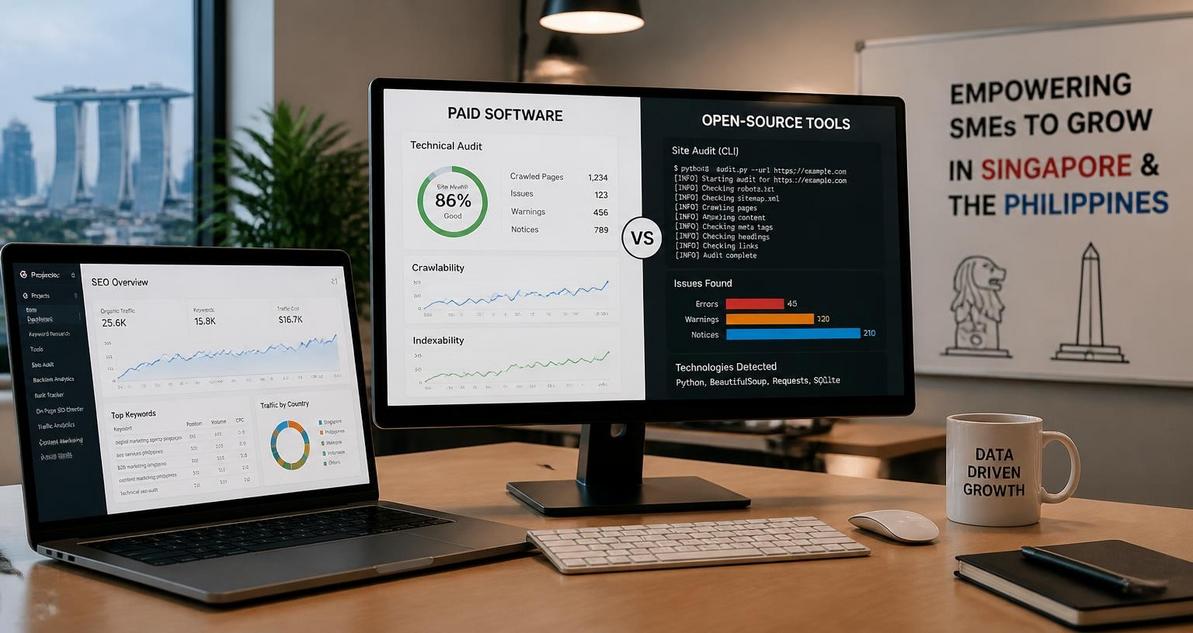
For Singapore and the Philippines, keyword research in 2026 is no longer about collecting high-volume terms and mapping them to a page. Decision-makers are now competing in search environments shaped by AI overviews, semantic retrieval, multilingual intent, and changing buyer journeys across B2B software, financial services, logistics, healthcare, and professional services. Perplexity AI has become useful here because it does more than generate topic ideas. It helps teams interrogate a query, inspect context, identify source patterns, and build a keyword strategy that matches how modern search systems interpret meaning. For agencies and in-house teams serving regional markets, the advantage is clear: you can move from surface-level keyword lists to a research process that captures intent clusters, topical gaps, and source-backed context that supports better content architecture.
Why Perplexity AI Changes Deep Keyword Context Research
Traditional keyword tools still matter, but they usually begin with a term and return search volume, difficulty, and related phrases. That is useful for prioritization, yet it rarely explains why a searcher is asking the question, what adjacent concepts matter, or how the query behaves across industries and geographies. Perplexity AI is valuable because it performs synthesis on top of search retrieval. It can surface current sources, summarize competing viewpoints, and expose the language patterns that dominate a topic space. For a Singapore fintech brand or a Philippine B2B outsourcing firm, this matters because search intent often reflects regulatory nuance, procurement stages, and local terminology that generic keyword tools miss.
Deep keyword context research focuses on three layers. First is lexical context, which looks at the exact terms and phrases used in search results, featured snippets, support forums, and technical documentation. Second is semantic context, which connects entities, synonyms, and related concepts. Third is commercial context, which reveals whether the searcher is comparing vendors, trying to implement a solution, or validating a purchase decision. Perplexity AI can help unify these layers by combining query response, citation trails, and conversational iteration. That makes it especially useful when a team needs to decide whether a topic belongs in a product page, a comparison article, a technical guide, or a lead-generation landing page.
How it differs from legacy keyword workflows
Older workflows tend to start and end with volume data. That approach can miss high-intent long-tail queries that have low volume but strong conversion potential. In B2B environments, especially in Singapore and the Philippines, those queries are often shaped by role-specific language such as procurement, compliance, deployment, integration, or implementation. Perplexity AI helps teams examine those modifiers in context and connect them to actual source material. When a marketer sees repeated references to pricing models, security architecture, SLAs, or API compatibility, the content strategy can shift from broad awareness content to bottom-of-funnel assets that support sales conversations.
Building a Deep Keyword Context Workflow with Perplexity AI
A practical workflow starts with a seed keyword and expands outward in controlled steps. The goal is not to ask Perplexity AI for random related terms. The goal is to guide it through a sequence of prompts that reveal searcher intent, source evidence, and content opportunities. A disciplined workflow produces better outputs than a one-off query because each step narrows ambiguity and validates the prior layer of research. This is especially useful in B2B sectors where the same term can mean different things depending on technical maturity, buyer role, or market maturity.
Step 1: Establish the entity and intent frame
Begin by defining the core entity, not just the keyword. For example, instead of asking about “keyword research tools,” define the product category, audience type, and region. Ask Perplexity AI to identify how that entity is discussed in current sources, what problems it solves, and what adjacent terms consistently appear. Then classify the intent: informational, evaluative, navigational, or transactional. This mirrors how search quality systems and content strategists think about relevance. In 2026, entity-first research is more reliable than keyword-first research because it reduces ambiguity and aligns with semantic indexing.
Step 2: Extract source-backed terminology
Perplexity AI is particularly useful when you need terminology that is backed by sources rather than invented by a model. Ask it to list the phrases that appear most consistently across product documentation, analyst reports, government guidance, vendor pages, and technical articles. Review whether those phrases indicate a standard industry term, a marketing variation, or a regional synonym. In Singapore, for example, buyers may reference data governance, PDPA alignment, or enterprise security controls more explicitly. In the Philippines, distributed workforce operations, outsourcing compliance, and cloud-first deployment language may appear more frequently. Capturing those variations improves relevance and helps content teams localize without diluting meaning.
Step 3: Map modifiers that signal commercial maturity
Keyword modifiers reveal where a searcher sits in the buying cycle. Words such as best, pricing, vendor, implementation, integration, alternatives, compliance, and case study are highly informative in B2B research. Perplexity AI can help identify which modifiers cluster around a topic and which ones appear in source documents rather than only in search data. That distinction matters because source-based modifiers often point to real market demand. A keyword map built this way can separate early-stage curiosity from late-stage evaluation. It also helps content teams decide whether to create a thought-leadership article, a technical comparison, or a sales enablement asset.
Using Perplexity AI to Analyze SERP Context, Entity Coverage, and Content Gaps
Search results pages are no longer simple lists of blue links. They often include AI-generated answers, videos, local packs, discussion threads, and product-rich results. Perplexity AI can help you understand the context around a query by summarizing the dominant angles represented in the current results. That gives your team a faster way to identify what Google and other discovery systems are rewarding. The key is to use Perplexity as a contextual analysis layer, not as a replacement for validation in your analytics and rank-tracking tools.
Identify the dominant angle in the current results
Ask Perplexity AI to summarize the main themes present in the top sources for a target keyword. You are looking for recurring narratives such as definition-led explainers, pricing-led comparisons, implementation guides, or regulation-led updates. If most sources are educational and generic, that may signal room for a more technical, enterprise-focused page. If most sources are vendor-led and sales-oriented, a neutral, evidence-based guide may stand out. This type of analysis is especially relevant in sectors where trust, compliance, and technical credibility influence conversion.
Detect missing entities and subtopics
One of the most valuable uses of Perplexity AI is gap detection. Ask it what important subtopics are present in trusted sources but absent from your target page or existing content cluster. For example, a cybersecurity topic might mention identity federation, zero trust, log retention, audit trails, and privileged access management. A CRM integration topic might include webhooks, API rate limits, sync latency, data normalization, and field mapping. When these entities are missing from your content, search engines may treat the page as incomplete or less authoritative. More importantly, users may not find the operational detail they need to move forward.
Compare intent across markets
For Singapore and the Philippines, the same search query can have different expectations. Singapore users often demand concise, compliant, and technically rigorous content. Philippine audiences in B2B contexts may emphasize affordability, scalability, and operational fit, especially in service-led industries. Perplexity AI can help compare source patterns across these contexts by prompting it to identify how the topic is framed in each market. That insight supports localization strategy, page structure, and offer positioning. It also prevents direct translation from replacing true market adaptation.
Prompt Engineering Patterns for High-Value Keyword Research
Getting better research from Perplexity AI depends on prompt design. A vague prompt produces broad summaries. A precise prompt produces structured intelligence. The best prompts specify the industry, buyer stage, region, source type, and output format. They also ask for evidence and categorization, not just narrative text. This is where technical marketers can gain an edge, because they can turn a conversational tool into a repeatable research system.
Use layered prompts instead of single-shot queries
Start with a broad discovery prompt, then narrow the scope through follow-up questions. For example, first ask which entities and subtopics consistently appear around a keyword. Next ask which of those topics are most associated with purchase intent. Then ask which sources support those claims. Layered prompting reduces noise and helps you separate general topic coverage from revenue-relevant opportunities. This approach is closer to qualitative research methodology than to casual AI usage.
Ask for comparisons and contradictions
Strong keyword research is not only about consensus. It is also about identifying contradictions across sources. Perplexity AI can surface where analysts, vendors, and documentation disagree on terminology or implementation. That matters because contradiction often reveals opportunity. If multiple sources disagree on a framework, the content team can create a clarifying guide. If sources use different labels for the same entity, the page can incorporate all relevant language without keyword stuffing. This improves semantic coverage and reduces the risk of content mismatch.
Request structured outputs for content operations
For an agency workflow, prompt Perplexity AI to return data in categories such as primary intent, supporting entities, audience role, funnel stage, and content asset recommendation. Structured outputs make it easier to move research into editorial planning. They also support content briefs, internal linking plans, and SEO hub maps. In teams handling multiple clients across Singapore and the Philippines, structured outputs reduce handoff friction between strategists, writers, and technical SEO specialists.
Turning Research into SEO Architecture and B2B Content Assets
Keyword context research has value only when it changes execution. Once you have contextual insight, the next step is to translate it into page types, cluster models, and internal linking logic. This is where many teams underuse AI. They stop at insight generation and fail to operationalize it. A more mature workflow uses the research to decide the article hierarchy, CTA placement, schema opportunities, and supporting assets that should surround a core page.
For example, if Perplexity AI shows that a topic attracts evaluation-stage queries, create a comparison page, a buyer’s guide, and an implementation checklist. If the topic attracts operational queries, create a technical explainer, an FAQ, and a deployment article. If the topic includes regulatory or compliance language, create a separate section that addresses governance, risk, and data handling. This approach mirrors topic cluster design, but it is grounded in source-level context rather than only keyword adjacency.
It also helps with internal linking. Pages built from the same contextual cluster should reinforce each other with consistent entity usage and complementary angles. A broad pillar page can target the main topic, while supporting articles address sub-intents such as integration, pricing, implementation, comparison, and troubleshooting. Search systems reward topical depth when pages collectively address a subject with clarity and completeness. Perplexity AI helps surface the language that should appear across those pages so that the cluster feels coherent rather than stitched together.
For B2B brands in Singapore and the Philippines, this is especially important because the sales cycle often includes multiple stakeholders. A marketing manager may look for awareness content, an IT manager may need technical validation, and procurement may want commercial proof. Deep keyword context research enables content that speaks to each role without creating duplicate pages that compete with one another. The result is a cleaner architecture and a more persuasive user journey.
Implementation Checklist for a Perplexity AI Keyword Research System
Use the checklist below to operationalize Perplexity AI in your SEO and content workflow:
- Define the entity, audience, region, and business objective before prompting.
- Run a broad discovery query to identify recurring entities, subtopics, and intent signals.
- Validate terminology against trusted source types such as documentation, analyst content, vendor pages, and regulatory references.
- Classify modifiers by commercial maturity, including informational, evaluative, and transactional terms.
- Compare how the topic is framed in Singapore and the Philippines to account for local terminology and buyer expectations.
- Identify missing entities and subtopics that should appear in your page or cluster.
- Translate the research into a page type, such as a guide, comparison page, technical explainer, or landing page.
- Build internal links from the pillar page to supporting content that covers adjacent intents.
- Use the contextual findings to inform titles, headers, FAQ sections, and schema opportunities.
- Review performance in search console, analytics, and rank tracking, then refine the prompt sequence based on what ranks and converts.
When used with discipline, Perplexity AI becomes more than a research assistant. It becomes a context engine for modern keyword strategy, helping teams in Singapore and the Philippines identify what searchers mean, what sources support the topic, and what content structure is most likely to earn qualified visibility.

I am Tricia Huang Mei, an Advertising Partner in Sotavento Medios with over two decades of experience in the Singapore advertising and business sectors. My career is defined by a commitment to driving high-impact marketing campaigns and fostering sustainable growth for the diverse business portfolios I manage.