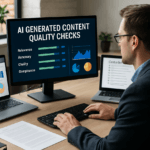
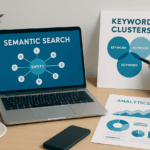
Search is becoming more complex as businesses compete for visibility across traditional search engines, local results, and increasingly intelligent search experiences. Technology can help businesses process information faster, identify opportunities, and streamline optimisation, but tools alone do not create sustainable results. AI SEO becomes genuinely valuable when data-driven technology is combined with human expertise, business objectives, and a clear understanding of customer behaviour. This balanced approach can help businesses make better decisions while using their SEO resources more efficiently.
Key Takeaways
- AI can accelerate SEO research, analysis, and optimisation.
- Human judgement remains important for strategy and quality control.
- Search intent should guide AI-assisted content decisions.
- Existing content can provide valuable optimisation opportunities.
- AI can help identify technical and competitive gaps.
- Meaningful business outcomes matter more than rankings alone.
- Continuous testing helps turn SEO insights into sustainable growth.
Start with Strategy, Not Technology
AI tools can analyse enormous amounts of information in a short period, but that does not mean every available feature should be used. A successful strategy begins by understanding what the business wants to achieve and who it wants to reach.
Technology should support those objectives rather than determine them. This ensures optimisation remains focused on meaningful opportunities instead of becoming an exercise in automation.
Define the Business Goal
The first step is to establish whether the priority is qualified traffic, lead generation, online sales, brand visibility, or expansion into new markets. Clear objectives provide a basis for evaluating every SEO decision.
Identify Where AI Adds Value
AI is particularly useful for repetitive analysis, large datasets, pattern recognition, and research. Human professionals can then interpret those findings and decide which opportunities deserve investment.
Use AI to Discover Search Opportunities
Search research can involve thousands of keywords, topics, competitors, and customer questions. Analysing these areas manually can take considerable time, particularly for websites operating across multiple products or markets.
Discover Topic Opportunities
AI can help identify related searches, frequently discussed questions, content gaps, and emerging themes. These insights can provide a useful starting point for building a more comprehensive content plan.
Prioritise the Right Opportunities
Not every suggestion deserves attention. Search intent, competition, business relevance, audience value, and conversion potential should determine which opportunities move forward.
| Data Area | AI-Assisted Insight |
| Keywords | Related search opportunities |
| Competitors | Visibility gaps |
| Search queries | User questions |
| Content | Missing topics |
Put Search Intent at the Centre
One of the biggest mistakes in AI-assisted SEO is focusing on keywords without understanding why people search for them. A keyword represents an opportunity, but the intent behind it determines what kind of experience a user expects.
Understand Different Intent Types
Searches may be informational, commercial, transactional, or navigational. Recognising these differences helps businesses choose suitable content formats and landing pages.
Match Intent with Experience
The relationship should be straightforward:
Search Query → Intent → Content → Experience → Conversion
When these elements align, users are more likely to find the information they need and continue through the website.
Build Better Content with AI-Assisted Research
AI can speed up the early stages of content development, but efficiency should never come at the expense of originality or credibility. Automatically produced material can easily become repetitive if it is not guided by genuine expertise.
Use AI for Research Support
AI can help identify questions, group related topics, analyse competing content, and uncover areas that existing resources have not adequately addressed.
Keep Expertise at the Core
Content should include accurate information, practical examples, expert perspectives, and original insights. Human review is essential for maintaining factual accuracy, brand relevance, and E-E-A-T.
Useful applications include:
- Topic research
- Content gap analysis
- Question discovery
- Content planning
- Competitor research
- Editorial support
Improve Existing Content Before Creating More
Businesses often assume that growth requires publishing more pages. In reality, some of the strongest opportunities may already exist within the website.
Identify Underperforming Pages
Look for pages that previously performed well, have outdated information, or attract relevant visitors without producing meaningful engagement. These pages can become optimisation priorities.
Find Specific Improvements
Rather than rewriting everything, businesses can improve headings, update information, address missing questions, strengthen internal links, and make calls to action more relevant.
A practical process is:
Audit → Identify → Improve → Measure
Make Technical SEO More Efficient
Technical optimisation can become particularly challenging on large websites. Thousands of pages may contain indexing problems, broken links, duplicate content, metadata issues, or structural inconsistencies.
For organisations managing complex websites or multiple markets, Enterprise SEO can provide a structured framework for scaling optimisation while maintaining consistency across the site.
Detect Technical Patterns
AI can assist in identifying unusual patterns across crawling, indexing, metadata, internal links, and content duplication. These findings can then be reviewed by an SEO professional.
Prioritise by Impact
Not every technical issue has the same importance. Businesses should consider potential search impact, user experience, implementation effort, and business relevance before deciding what to fix first.
| Technical Area | Potential AI Support |
| Crawling | Identify recurring issues |
| Indexing | Detect unusual patterns |
| Content | Flag duplication |
| Metadata | Find missing elements |
| Internal links | Identify opportunities |
Use Competitor Intelligence Strategically
Competitor analysis becomes more useful when it goes beyond copying what other businesses are doing. AI can help process competitor content, keyword visibility, and search presence to reveal areas where a business may have an opportunity to differentiate itself.
Identify Competitive Gaps
Businesses can examine topics competitors cover extensively, areas where their visibility is strong, and questions that remain poorly addressed. This can reveal potential content opportunities.
Turn Insights into Differentiation
The objective should not be duplication. Competitor data should help businesses identify opportunities to provide deeper expertise, stronger resources, clearer experiences, or more useful information.
Combine AI Insights with Human Expertise
The strongest approach does not position AI and SEO professionals against each other. Instead, each contributes different strengths to the optimisation process.
AI can process information quickly and identify patterns, while experienced professionals understand business context, customer expectations, brand positioning, and strategic priorities.
| AI Strength | Human Strength |
| Data analysis | Strategic judgement |
| Pattern detection | Context |
| Automation | Creativity |
| Large-scale processing | Brand understanding |
| Repetitive tasks | Decision-making |
Maintain Human Oversight
Human review ensures recommendations are appropriate, ethical, accurate, and aligned with business goals. This is particularly important when decisions affect important commercial pages or brand reputation.
Measure Meaningful Growth
Smarter optimisation requires smarter measurement. Rankings can show visibility, but they do not necessarily indicate whether a business is attracting valuable visitors or generating commercial outcomes.
Businesses should therefore connect SEO reporting with actual performance indicators.
Track More Than Rankings
Useful metrics include:
- Organic visibility
- Qualified traffic
- Click-through rate
- Engagement
- Leads
- Conversion rate
- Revenue contribution
Turn Data into Decisions
Performance information should influence future priorities. Strong-performing content can be expanded, while underperforming pages can be tested and refined based on evidence.
Create a Continuous Improvement Cycle
SEO is not a one-time activity. Search behaviour changes, competitors publish new content, websites evolve, and search technologies continue to develop.
Test What Works
Businesses can experiment with content improvements, page structures, technical changes, and new search opportunities. Results should be compared against clearly defined objectives.
Refine and Scale
Successful initiatives can be expanded, while weaker approaches can be adjusted or discontinued. This creates an ongoing cycle:
Discover → Analyse → Prioritise → Optimise → Measure → Learn → Scale
Final Takeaway
AI can make SEO more efficient, but smarter growth comes from knowing where and how to use it. Research, content analysis, technical reviews, competitor intelligence, and performance monitoring can all benefit from AI-assisted workflows, while human expertise remains essential for strategy, quality, context, and decision-making.
For businesses seeking sustainable organic growth, SEOCompany.me combines technology with strategic SEO thinking to help turn search data into practical opportunities and measurable outcomes.
Ready to Build a Smarter SEO Strategy?
Want to explore how AI-assisted optimisation can improve your organic search performance? Contact SEOCompany.me to discuss your current SEO challenges and develop a strategy aligned with your business goals.
Frequently Asked Questions
1. What role does AI play in modern SEO?
AI can support keyword research, competitor analysis, content planning, technical analysis, and performance monitoring. It helps process information efficiently while SEO professionals use those insights to make strategic decisions.
2. Can AI replace SEO professionals?
AI can automate certain repetitive tasks, but it cannot fully replace strategic judgement, creativity, business understanding, or human quality control. The strongest approach combines technology with experienced SEO expertise.
3. Can AI-generated content rank well?
AI-generated content does not automatically receive better rankings. Content still needs to demonstrate relevance, accuracy, originality, usefulness, and genuine expertise while satisfying the needs behind a user’s search.
4. How can AI improve existing website content?
AI can help identify declining pages, content gaps, weak sections, duplicated information, and potential optimisation opportunities. Professionals can then review these findings and make appropriate improvements.
5. How should businesses measure AI-assisted SEO?
Businesses should look beyond rankings and monitor qualified traffic, engagement, leads, conversions, and other relevant commercial outcomes. These metrics show whether optimisation is creating genuine business value.

I am Tricia Huang Mei, an Advertising Partner in Sotavento Medios with over two decades of experience in the Singapore advertising and business sectors. My career is defined by a commitment to driving high-impact marketing campaigns and fostering sustainable growth for the diverse business portfolios I manage.