In Singapore’s complex digital environment, which is a center for expensive B2B transactions and competitive B2C e-commerce, the selection of the appropriate Google Ads campaign type is a major strategic move and not just a choice of settings.
One could say that the argument whether to use the Standard Search Campaigns with their surgical precision or the broad, AI-driven, Performance Max (PMax) for scaling is essentially a discussion about Control versus Convenience. Local Singaporean businesses, such as FinTech startups and logistics companies that have been around for a while, will find that the best choice for 2025 depends solely on their business model, the number of conversions, and the level of comfort with automated decision-making.
The AI Imperative: Understanding the Context for PMax
Presently, Google is moving very fast towards an AI-first advertising environment. As a result of AI Overviews, the growth of YouTube viewership, and the complicated user journeys across Search, Discover, Display, and Gmail, no one channel can actually trace the full conversion funnel. It is Performance Max that embodies the main idea of a single, objective-driven campaign whose purpose is to obtain conversions through the use of Google’s AI in the most efficient way throughout its entire stock.
Performance Max (PMax): The All-Channel Growth Engine
PMax is not a new version of a conventional campaign; rather, it is a completely automated system that requires from advertisers only the top creative assets and audience signals and then relies on the algorithm to locate the customers who will convert wherever they might be.
| PMax Core Strengths | B2B/B2C Relevance in Singapore |
| Full Channel Reach | Critical in a mobile-first market where users jump between YouTube, Search, and Gmail. PMax ensures continuous presence. |
| New Customer Discovery | Excels at finding audiences who match your Ideal Customer Profile (ICP) but haven’t yet searched for a specific keyword. Ideal for new or emerging product categories. |
| Simplified Management | Consolidates multiple channels (Search, Display, Video, Gmail) into one campaign, freeing up time for high-value strategy work. |
| Creative Testing at Scale | Rapidly tests thousands of asset combinations to find the highest-performing ad versions, a huge advantage in a competitive market. |
The PMax “Black Box” Challenge for B2B
Where PMax is really good at doing a lot and very quickly for simple, high-volume conversions (for instance, e-commerce sales), the B2B sector in Singapore has to be very careful. The lack of transparency of the platform, which is often referred to as a “black box” and thus search query and placement data cannot be seen, is a considerable risk for companies that have long sales cycles and high-value, low-volume conversions. A loss of money that is meant for advertising on parts where it is not useful (e.g., people looking for jobs instead of CFOs) can very fast lead to a decrease in profit.
The core best practice to 2025 in order to reduce the opacity is to employ:
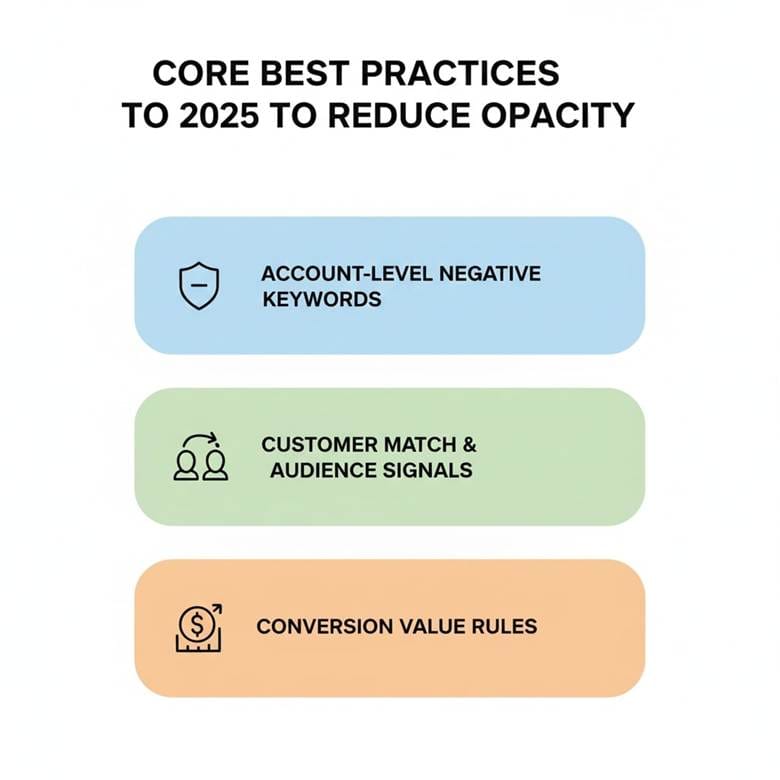
- Account-Level Negative Keywords: A crucial 2025 change giving the ability to technical experts to show the AI the way out of irrelevant, waste of budget, queries that the AI might not understand.
- Customer Match & Audience Signals: Supplying the AI with top-notch first-party data (CRM lists, highly-intent website visitors) that can drastically improve targeting accuracy.
- Conversion Value Rules: Helping the AI understand the different values of various conversions (e.g., Demo Request > E-book Download) so that it is not allowed to optimize only for low-quality volume.
Standard Search Campaigns: The Precision Tool
Standard Search Campaigns are still the very first choice to capture the demand of people who have a high intent to buy something and are at the bottom of the funnel.
These campaigns are essentially the ones which grab the user at the very moment when they are actively looking for a solution, thus, making them a must-have for business models that are specific, complicated, or have heavy compliance.
Search Campaign Core Strengths
| Search Core Strengths | B2B/B2C Relevance in Singapore |
| Surgical Control | Absolute control over keywords, ad copy, and landing page mapping. Essential for complex B2B sales cycles and compliant industries (Finance/Legal). |
| Message Precision | Guarantees that the ad copy precisely matches the user’s explicit search intent. Crucial for maintaining brand integrity and addressing specific pain points. |
| Conversion Quality | Consistently delivers higher quality leads for B2B. By targeting specific, high-intent keywords, you filter out broad, low-qualification traffic. |
| Full Transparency | Provides granular data on exactly which keywords and search terms drove the conversion, vital for sophisticated marketing analytics and attribution models. |
When Standard Search Dominates the Singapore Market
- Considering the present performance measures, Search campaigns should be:
- Complex B2B Lead Generation: For instance, you may want to focus on extremely specific, long-tail search phrases such as “enterprise resource planning implementation consultant Singapore”.
- Compliance & Brand Safety: For instance, businesses in the finance or healthcare sectors that are not able to risk automated, off-brand ad placements.
- Low-Volume, High-Value Conversions: This is the case when your monthly conversion goal is very low (e.g., <50) but the value of each is extraordinarily high ($1,000+).
- Competitor Bidding: For example, a strategy that includes aggressively targeting competitor brand names or specific product lines with tailored landing pages for direct comparison.
The Hybrid Model: The 2025 Strategic Imperative
Honestly, for the majority of seasoned marketing managers in Singapore, the question is not “Which one should I choose?” but rather “How do I make them work together?” The best strategy that works across the entire funnel in the contemporary Google Ads environment is a Full-Funnel Hybrid System.
| Funnel Stage | Recommended Campaign Type | Strategic Goal |
| Top/Mid-Funnel (Discovery) | Performance Max | Build awareness, generate broad customer interest, and capture audiences who are not yet searching for a solution. |
| Bottom-Funnel (High Intent) | Standard Search | Capture demand from users actively searching with high-intent keywords (e.g., “CRM software price,” “best cloud security services”). |
| Brand Protection | Standard Search | Ensure your brand name is always present at the top of the SERP with precise messaging. |
Actionable Implementation Steps
- Ring-Fence Keywords: Employ tightly controlled Standard Search campaigns to exclusively place bids on your highest-intent, highest-converting keywords (this may include branded and competitor terms).
- Strategic Exclusion: Use PMax negative keyword lists to exclude the terms that are already covered by your high-performing Search campaigns. In this way, budget cannibalization is avoided, and PMax is compelled to find genuinely incremental, new traffic.
- Asset Priority: Put a lot of effort into the production of high-quality video and image assets for PMax. As the algorithm operates across the whole network, better creative is by far the most significant lever that you have.
- Conversion Path Alignment: Make sure that your PMax landing pages are more comprehensive and of the top-funnel nature, whereas the landing pages of your Search campaign are highly specific and conversion-ready, thus, matching the exact keyword intent.
The Sotavento Medios
Singapore businesses cannot go back to the pre-AI stage after having adopted AI-powered advertising. Performance Max is the main source of incredible efficiency and scale, which, without a doubt, is a great growth lever. Still, a loss of control in PMax can be quite a costly issue in a market characterized by complex B2B services and discerning consumers
The winning strategy for 2025 is a carefully planned coexistence. Utilize PMax’s reach and automation for market expansion and creative testing, but use Standard Search campaigns that are carefully managed to strongly support your bottom-funnel, high-value demand. This hybrid approach is the best of both worlds: the growth is scalable and there is financial control at the strategic level.

Jeremy Lee is a seasoned digital marketing director and strategist with over two decades of experience in the industry. As the founder of Sotavento Medios, I manage a diverse portfolio of over 50 businesses, helping brands grow through advanced search strategies and digital innovation. My work focuses on bridging the gap between traditional search engine optimisation and the evolving world of AI-driven answer engines.