Strong Google search rankings don’t give the full picture any more. A company may achieve a good position in conventional search and yet fail to appear when customers use ChatGPT, Gemini, Perplexity, or Google’s AI services to compare providers, recommend products, or suggest solutions.
That’s why learning how to track your brand in AI search has now become an essential extension of SEO and forms a key component of generative engine optimization (GEO). The first thing you should do if you want to find out how to consistently get your brand mentioned and cited in AI-generated answers is to benchmark its performance.
I choose Semrush One for my AI brand monitoring since it brings together the SEO Toolkit and the AI Visibility Toolkit into a single workflow. It allows me to research prompts, benchmark visibility, analyse my competitors, monitor brand perception, keep an eye on priority prompts, and check technical AI readiness all without having to use a number of different tools. Like that, it is better than manually tracking AI prompts and hoping that my brand ends up being seen.
TL;DR: How to Track Your Brand Across AI Search with Semrush One
My Semrush One workflow has six steps:
- Benchmark: Save your AI Visibility baseline in Visibility Overview.
- Research: Find the prompts your audience asks in Prompt Research.
- Compare: Surface missing prompts and missing sources in Competitor Research.
- Diagnose: Use Brand Performance and AI Search Health to find out why competitors win.
- Optimize: Fix the biggest cause first, whether that is content, citations, positioning, or technical access.
- Track: Monitor a stable set of priority prompts daily in Prompt Tracking.
What exactly does AI brand tracking measure?
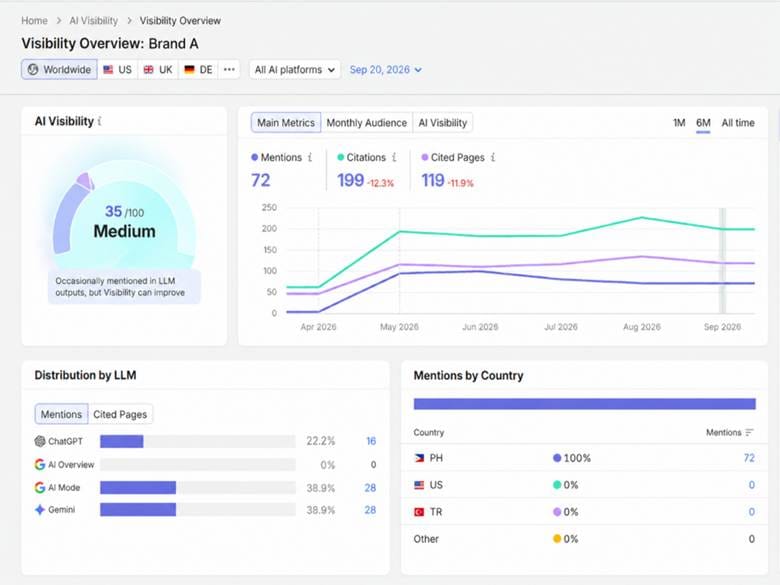
AI brand tracking looks at how consistently and accurately a company is represented in the answers that are generated by AI. In Semrush One I use a number of signals rather than just one visibility figure.
| Metric | What I Use It For |
| AI Visibility | Benchmarking overall presence in AI-generated answers. |
| Mentions | How often the brand appears for relevant topics and prompts. |
| Cited Pages | Pages that AI systems use as sources. |
| Citations | How frequently the domain supports AI-generated answers. |
| Share of Voice | Brand mentions compared with competitors. |
| Sentiment | How AI platforms describe the brand. |
| Narrative Drivers | Topics, questions, and sources shaping brand perception. |
| Average Position | Where the domain’s citations appear for tracked prompts. |
| Prompt Visibility | Changes across a defined set of important AI prompts. |
These measures deal with different questions; it’s possible for a brand to have strong citation visibility in informational content but a weak share of voice when it comes to commercial queries in which users compare different providers, so I investigate where it appears, why that is the case, and whether it is present when buying decisions are being made.
Why Traditional Rank Tracking Isn’t Enough
I can still see which keywords and pages are working based on the rankings, clicks, and conversions. However, AI platforms introduce an extra level of discovery. Rather than providing a static set of blue links, they summarize the information, compare the different providers, quote several sources, and suggest specific options or even omit a company altogether, leading to situations such as these:
- The brand has a good position on Google but is mentioned by few AI sources.
- A competitor is frequently recommended without managing to dominate the rankings.
- The company has a weak share of voice even though the website is frequently cited.
- The creation of strong SEO content fails to help in establishing the position that the company desires.
That’s the reason I carry out this analysis in Semrush One, since the tool combines traditional SEO with AI visibility within a single environment so that I can observe how the two work together. For my full opinion, see my Semrush One review covering SEO, AEO, GEO, and AI visibility.
Step 1: Establish Your AI Visibility Baseline in Semrush One
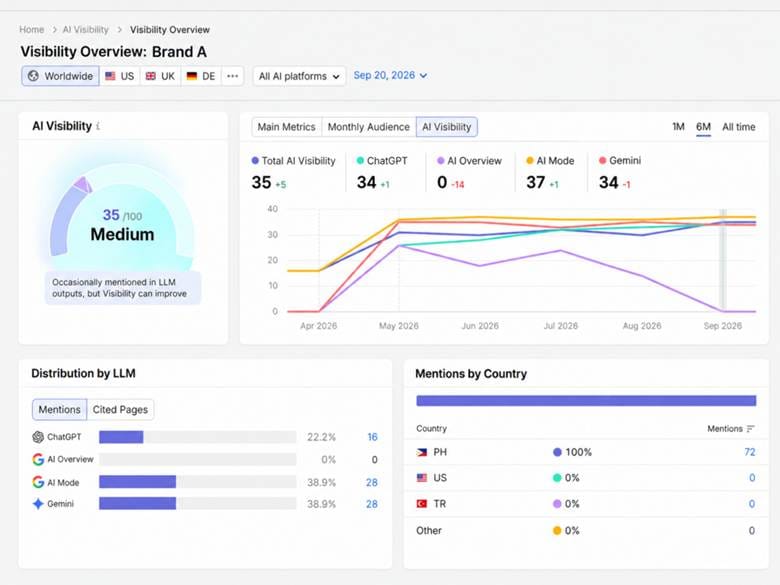
The first step is to look at the Visibility Overview, as this is the quickest method of assessing a brand’s AI footprint before making any changes to its content, technical elements, or off-site strategy. I examine the AI Visibility Score, the Mentions, the Cited Pages, the Citations, the trends, the performing topics, and the distribution by LLM together with the geographic mentions.
Before carrying out major optimizations I save the baseline; otherwise I wouldn’t be able to determine whether the later changes had improved AI search visibility or whether I was merely responding to individual AI responses.
Step 2: Find the AI Prompts That Actually Matter
It is a common error to base your entire prompt list on the brand. For example, prompts such as “What is [Brand]?” are useful for monitoring public perception but do not indicate whether people can find out about the company before they know its name.
I carry out discovery using Prompt Research in Semrush One by entering a category, a product, a service, or an industry topic and then obtaining related prompts together with AI Volume, intent, relevant brands, and source domains; my guide on making the switch to prompt research explains how this approach builds upon keyword research.
Category Discovery Prompts
They indicate if the brand shows up when a person is looking around in the market. For example: “What are the best [product/service] providers?”
Problem-Solution Prompts
They show if the company appears to the user before the user has decided on a type of solution. For example: “Which companies can help with [problem]?”
Comparison and Decision Prompts
The ones that are most important are due to the fact that the AI platform is looking at different options. For example: “[Brand A] versus [Brand B]” and “What are the alternatives to [competitor]?”
Research into prompts also indicates intent, allowing me to tell the difference between informational and commercial questions. I focus on those prompts in which including the answer would be important to the business, not just on those which have measurable demand.
Step 3: Compare Your Brand Against AI Competitors
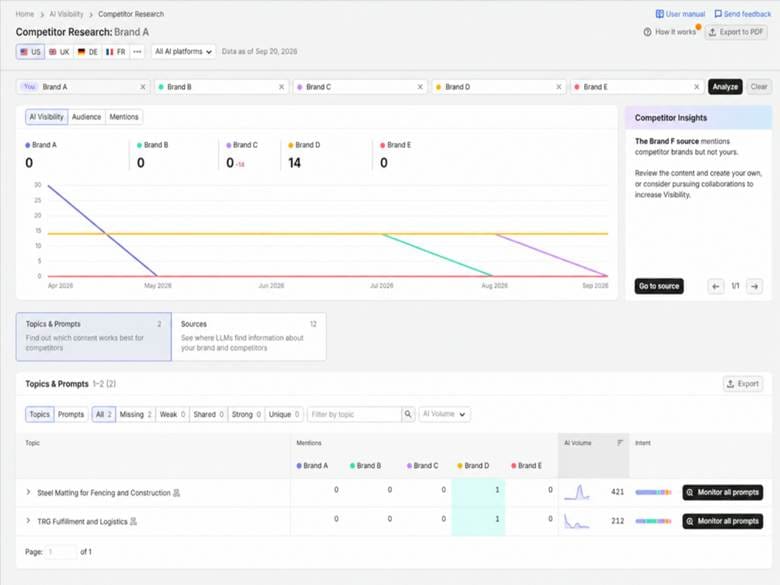
When I have an understanding of what the market wants, I then proceed to Competitor Research, a stage at which AI brand monitoring proves more valuable than simply counting mentions. The process involves comparing the brand’s situation with that of its competitors in terms of AI visibility, mentions, citations, topics, prompts, and sources, and it identifies those prompts where competitors are present but the brand is not. I am looking for two kinds of gaps, a point that I have already discussed in my guide on how to discover AI visibility gaps before your competitors do.
Missing Prompts
They are prompts in which competing brands are mentioned while mine isn’t, and they usually indicate content or positioning opportunities.
Missing Sources
This list includes cases where competitors are cited but my brand is not, indicating that the issue might not be on our own website. Since our competitors obtain citations from publishers, directories, or industry resources, the solution could be to increase our external presence, which is why I use AI search to reverse engineer the citations of our competitors.
Step 4: Measure Share of Voice and Brand Perception
Visibility by itself doesn’t indicate how a brand is portrayed, which is why I rely on Brand Performance. This tool examines Share of Voice, sentiment, questions, and narrative drivers on ChatGPT, Gemini, Perplexity, Google AI Mode, and Google AI Overviews.
The reports illustrate the extent of the brand’s presence in AI conversations, which competitors have a greater Share of Voice, and whether the company is referred to in a positive, neutral, or negative way. Narrative Drivers are particularly useful since a simple count of mentions only indicates that the brand has appeared, whereas narrative analysis shows the reasons behind this and identifies the various themes and domains that influence the answer.
Step 5: Track Priority Prompts Over Time
Research identifies the opportunities for me, and tracking indicates if the strategy is effective. I pass on the most commercially relevant prompts to Prompt Tracking, which checks custom prompts each day in the various AI search environments we support, such as ChatGPT Search, Google AI Mode, and Gemini. This tracking provides information on visibility, average position, competitor performance, and which domains or pages are cited.
To get an understanding of the market I refer to the broader reports and use Prompt Tracking for the smaller group that needs to be monitored—this includes prompts related to core services, priority products, important locations, high-intent comparisons, and revenue-driving customer problems. The way I decide which AI search prompts to track is as follows: consistency is also important since changing the prompts that are tracked every reporting period would make it impossible to determine whether actual improvements in visibility have taken place.
Step 6: Diagnose Why Competitors Appear Instead of You
It is at this point that the Semrush One workflow becomes practical. Just knowing that another brand is mentioned more frequently does not suffice, so I look into the reason for the difference.
| Area | Semrush One Workflow |
| Prompt Coverage | Identify missing topics and prompts with Prompt Research and Competitor Research. |
| Brand Visibility | Compare Mentions and AI Visibility in Visibility Overview. |
| Competitive Position | Review competitor gaps and Share of Voice. |
| Brand Perception | Analyze Brand Performance and Narrative Drivers. |
| Citations | Review Cited Pages, Sources, and Missing Sources. |
| Technical Access | Review AI Search Health and crawler accessibility. |
| Long-Term Performance | Monitor priority prompts through Prompt Tracking. |
Because of this I am not led to think that every AI visibility issue requires new content; the problem could lie in missing content, a page that is unclear, weak third-party mentions, or blocked crawlers, and by understanding how the LLMs decide which brands to recommend I can work out which of these to check first.
Step 7: Check Your Technical Readiness for AI Search
Even if the content is strong, it won’t be of any use if the AI search crawlers can’t access it, which is why I have included AI Search Health in the workflow. In the Semrush Site Audit, it examines technical aspects such as crawler access, structured data, and internal linking, and it is able to detect pages that have been blocked from major AI crawlers. I look at:
- AI Search Health
- Pages blocked from AI search
- AI crawler access and relevant robots.txt restrictions
- Structured data issues
- Internal linking and crawlability problems
- AI-specific Site Audit warnings
I carry out this step following the visibility analysis since an audit is more useful when I know which pages are important; if an important service page is missing from the AI answers and the crawlers cannot reach it,, I have a specific issue to fix.
Step 8: Turn the Data Into an Optimization Workflow
At this stage, Semrush One has demonstrated to me where the brand currently is, what users are asking, where the competitors have advantages, and what the technical obstacles are, after which I associate the findings with one of these scenarios so that I never optimize without having a clear basis.
If the Brand Is Missing From Important Prompts
I check if the website deals with the subject in question and whether the brand is clearly linked to it; the solution could be a new landing page, more effective service copy, a comparison resource, or FAQ content. For both AEO and GEO I use this ‘update or create content’ approach to make my decision and then assign each prompt to a page with intent-to-answer mapping.
If Competitors Have Stronger Citation Coverage
I look at the domains and the pages that contribute to their visibility. This may indicate possibilities for original research, external brand mentions, digital public relations, or more clear expertise signals.
If the Website Is Cited but the Brand Is Rarely Recommended
I will look into the positioning; the content might be good enough to serve as a source even if no explanation is given as to why the company should be regarded.
If Visibility Is Strong but Sentiment or Positioning Is Weak
The identification of which attributes and sources influence the way AI describes the brand is done by using Brand Performance and Narrative Drivers, and this enables me to decide which themes to tackle first.
If Important Pages Are Technically Restricted
I always look at the Site Audit issues that are relevant before asking for any content changes, since it is impossible for crawlers to earn citations for content that they cannot reach.
How I Track ChatGPT, Gemini, Perplexity, and Google AI
I do not regard all AI platforms as being in the same ranking environment, which is why I use different Semrush One reports according to the type of analysis I require.
ChatGPT
I look at the various topics and prompts that cause mentions, which sources are cited, and how our performance stacks up against that of our competitors. Prompts that are important are entered into Prompt Tracking.
Gemini
To check whether other AI platforms rely on different topics, pages, or sources, I compare Gemini’s visibility with that of the other platforms and also include important Gemini prompts in Prompt Tracking.
Perplexity
I look at Perplexity primarily in terms of Brand Performance, with a special focus on Share of Voice, perception, the questions it receives, and brand narratives. This approach illustrates how the company is portrayed outside of traditional search.
Google AI
I regard Google AI Overviews and AI Mode as being two separate features, and Semrush One offers visibility data for both of them, with Prompt Tracking covering the selected AI Mode prompts.
How to Measure and Report AI Visibility Growth in Semrush One
I take a benchmark reading before carrying out any significant changes and then observe how the Semrush One metrics evolve. As the AI-generated answers vary, I do not consider that the brand has appeared once after an article was published as a measure of success; instead, I look for wider trends:
- More priority topics and previously missing prompts surfacing the brand
- Share of Voice increasing against relevant competitors
- More strategic pages receiving citations
- Better visibility for tracked high-intent prompts
- Stronger, more accurate narratives and fewer technical barriers for AI crawlers
The AI datasets from Semrush and the custom Prompt Tracking update are updated at different frequencies, so I base my analysis on trends rather than on individual changes. For a more detailed examination of the metrics, refer to my guide on measuring AEO performance.
When it comes to reporting, I focus on business questions rather than simply listing all the metrics, and I cover the areas of visibility, competitor gaps, content opportunities, external authority, technical access, and progress on the tracked prompts. The Semrush One product offers exports for several of the AI Visibility reports, and its My Reports integration enables the AI visibility data to be included in reports that are ready for stakeholders.
Common AI Brand Tracking Mistakes
There are several mistakes which can cause AI visibility data to be of less use, and these are the ones I look for.
Tracking Only Branded Prompts
It indicates whether or not an AI platform recognizes the brand, not whether customers are able to find it. Include non-branded prompts from Prompt Research.
Treating AI Visibility as One Metric
The AI Visibility Score alone does not give the full picture since review mentions, citations, share of voice, sentiment, and those of the competitors all need to be looked at separately.
Tracking Every Prompt You Can Find
Having more data won’t lead to a better strategy; you should use Prompt Research to identify opportunities and then use Prompt Tracking only for those prompts that are important to the business.
Ignoring the Sources Behind Competitor Visibility
A competitor gap could be due to an authority issue rather than a content one. Carry out competitor research and examine the narrative drivers to look at the areas that are influencing the answers.
Changing Your Tracked Prompts Constantly
This reduces the value of your benchmark. To ensure that changes can be compared over time, it’s important to maintain a stable core set.
Assuming Every Gap Requires a New Article
Start by deciding if the issue lies in content coverage, positioning, citations, entity clarity, or technical access, since Semrush One provides a report for each of these areas.
Looking at AI Visibility Separately From SEO
AI search is still a kind of discovery environment and not a justification for giving up traditional search; it is helpful to understand the differences between AEO and GEO since both of them enhance SEO rather than replace it.
Key Takeaway
I never begin AI brand monitoring by manually checking whether or not the AI platform knows the company. To work out how to track your brand in AI search, I first establish a baseline in Semrush One and then use Prompt Research, Competitor Research, Brand Performance, Prompt Tracking, and AI Search Health to identify visibility gaps, measure public perception, and detect technical problems.
The way to proceed is to benchmark, carry out research, compare the results, diagnose the situation, optimise, and keep track. The actual value does not lie in simply knowing that the brand has appeared; it is in finding out which topics make the brand visible, which competitors show up in those searches, which sources influence the answers, and how AI describes the company, so that I can decide on the next changes to make.
Frequently Asked Questions About Tracking Your Brand in AI Search
How can I keep an eye on my brand as it appears on ChatGPT, Gemini, Perplexity, and Google AI?
You can use Semrush One to benchmark your domain in the Visibility Overview, to find prompts in the Prompt Research feature, and to compare your competitors in the Competitor Research section; afterwards, measure your Share of Voice and sentiment using Brand Performance and keep an eye on the priority prompts in Prompt Tracking.
What is the difference between an AI citation and an AI mention?
When an AI response refers to your brand, that is known as a mention. When it uses your website as a source, this is called a citation. It is possible for a brand to have one of these without having the other, which is why I keep them separate.
How frequently should I check my AI visibility?
Prompt Tracking checks our custom prompts on a daily basis, but I look at trends rather than at individual changes since AI answers vary. Each reporting period I compare the results with my stored baseline.

Sandamalee is a dedicated digital marketing professional and a core member of the Sotavento Medios team. I work closely with my colleagues to manage daily digital operations, ensuring that every project meets the high standards our clients expect. My focus is on maintaining the technical and editorial integrity of our diverse business portfolios, helping brands stay consistent and impactful in their online presence.