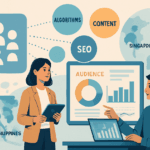
For businesses in Singapore and the Philippines, AI writing assistants are no longer novelty tools. They now sit inside the same content operations that support lead generation, product education, compliance messaging, and multilingual market expansion. That makes the selection criteria much stricter than “Can it draft fast?” In 2026, the real question is whether an AI writing assistant can support E-E-A-T signals across the entire content workflow: experience, expertise, authoritativeness, and trustworthiness. For B2B teams that publish for regulated industries, technical buyers, or procurement committees, the wrong tool can quietly introduce factual drift, weak sourcing, brand inconsistency, and content that performs poorly under both human review and search quality assessment.
The best AI writing assistants are not the ones that write the most persuasive copy with the fewest prompts. They are the ones that help teams produce verifiable, reviewable, and strategically useful content while preserving editorial control. That matters in Singapore and the Philippines because many B2B organizations work across multiple markets, languages, and stakeholder expectations. A finance company in Singapore may need precise terminology, policy alignment, and source traceability. A BPO provider in the Philippines may need scalable thought leadership, regional nuance, and consistency across sales, SEO, and employer-brand content. In both cases, E-E-A-T is not a theory. It is an operational requirement.
What E-E-A-T Really Means for AI Writing in 2026
E-E-A-T is often discussed as a search quality concept, but in practice it behaves like a content governance framework. It affects how content is planned, researched, drafted, reviewed, and updated. When AI enters the workflow, the standard gets harder to meet because the tool can amplify both good and bad editorial habits. A strong AI writing assistant should reduce ambiguity, not increase it. It should help teams maintain source fidelity, reflect subject-matter expertise, and avoid unsupported claims.
Experience is now visible in the workflow
Experience is not just a writer saying they have done the work. It shows up in how the content reflects real implementation detail, operational tradeoffs, and market-specific context. An AI assistant that only produces generic copy will fail here. A better assistant helps incorporate field knowledge, for example, how a Singapore fintech compliance team structures approval chains or how a Philippine outsourcing provider aligns sales enablement with service delivery realities. The best systems support prompt templates, context injection, and brand knowledge bases so that first-hand operational detail becomes part of the draft instead of a late-stage rewrite.
Expertise depends on source handling
Expertise requires more than fluent language. It requires accurate terminology, domain-specific structure, and the ability to preserve technical meaning. AI tools that hallucinate definitions, blur compliance terms, or overgeneralize B2B concepts create editorial risk. For technical audiences, the assistant should support source-backed drafting, citation workflows, and controlled outputs. In practice, that means the tool should let editors ground content in approved documents, internal subject-matter notes, product documentation, or vetted external references.
Authoritativeness and trustworthiness are reviewable, not cosmetic
Authoritativeness is strengthened when content aligns with recognized frameworks, industry standards, and consistent organizational messaging. Trustworthiness depends on transparent sourcing, factual accuracy, and editorial accountability. If an AI tool can log prompts, preserve revisions, and integrate with review systems, it becomes easier to audit the content path from draft to publication. That is especially important for organizations in banking, healthcare, logistics, SaaS, and professional services where content may influence purchasing decisions or compliance perceptions.
The Evaluation Criteria That Separate Strong Tools from Weak Ones
Many AI writing assistants look similar on the surface. They all promise speed, consistency, and better copy. The difference appears when you assess them against actual publishing requirements. For 2026 E-E-A-T readiness, the evaluation should focus on governance, accuracy, workflow fit, and editorial controls. If a tool cannot support those four areas, it may still be useful for ideation, but it will not reliably support high-stakes B2B content.
1. Source grounding and citation support
A serious AI writing assistant should allow the user to anchor output to source material. That can include knowledge base files, URLs, internal style guides, or brand documents. The objective is not just better wording. It is traceability. Tools that generate text without grounding often produce confident but unsupported statements, which creates risk for content that aims to rank, convert, or educate senior buyers. For E-E-A-T compliance, the ideal assistant should help editors see where claims came from and which parts need human verification.
2. Controlled tone and brand consistency
B2B teams in Singapore and the Philippines often operate across multiple sectors, product lines, and buyer personas. A weak assistant will flatten those differences and produce generic content that sounds interchangeable. A stronger tool should support reusable voice profiles, terminology rules, banned phrases, preferred sentence structures, and content intent models. This is not just a branding issue. Consistency improves trust, especially when the same company publishes white papers, landing pages, sales decks, and executive commentary.
3. Workflow compatibility with human editors
The best AI writing assistants do not replace editorial teams. They integrate with them. Look for tools that support collaboration, versioning, comments, and revision tracking. For enterprise teams, the question is whether the assistant fits the content approval chain. If legal, marketing, product, and SEO teams all need sign-off, the tool should help preserve accountability rather than creating isolated drafts outside the approval process.
4. Factual discipline and hallucination resistance
Factual discipline is one of the clearest differentiators. Some tools excel at creative copy but struggle with technical precision. Others are better at structured, factual output but weaker on polish. The strongest assistants balance both. They should make it easy to maintain a clear line between verified facts and draft language. In a 2026 search environment, that matters because quality reviewers and users are less tolerant of vague, repetitive, or overpromising content.
Which AI Writing Assistants Are Best for E-E-A-T-Ready B2B Content
No single assistant is perfect for every use case. The best choice depends on whether your team needs long-form research, SEO production, brand governance, or enterprise-level collaboration. For B2B organizations targeting Singapore and the Philippines, the most useful assistants tend to fall into distinct categories. The right stack often combines a general-purpose model for drafting with a specialized tool for optimization, governance, or enterprise search.
General-purpose drafting assistants
General-purpose assistants are best for ideation, first-draft generation, internal briefing documents, and repurposing approved content into multiple formats. Their main advantage is flexibility. They can support everything from webinar abstracts to product explainer drafts. Their weakness is that they require strong prompt discipline and human fact-checking. Without constraints, they can introduce unsupported claims or generic phrasing. For E-E-A-T-sensitive work, these tools should be used with structured prompts, source material, and a mandatory editorial review layer.
SEO-focused writing platforms
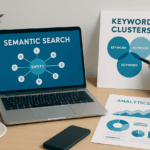
SEO-focused platforms are more useful for content that must satisfy search intent, topical coverage, and internal linking requirements. They often help teams identify related subtopics, semantically relevant terms, and content gaps. That makes them valuable for service pages, comparison pages, and industry guides. However, ranking support alone is not enough. If the platform generates templated or repetitive output, the content may underperform on trust signals and reader engagement. The best SEO assistants provide structure while still allowing writers to add original insight and domain evidence.
Enterprise content platforms
Enterprise platforms are better suited for larger B2B organizations with governance requirements. They typically offer permissions, audit trails, shared libraries, and brand guardrails. For teams in regulated environments, this matters because it reduces the chance of unauthorized claims or off-brand publishing. These tools are especially relevant when multiple departments contribute to one content engine. Marketing can draft, subject matter experts can annotate, and legal or compliance can review within a controlled environment.
Research-enhanced assistants
Research-enhanced assistants are useful when the content must cite current market conditions, industry benchmarks, or policy changes. They can accelerate source discovery and summarization, but only if the user validates the references. In technical B2B writing, they are most effective as research accelerators rather than autonomous authors. The writer still needs to interpret the source, compare viewpoints, and preserve factual boundaries. That is especially important when covering fast-moving topics such as cybersecurity, cloud infrastructure, AI governance, or regional digital regulation.
How to Use AI Writing Assistants Without Losing Quality or Credibility
Tool choice matters, but process matters more. Even a strong assistant can produce weak content if the workflow is poorly designed. The most reliable B2B teams use AI as a controlled drafting layer inside a broader editorial system. They do not ask the model to think for them. They use it to accelerate specific tasks while keeping verification and strategic judgment in human hands. This approach is more practical for complex markets like Singapore and the Philippines, where buyer sophistication and industry variation demand precision.
Use AI for structured drafting, not final authority
AI should speed up outline creation, headline exploration, summarization, and variant generation. It should not be the final arbiter of technical claims. When a topic involves market size, legislation, platform capabilities, or implementation guidance, the content team should verify every material statement against primary or approved secondary sources. A workable standard is simple: if a sentence would matter to procurement, legal, or a domain expert, it should be checked by a human.
Build a prompt framework around business context
Generic prompts produce generic content. Strong prompts include audience, objective, proof points, brand language, and source limitations. For example, a prompt for a managed IT services article should specify the target buyer, the service tier, the market, and the terms that must be used or avoided. This reduces revision cycles and produces drafts that are closer to publication quality. For regional B2B teams, prompts should also capture localization requirements, such as Singapore-specific regulatory references or Philippine market terminology.
Create an editorial rubric for E-E-A-T checks
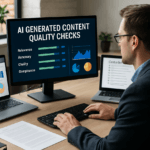
Use a review rubric before publishing. The rubric should ask whether the content reflects real operational knowledge, whether claims are supported, whether the tone matches the brand, whether the content resolves the search intent, and whether the structure helps a reader make a decision. This makes E-E-A-T measurable inside the workflow. It also helps content managers identify whether the issue is the AI tool, the prompt, or the editorial process.
Measure quality with human and search signals
For B2B content, quality should be measured using a blend of human and performance indicators. Human signals include SME approval, revision count, and factual corrections. Search signals include impressions, qualified traffic, engagement on high-intent pages, and assisted conversions. A good AI writing assistant should help improve production efficiency without degrading these signals. If output volume rises but editorial correction also rises, the tool is creating more work than value.
Implementation Checklist for B2B Teams Adopting AI Writing Assistants
Before rolling out an AI writing assistant across your content operation, treat it as a controlled system, not a software purchase. Define the use cases first. Decide which content types can be AI-assisted and which must remain heavily human-led. Service pages, outline generation, internal briefs, and repurposing tasks are usually safer starting points than legal, medical, financial, or policy-sensitive content. Then assign ownership for prompt standards, fact-checking, and approval workflows so the process does not depend on one person’s judgment.
- Map every content type to a risk level: low, medium, or high.
- Approve a source hierarchy for facts, terminology, and claims.
- Create brand voice rules and banned phrase lists.
- Require human review for all technical, legal, financial, or compliance-related assertions.
- Set up version tracking so edits remain auditable.
- Use AI for research acceleration and drafting support, not factual authority.
- Review output against an E-E-A-T rubric before publication.
- Track revision burden, search performance, and SME approval rates after rollout.
For teams in Singapore and the Philippines, this checklist is the difference between scalable content operations and noisy automation. The best AI writing assistants do not just save time. They help maintain the standards that B2B buyers, regulators, and search systems expect from credible digital content.

I am Tricia Huang Mei, an Advertising Partner in Sotavento Medios with over two decades of experience in the Singapore advertising and business sectors. My career is defined by a commitment to driving high-impact marketing campaigns and fostering sustainable growth for the diverse business portfolios I manage.