The Singaporean B2B environment is characterized by exactness, high-value transactions, and a mature attitude towards digital spending. It is no longer a decision that business owners and marketing directors in this market can afford to make, that is, merely tracking clicks and impressions without understanding their tactical significance. The crux of Google Ads success in Singapore is the transition from vanity metrics to profitability metrics that have a direct connection to the bottom line and the B2B sales cycle which is usually very long and complex.
As Technical SEO and Digital Marketing Strategists at Sotavento Medios, our emphasis is not only on the aspects that need tracking, but also on the manner in which these metrics correlate with the latest changes in the platform specifically the growing dependence on Google’s AI and the requirement for first-party data.
This evaluation defines the Key Performance Indicators (KPIs) that you absolutely need to keep very close tabs on if you want to be able to generate high-quality leads in a measurable manner and achieve a demonstrable Return on Ad Spend (ROAS) in the highly competitive Singapore market.
The Foundational Metrics: Beyond the Basics
Before diving into profitability, a technical audit requires a clear view of the ad’s immediate relevance and efficiency. These metrics ensure your campaigns are optimized at the auction level.
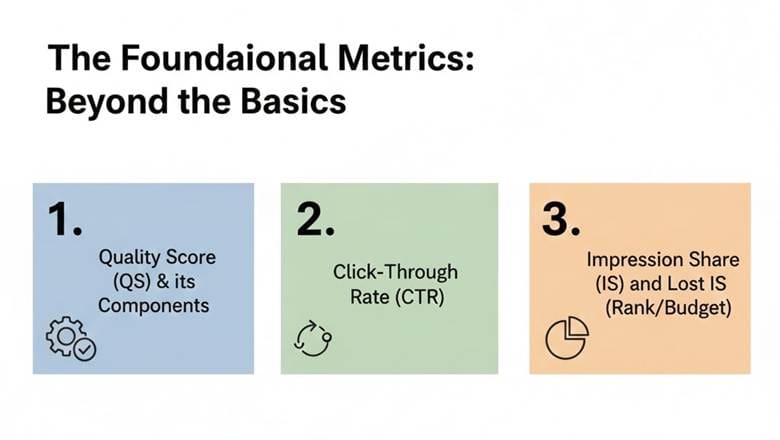
1. Quality Score (QS) & its Components
The Quality Score is the engine of your campaign efficiency, which is often forgotten or ignored for its direct financial impact. It is a measure made by Google to check the relevancy of your keywords, ad copy, and landing page to the user’s search query.
- Why it Matters in Singapore: With a market characterized by high Average Order Values (AOV) and tough competition for keywords (such as “enterprise cloud solutions Singapore”), a slight increase in QS can have a significant effect in cutting your Cost Per Click (CPC) and enhancing your Ad Rank.
- Actionable Insight: Break down your QS into its three components: Expected Click-Through Rate (CTR), Ad Relevance, and Landing Page Experience. A low QS is a diagnostic signal that indicates your landing page needs immediate technical fixes such as improving its load speed and making it more relevant.
2. Click-Through Rate (CTR)
CTR is the percentage of users who clicked your ad after seeing it.
- B2B Context: An elevated CTR (quite frequently >5% for Search campaigns) is a strong indication that the ad copy you use is in line with the user’s intent. Nevertheless, the situation is quite different in B2C. In the case of B2B, if the high CTR is not accompanied by conversions, this is an indication that there is a breakdown in the sales funnel, most probably at the landing page or the offer level (for instance, a situation where a user clicks on “Download Whitepaper” but does not complete the form).
3. Impression Share (IS) and Lost IS (Rank/Budget)
Impression Share refers to the percentage of total eligible impressions that you actually got. This is a very important competitive metric.
- The Competitive Edge: Your Search Lost IS (Rank) in a highly competitive market such as Singapore, which is a dense financial and technology hub, indicates that you are losing visibility because of a low Ad Rank (low Quality Score or bid). Search Lost IS (Budget) shows that you are merely running out of budget before the end of the day which is a frequent problem in high-value B2B auctions.
- Actionable Insight: In case Lost IS (Rank) is significantly high, concentrate on raising Quality Score. When Lost IS (Budget) is significantly high, you should definitely reconsider your budget pacing and targeting of high-intent keywords by narrowing down.
The Profitability & Funnel KPIs (The North Star Metrics)
For B2B marketing managers and business owners, these are the metrics that matter most to the CFO, as they tie ad spend directly to revenue pipeline.
4. Cost Per Acquisition (CPA) / Cost Per Lead (CPL)
- $$\text{CPL} = \frac{\text{Total Campaign Cost}}{\text{Number of Qualified Leads}}$$
- Strategic Focus: In Singaporean B2B, it is necessary that the emphasis be changed from the generic “lead” (e.g., newsletter sign-up) to a Marketing Qualified Lead (MQL) or Sales Qualified Lead (SQL). You have to differentiate the conversions in Google Ads in order to be able to track the Cost Per MQL and Cost Per SQL. The achievement of a very low CPL for a MQL with high value is like finding the holy grail.
5. Return on Ad Spend (ROAS) and Return on Investment (ROI)
In B2B, ROAS is a key factor that helps in spending justification, however, ROI is the one that reveals the real business scenario.
- The B2B Difference: As the revenue event (the final sale) is mostly happening outside the 30-day Google Ads attribution window, it is necessary to give a proper conversion value to your lead actions. For instance, if a demo booking leads to a $10,000 deal with a 10% probability, then its Conversion Value would be $1,000.
- Current Trend (2025): The most effective way is to link your CRM/Sales pipeline data with Google Ads (for example, through Enhanced Conversions for Leads). This enables you to calculate Closed-Loop ROI by following an MQL through to a closed deal, thus providing a real-time, data-driven insight that budget holders are looking for.
| B2B Industry | Average ROAS (PPC) | Purpose |
| SaaS (Mid-Market) | $\sim2.6$ | Maximize Lead-to-SQL Volume |
| Enterprise Tech | $\sim3.2$ | Maximize Value of High-Intent Searches |
| Commercial Services | $\sim1.65$ | Establish baseline acquisition cost |
(Note: These are global general B2B benchmarks. The high concentration of the Singaporean market and commercially high-intent keywords may drive the cost per click up, which, in turn, may initially lower your target ROAS for market penetration.)
6. Customer Lifetime Value (LTV) & Customer Acquisition Cost (CAC)
In the case of SaaS and subscription-based services, these are the main financial KPIs that show the context of your Google Ads spend.
- $$\text{CAC} = \frac{\text{Total Sales \& Marketing Expenses}}{\text{Number of New Customers Acquired}}$$
- The LTV/CAC Ratio: It is this ratio ($\text{LTV}:\text{CAC}$) that the management team focuses on. A good ratio, generally 3:1 or more, is an indication of a business model that is both sustainable and profitable. Therefore, the real measure of your Google Ads effectiveness should be the extent to which it helps to keep this ratio at a favorable level. It is necessary for you to have your CPA/CPL target levels set well enough below your CAC target so that you can still accommodate internal sales expenses.
The Modern B2B Imperative: Post-Click Metrics
The move to AI-powered campaigns such as Performance Max (PMax) and Smart Bidding is making on-site behavior more important than ever. Google’s AI operates on the basis of its prediction of the most likely conversions in the future, and this prediction is very much dependent on the latest post-click signals.
7. Conversion Rate (CVR) and Bounce Rate
These indicators measure how well your landing page works for the users.
- Conversion Rate: The fraction of ad clicks that lead to a conversion clearly defined (e.g., demo request). In case of a low CVR ($\text{<5\%}$) combined with a high CTR, it indicates that your targeting is right, but your landing page copy, design, or offer is not giving what the ad promised.
- Bounce Rate (or Engagement Rate): A high bounce rate (e.g., $\text{>70\%}$) typically indicates that the user considered the page irrelevant. This is a warning signal for Google’s algorithm and thus will increase your CPC gradually.
8. Lead Source Attribution & Velocity
The contemporary B2B purchaser in Singapore is very likely to have a multichannel journey.
- Attribution Modeling: Don’t stick to the default “Last Click” attribution only. Employ Data-Driven Attribution in Google Ads and connect your Google Ads campaigns more accurately when they are the initial touchpoint in a long, complex B2B funnel.
- Lead Velocity Rate (LVR): This metric is essential for Sales-Marketing alignment and it shows the speed at which qualified leads are going through the pipeline. If there is a sudden increase of MQLs from Google Ads, this must be accompanied by a constant or better LVR for the campaign to be genuinely successful.
Next Steps
In order to be successful in B2B in Singapore your Google Ads KPI strategy needs to be more complex than just simple metrics. You have to function as a revenue engine, concentrating very hard on Cost Per Qualified Lead (CPQL), Closed-Loop ROAS, and finally the LTV:CAC ratio. It is the technical side of things like correct conversion tracking, CRM integration, and an unwavering Quality Score that really distinguishes a losing campaign from a valuable strategic asset.
If the setup for your Google Ads is such that you cannot get detailed Cost Per SQL reports and you are not sure about the conversion values, then your campaigns are at a high risk of being wrongly allocated.

Jeremy Lee is a seasoned digital marketing director and strategist with over two decades of experience in the industry. As the founder of Sotavento Medios, I manage a diverse portfolio of over 50 businesses, helping brands grow through advanced search strategies and digital innovation. My work focuses on bridging the gap between traditional search engine optimisation and the evolving world of AI-driven answer engines.