The hyper-competitive Singapore current internet generation requires a very technical and exact method of paid media. A startup setting a Google Ads budget is definitely not a cause of a wild guess; it is a serious exercise of financial modeling and strategic allocation of resources. Simply wasting ad spend is not only inefficient but it can also be a factor for ending the startup’s runway.
Being technical SEO and marketing strategists, we consider Google Ads budgeting as a tool for controlling and optimizing your Cost Per Acquisition (CPA) so that it corresponds to your lifetime customer value (LTV) rather than a limit for spending. This manual explains how to accomplish the fundamental steps and have the current 2026 Singapore benchmarks in order to decrease the risk of your first advertising investment and make a smooth transition from speculative spending to predictable, profitable growth.
The Foundational Shift: From ‘What Can I Afford?’ to ‘What Does a Conversion Cost?’
A startup’s error that is most significant by far is the setting of a budget through the use of the money that simply flows from one hand to another. Starting with the definition of a profitable target CPA and then figuring out how much money would be needed to achieve that by working backward is the right way.
Step 1: Calculate Your Target CPA
Before interacting with Google’s advertising platform, people are in need of first setting up the financial aspect for the new client acquisition which will eventually lead to the success of the business.
- Calculate Customer Lifetime Value (LTV): This is very important for B2B or subscription models. Make a rough calculation of the net profit that a customer will generate during the retention period that you can reasonably expect.
- Define Maximum Permissible CPA (Max CPA): It is the highest cost with which you can afford to get one customer without losing the risk of a healthy margin. A common point of reference for a sustainable model is a Max CPA which is 10% to 30% of your LTV.
- Determine Target CPA: In paid media, conservatively Target CPA should be set at a value which is considerably lower than your Max CPA in order to have a reserve for ad management fees, overhead, and the inefficiencies of the initial campaign.
Example:
- Your SaaS LTV is S$5,000.
- Your Max CPA (30% of LTV) is S$1,500.
- Your Target CPA for Google Ads would be S$500 – S$750 so that you can keep making a profit and grow your business.
Step 2: Incorporate Singapore Industry Benchmarks
Due to intense competition in tightly packed verticals, the Singapore market has higher Cost Per Click (CPC) rates than many global benchmarks. Your budget should reflect this fact.
| Industry Vertical | Average CPC (SGD) | Small Business Monthly Budget (SGD) |
| Finance/Insurance | S$3.50 – S$6.50 | S$3,000 – S$10,000+ |
| Healthcare/Education | S$2.00 – S$6.00 | S$1,500 – S$5,000 |
| Retail/E-commerce | S$0.80 – S$3.00 | S$1,000 – S$3,000 |
| B2B Services | S$3.30 – S$5.70 | S$2,000 – S$8,000 |
Essential Startup Budget Advice: Most small Singapore startups would require a minimum initial budget of S$1,000 to S$3,000 monthly to be able to carry out a targeted campaign for a sufficient period of time for Google’s machine learning (Smart Bidding) to collect conversion data and optimize effectively.
Tactical Budget Allocation & Campaign Structure
A startup’s budget constrained by the necessity of very carefully planned, conversion-focused campaign structures is what we are talking about here. The objective is to get as much data as possible and make instant conversions, rather than gaining broad awareness.
Phase 1: The Minimum Viable Data (MVD) Budget
In a first 4-6 week sprint, only a portion of your total budget is needed to be fully dedicated to generating the conversion data which is necessary to enable Smart Bidding.
- Focus: High-intent and long-tail keywords only. Do not use costly, generic keywords at all.
- Campaign Type: Mainly Search Campaigns targeting high-intent users and one single, tightly-scoped Performance Max (PMax) campaign concentrating on existing customer lists or highly specific audiences.
- Bidding Strategy (The Current Trend):
- Start with: Maximize Clicks (if the bid cap is low) or Maximize Conversions (in case you’ve set up conversion tracking).
- Goal: It is generally agreed by experts that a Maximize Conversions campaign should be the first one to be used, even if it causes a slight increase of CPCs, in order to reach the important 15-20 conversions per month level as quickly as possible. This is the signal volume that Google’s AI needs for its learning process.
- Transition to: Target CPA (tCPA) should be used after you have normal conversion volumes, with the tCPA being the one you determined in Step 1.
Daily Budget Strategy for Scalability
Google Ads provides for daily budgets, but it should be noted that the daily spend may vary by as much as 100% from the actual daily budget. Budgeting is done on the basis of a monthly cap (Daily Budget $\times$ 30.4 days).
| Startup Budget Level | Recommended Daily Budget (SGD) | Monthly Spend (SGD) |
| Minimum Viable | S$35 – S$50 | $\approx$ S$1,064 – S$1,520 |
| Actionable Growth | S$65 – S$100 | $\approx$ S$1,976 – S$3,040 |
| Aggressive Scale | S$150+ | $\approx$ S$4,560+ |
Pro-Tip (Pacing): If you have a tight budget, you are usually more efficient if you quickly use up a good portion of your money, for instance, you operate S$100/day for 15 days, collect conversion data, and then make your changes and stabilize, instead of continuously using S$50/day over 30 days and getting a low volume of data for the algorithm to optimize. A small daily budget can cause a situation where you do not gain enough momentum and, thus, the month is wasted.
The Non-Negotiable Technical Mandates
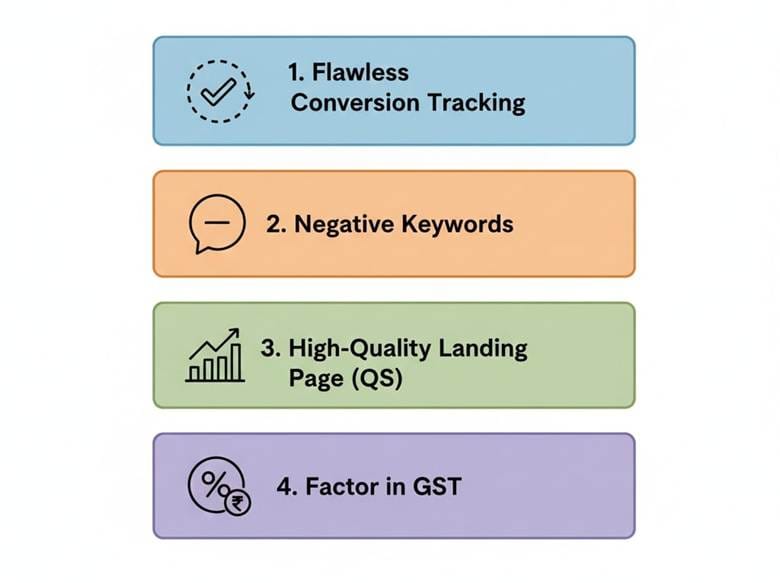
The budget is a wasted investment without the proper technical foundation.
- Flawless Conversion Tracking: Make sure to accurately implement conversion tracking (e.g., Lead Form Submissions, Demo Bookings, Phone Calls). If Google is not aware of what a valuable action is, Smart Bidding will not serve any purpose.
- Negative Keywords: Before launch, develop a huge, sturdy negative keyword list. In markets with high CPCs such as Singapore, a few clicks that are not relevant to your business (e.g., “free,” “jobs,” “low-cost solution”) may consume your small budget within a couple of days.
- High-Quality Landing Page (QS): The Quality Score (QS) of your ad is one of the factors that directly influences your real CPC. A landing page that is highly relevant, quick, mobile-optimized, has clear messaging and a simple Call-to-Action (CTA) will result in a higher QS and thus your effective cost per click will be lower. If the landing page experience is poor, costs will increase significantly.
- Factor in GST: Remember to include the 9% GST for all Google Ads invoices in Singapore. A monthly spend of S$3,000 is actually billed at S$3,270. Your operating budget should take this into account.
Budgeting as a Growth Lever
In the case of a small Singapore startup, the Google Ads budget is essentially a scientific experiment whose main objective is the validation of your acquisition cost model. The question is not about how much you spend, but rather how efficiently you can use the spend to obtain the conversion data which is a prerequisite for modern AI-driven bidding strategies.
Keeping focus on a clearly defined Target CPA, running tightly segmented, high-intent campaigns and, most importantly, being technically correct in terms of robust conversion tracking and the use of negative keywords, you will be able to go through the competitive Singapore market with a budget that is lean, data-driven and of low risk.
Looking for an independent, technical audit of your Google Ads strategy and the setup of your conversion tracking before the launch?
Our team is the right partner to help you in the process of initial media spend de-risking, if you are a fast-growing B2B startup.

Jeremy Lee is a seasoned digital marketing director and strategist with over two decades of experience in the industry. As the founder of Sotavento Medios, I manage a diverse portfolio of over 50 businesses, helping brands grow through advanced search strategies and digital innovation. My work focuses on bridging the gap between traditional search engine optimisation and the evolving world of AI-driven answer engines.