In B2B marketing, the discussion about budget should not be limited to just a percentage allocation of revenue. Given the highly competitive digital scenario of 226, where the cost of getting conversions keeps going up, using a Goal-Oriented Budgeting approach becomes a must. This is the only data-driven method that tightly connects the cost of acquisition to the desired sales volume and is the way to make sure that marketing expenses are not just costs but a measurable capital investment.
At Sotavento Medios, we do not settle for indistinct forecasts. We firmly believe that the monthly marketing budget has to be a direct and measurable outcome of your financial goals. In this article, we will demystify the exact technical formula, bring in the current B2B cost benchmarks, and share practical strategies that will help you work this vital equation to your advantage.
The Core Technical Formula for Budget Estimation
The exercise of figuring out your monthly media budget from a target Cost Per Acquisition (CPA) and a desired sales volume is, in essence, a very powerful strategic move of reverse-engineering. It really turns the question of “How much can we spend?” into “How much do we have to spend to achieve our sales goals?”
Step 1: Define the Required Number of Acquisitions
Initially, one should set the monthly sales target in the most explicit way possible. In order to make it easier, let us consider that “Acquisition” (A) stands for a qualified sale or a high-value contract (e.g., a Customer, not just a Lead).
- Required Monthly Acquisitions ($A_R$): This is the net amount of new customers/sales that your marketing initiatives should bring about in a month.
Actionable Insight: In case your sales team needs 10 high-quality opportunities (SQLs) in order to close 1 customer and your target is 5 customers, then your $A_R$ will be equal to 5. For B2B, it is extremely important to precisely define the rates from lead to opportunity and from opportunity to customer. At present, B2B benchmarks position the visitor-to-customer funnel conversion rate at a minimum of 0.5%, and a maximum of 1.8%, which highlights the need for very accurate tracking.
Step 2: Establish the Target Cost Per Acquisition (CPA)
Your Target CPA is the highest figure with which you are still able to acquire one customer and keep your business profitable. Do not mistake this for the industry average – it is a P&L-driven metric and is linked to the Customer Lifetime Value (LTV) and Gross Margin of your business.
The most commonly accepted standard for profitability is to keep the LTV:CAC (Customer Acquisition Cost) ratio at a minimum of three to one. Hence, your Target CPA (which is very often used interchangeably with CAC in setting goals) should be, in the best case, one-third of your LTV at most.
LTV Example: Supposing your average customer brings you $15,000 in gross profit over their lifecycle, your Maximum Allowable CPA would be $5,000. You should fix your Target CPA at a much lower level, for example, at $4,000 so that there is a cushion for operating costs and changes in the market.
Step 3: Calculate the Estimated Monthly Budget
The moment when $A_R$ and Target CPA are determined, the calculation becomes a child’s play.
Estimated Monthly Budget
Calculation Example:
- Target CPA: $1,500 (assuming a profitable LTV:CAC ratio)
- Required Monthly Acquisitions ($A_R$): 20
- Estimated Monthly Budget (B): $1,500 times 20 = \$30,000
This $30,000 is the approximate media budget that is needed to reach the volume goal with the desired cost efficiency.
Factoring in 2026 Digital Marketing Realities
Any budget planned out in theory should take into account the current digital environment, which is quite unpredictable. If you disregard channel-specific CPA benchmarks and the prevailing trends in the market, you will end up immediately with your budget falling short and targets not being achieved.
The Impact of Platform Volatility and AI Bidding
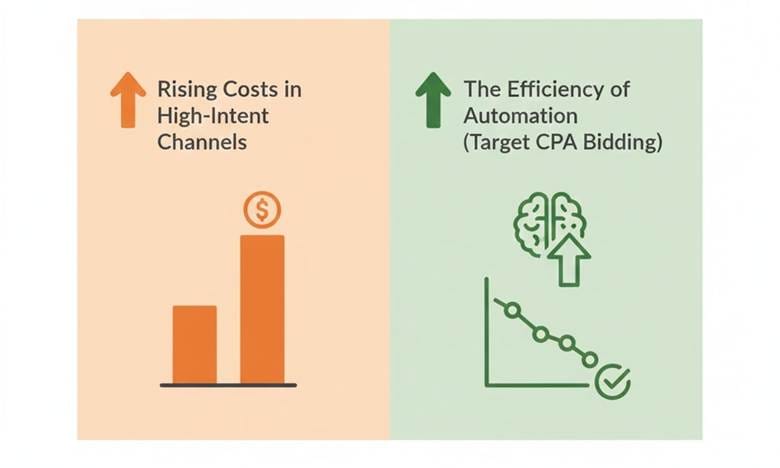
- Rising Costs in High-Intent Channels: Despite B2B Paid Search (Google Ads) still being a vital and intention-rich channel, the cost per clicks (CPCs) and cost per acquisition (CPAs) are going upwards. Present-day 2026 benchmarks for B2B tech/services indicate that CPAs are almost always close to or over $1,000 for macro-conversions. Your overall Target CPA should be reasonable in relation to these channel situations.
- The Efficiency of Automation (Target CPA Bidding): To a large extent, machine learning is used by contemporary ad platforms in setting bids (e.g., Google Ads‘ Target CPA bidding) for achieving a given average CPA. Nonetheless, these platforms require that a certain budget be spent for the volume of data necessary for efficient optimization to be attained. If the budget is too low, the AI will not be able to find the expensive yet fruitful paths for conversions.
Creative and Funnel Diversification
The benchmark “70/20/10” (70% tried methods, 20% new strategies, 10% experimental) is more applicable than ever. One cannot just depend on paid search for B2B marketing. A well-balanced budget should have provisions for:
- Full-Funnel Content: Through SEO and content marketing, one can reduce CPL/CPA by even more than half (up to 60%) over a given period of time.
- Emerging Channels: The future of marketing lies in short-form videos (YouTube Shorts, Reels) and getting branded demand through good-quality display/video ads, which in turn lowers the cost of bottom-of-funnel conversion.
Actionable CPA Optimization Strategies
Relentless optimization is what will allow you to make your estimated budget last longer:
| Optimization Strategy (Focus) | Technical Implementation | Business Impact |
| Landing Page Experience | Improve Core Web Vitals (LCP, FID, CLS) and ensure 1:1 message match between ad copy and page header. | Boosts Quality Score and Conversion Rate (CVR), directly lowering the actual CPA. |
| Audience Refinement | Leverage first-party CRM data for highly specific retargeting and exclusion lists (e.g., exclude unqualified leads). | Reduces wasted spend on low-intent clicks, focusing budget on prospects most likely to convert. |
| Creative Testing | Implement continuous A/B testing on ad copy, CTAs, and visual elements. Run Brand Lift studies for awareness campaigns. | Research shows regular creative testing can yield 15-30% better CTRs, increasing conversion volume without raising the budget. |
Budget Flexibility and The Continuous Audit
The planned budget per month ($\$30,000$ in our example) should not be a simple limit of the expenses. It is the initial assumption for the month. As CPAs are affected by factors that change continuously (competitor activity, seasonality, algorithm changes), the budget has to be managed in a flexible manner.
Key Budget Management KPIs
- LTV:CAC Ratio: The main one of all. Keep an eye on it all the time. If the rate goes under 3:1, a very short notice action is required – either to increase LTV or decrease CPA.
- Conversion Rate (CVR): A slight CVR improvement (for instance, 7.1% to 7.33%) may result in an amazingly efficient budget, thus, more acquisitions with the same amount of money.
- Time-to-Conversion/Sale: B2B sales cycles are quite long (on average 192 days and 62 touchpoints). Employ multi-touch attribution models to allocate the credit to all the marketing efforts that were there through the whole journey and not just the final click.
Through strict compliance with a goal-based budgeting model, B2B executives transform an indistinct marketing allocation into a transparent, high-performing growth tool. The formula is straightforward; the real value lever is the discipline to track, optimize and align the CPA with actual business profitability.
Strategic Next Step
Is your current marketing budget driven by historical spend or by a technically sound, LTV-aligned Target CPA? Sotavento Medios is a specialist in providing the Technical SEO and Digital Strategy Audit that is needed to accurately map your funnel, set a profitable Target CPA, and design a budget based on business outcomes that are certain rather than a guess

Jeremy Lee is a seasoned digital marketing director and strategist with over two decades of experience in the industry. As the founder of Sotavento Medios, I manage a diverse portfolio of over 50 businesses, helping brands grow through advanced search strategies and digital innovation. My work focuses on bridging the gap between traditional search engine optimisation and the evolving world of AI-driven answer engines.