The acquisition of B2B leads in the competitive, data-sensitive Singapore market is not just about volume. It requires a careful assessment of quality, compliance, and strategic fit. For seasoned marketing managers and technical specialists, relying solely on a lead provider’s count is both financially and structurally naive. The real test of a lead provider is their ability to deliver prospects that speed up pipeline velocity and improve Customer Lifetime Value (CLV).
As a technical SEO and marketing strategist at Sotavento Medios, I support a framework that goes beyond basic metrics like Cost Per Lead (CPL) to focus on deep, measurable attributes that indicate real intent, fit, and velocity. This article outlines the data-driven framework needed to audit and evaluate lead quality from any provider based in Singapore.
The ICP-First Audit: Defining True Lead Fit
A common mistake in lead generation is not clearly defining an Ideal Customer Profile (ICP). In the B2B world, a high-quality lead aligns closely with your ICP. Your audit of a lead provider should start by reviewing their targeting process against this profile.
1. The BANT+ Qualification Framework
While BANT (Budget, Authority, Need, Timeline) is a well-known system, the modern B2B market needs an upgrade, especially in a complex environment like Singapore. We suggest using the BANT+ Framework as the minimum qualifying data for any Sales Qualified Lead (SQL) delivered:
| Component | Definition (Required Data Point) | Strategic Value |
| Budget | Explicitly confirmed funding or expenditure history. | Assesses immediate fiscal viability. |
| Authority | Named decision-maker or key stakeholder (e.g., C-level, VP, Head of Department). | Determines access to the final sign-off. |
| Need | Identified, specific, and quantified pain point directly solvable by your product. | Confirms product-market fit and urgency. |
| Timeline | Defined project start date or implementation window (e.g., Q1 2026). | Predicts sales velocity and resource allocation. |
| + Firmographic Fit | Industry vertical (e.g., FinTech, Logistics, SaaS), company size (FTEs/Revenue), and Singapore-based operational status. | Ensures structural compatibility and CLV potential. |
Actionable Insight: Ask for a sample of ten leads with the corresponding BANT+ data points before entering a long-term contract.
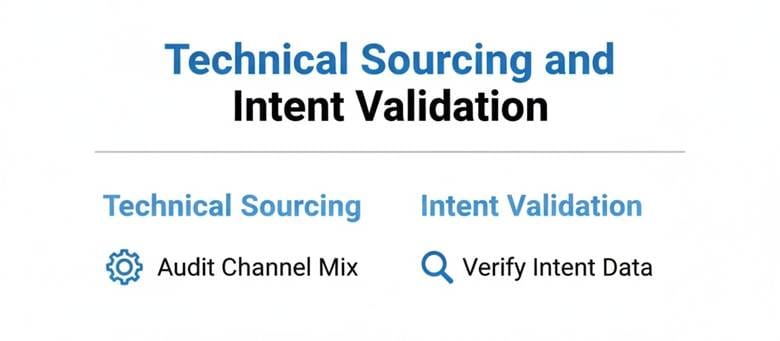
2. Technical Sourcing and Intent Validation
Lead quality is closely linked to the source. A high-value lead comes from clear intent signals, not just large list purchases.
Audit Channel Mix: Request a transparent breakdown of the lead sourcing channels. Channels like LinkedIn Sales Navigator targeting, intent-driven PPC campaigns (transactional keywords), and gated premium content downloads (e.g., Singapore Budget Analysis Whitepapers) show higher lead quality intent compared to broad cold email campaigns.
Verify Intent Data: The provider must demonstrate how they capture intent. For instance, did the lead visit a pricing page, attend a product webinar, or download a competitor comparison report? These digital footprints provide far more confidence than a generic contact form submission.
Pipeline Velocity and Post-Handoff Metrics
The true economic value of a lead is measured by the sales cycle. This requires close cooperation between sales and marketing and a shift in key performance indicators.
1. Measuring True Conversion Efficacy
The main evaluation metric is not the number of leads generated (Lead Volume) but how efficiently they move through your funnel.
$$\text{Lead Quality Score} = \frac{\text{MQL to SQL Conversion Rate}}{\text{Average Days in MQL Status}} \times \text{Average Deal Size}$$
MQL to SQL Conversion Rate: This is the most revealing metric. A high volume of leads with a low MQL to SQL conversion rate signals a quality issue, as your sales team wastes time vetting unqualified prospects. A reputable provider should aim for a conversion rate well above the industry average for your field.
Sales Cycle Length (Per Source): Examine how long it takes for leads from the provider’s specific channel to transition from SQL to Closed-Won. If a provider’s leads frequently stall or have a notably longer sales cycle than your in-house leads, the quality is questionable, regardless of the initial lead count.
2. Long-Term Revenue Metrics
The most advanced B2B evaluations connect the lead source to revenue performance over time.
Customer Acquisition Cost (CAC) by Source: Compute the total cost (provider fee plus internal sales/nurturing expense) to convert a lead into a paying customer. A costly but high-quality lead can result in a lower, more profitable CAC than a cheap, low-quality lead that requires extensive sales time.
Customer Lifetime Value (CLV) by Source: High-quality leads are more likely to become long-term, high-value clients. Track the CLV of customers generated by the provider. If the CLV is lower than your average, the leads might not fit well, potentially leading to one-time transactions that don’t support business growth.
Navigating Singapore’s Regulatory Compliance (PDPA)
A crucial, non-negotiable aspect of lead quality in Singapore is compliance with the Personal Data Protection Act (PDPA). A lead obtained improperly is a legal risk, not an asset.
Data Sourcing and Consent Audit
You must require verifiable proof that the provider follows PDPA guidelines, particularly regarding Consent and Notification Obligations.
Verifiable Consent: The lead data must include documented evidence of explicit or ‘deemed’ consent for contact (e.g., B2B marketing). The provider must show that the data subject was notified about the purpose of data collection.
DNC Registry Check: The provider must demonstrate that they routinely check contact lists against Singapore’s Do Not Call (DNC) Registry for telemarketing and SMS campaigns, and be able to show this through an audit trail. Non-compliance exposes your firm to significant fines from the Personal Data Protection Commission (PDPC).
Accuracy Obligation: Given the quick turnover in B2B personnel, high-quality data must be current data. The provider should explain their data cleansing and verification practices (e.g., quarterly LinkedIn verification) to ensure contact details and job roles are accurate and complete.
Sotavento Medios: Final Technical Assessment
In any B2B engagement in Singapore, the relationship with a lead provider should be treated as a strategic partnership requiring complete data integration. Don’t outsource the quality assessment; integrate the provider’s data stream into your own CRM and analytics dashboard.
A high-value lead provider in the Singapore market is marked by:
1. Transparency: Willing to share BANT+ data points and sourcing methods.
2. Compliance: Clear, verifiable adherence to PDPA and DNC rules.
3. Performance: Metrics focused on downstream revenue (SQL Conversion Rate, CAC, and CLV), not just upstream volume (CPL).

Jeremy Lee is a seasoned digital marketing director and strategist with over two decades of experience in the industry. As the founder of Sotavento Medios, I manage a diverse portfolio of over 50 businesses, helping brands grow through advanced search strategies and digital innovation. My work focuses on bridging the gap between traditional search engine optimisation and the evolving world of AI-driven answer engines.