For B2B teams in Singapore and the Philippines, the pressure to connect organic search with revenue is increasing fast. Decision-makers want channel efficiency, technical teams want cleaner attribution, and sales leaders want leads that arrive with stronger intent. HubSpot’s AI tools are useful here because they sit inside a system that already connects content, CRM data, lifecycle stages, and lead management. When SEO and sales funnels operate in separate workflows, content can attract traffic without advancing opportunities. When HubSpot AI is used correctly, it helps marketing teams identify search demand, map intent to funnel stages, and build a content engine that supports both acquisition and pipeline progression.
The practical advantage is not just speed. HubSpot’s AI features can reduce manual work in topic research, content optimization, lead scoring, segmentation, and sales handoff analysis. That matters in regional markets where buying cycles are often multi-stakeholder and where teams must balance English-language search behavior with localized commercial intent. The goal is not to let AI write everything. The goal is to make AI assist a disciplined workflow that aligns keyword strategy, page architecture, conversion paths, and CRM visibility.
Use HubSpot AI to build a search strategy that reflects funnel intent
SEO and sales alignment starts with keyword intent, not just keyword volume. HubSpot’s AI-assisted content tools help teams translate broad topics into specific business questions, pain points, and commercial comparisons. In a B2B environment, that means separating informational queries from evaluation queries and decision-stage queries. For example, someone searching for “what is revenue attribution” is not ready for a pricing conversation, while someone searching for “best CRM for B2B lead scoring” is already signaling commercial evaluation.
HubSpot’s content strategy tools can support this classification by helping marketers cluster topics around buyer questions and industry terms. This is especially useful in Singapore and the Philippines, where buyers often research across global SaaS terms while still expecting locally relevant service delivery, compliance awareness, and regional case context. Instead of building content around single keywords, structure pillar pages and supporting articles around mapped intent stages. Use AI to expand semantic variations, identify related questions, and detect gaps in the existing content library.
Turn search intent into funnel architecture
Once intent is mapped, the next step is funnel design. Top-of-funnel content should answer educational queries and build topical authority. Middle-of-funnel content should compare approaches, explain implementation, and qualify use cases. Bottom-of-funnel content should address pricing, integration, migration, and operational fit. HubSpot AI can help brainstorm these content angles, but the strategy should be grounded in your CRM and sales feedback, not generic AI suggestions.
In practice, build content clusters that reflect the actual sales conversation. If sales teams frequently hear questions about implementation time, reporting quality, or integration with ERP and accounting systems, those themes should become SEO priorities. This reduces the disconnect between ranking content and revenue content. It also increases the chance that organic visitors move from a blog article to a service page, then to a demo request or consultation form.
Use AI-assisted content creation without losing technical accuracy
HubSpot’s AI tools can accelerate drafting, outlining, and repurposing, but advanced B2B content still needs expert editing. For SEO, the quality bar is higher than readable copy. Each page must satisfy search intent, include correct terminology, and support internal linking to conversion-oriented assets. If AI is used only to increase publishing volume, the content library can become shallow and unaligned with sales priorities.
A better approach is to use HubSpot AI for structured drafting and editorial efficiency. Start with a brief that includes target persona, funnel stage, search intent, product positioning, internal links, and conversion goal. Then use AI to generate a first draft or content outline. After that, a subject matter expert should refine the copy for accuracy, compliance, and regional relevance. This is especially important for technical services firms, software vendors, and agencies selling complex solutions such as CRM implementation, automation, analytics, or managed digital marketing.
Strengthen trust signals with expert-led editing
Trust is a ranking and conversion factor. Search users and buyers are both sensitive to content that feels generic, inflated, or overly automated. Use AI-generated drafts as scaffolding, not as the final output. Add concrete implementation details, process explanations, and terminology that reflect actual service delivery. For example, if a page discusses sales funnel optimization, it should mention lifecycle stage definitions, lead routing rules, segmentation logic, and reporting thresholds rather than only broad claims about growth.
HubSpot’s AI can also help with content repurposing across channels. A detailed SEO article can be turned into a sales enablement summary, an email nurture sequence, or a LinkedIn post series. That reuse is valuable, but the core message must stay consistent across assets. If your SEO article emphasizes educational intent while your sales email pushes hard for a demo too early, the funnel breaks. The message progression should match the buyer stage and the data the CRM shows.
Connect AI-driven SEO with CRM data and lead scoring
The biggest advantage of using HubSpot is that SEO performance can be connected to downstream revenue data. Most teams track organic sessions, rankings, and form fills. Stronger teams connect those metrics to lifecycle stage movement, deal creation, and closed-won revenue. HubSpot’s AI and automation tools can support this by helping identify patterns in lead behavior, segment audiences more precisely, and improve scoring models based on actual engagement signals.
For example, if organic visitors from comparison-related pages consistently convert into sales-qualified leads at a higher rate than visitors from general educational posts, that is an actionable signal. It suggests that middle-of-funnel content deserves more internal linking, stronger CTAs, and perhaps dedicated nurture workflows. Similarly, if leads from one keyword cluster engage with pricing pages but do not progress, the issue may be a mismatch between content promise and offer design rather than keyword performance itself.
Use lead scoring to align marketing qualification with sales readiness
HubSpot lead scoring can be structured around both demographic fit and behavioral intent. Behavioral signals can include returning visits, high-value page views, content downloads, webinar attendance, and repeated engagement with solution pages. Demographic signals can include company size, job title, industry, and geography. AI can assist by highlighting patterns in historical conversions, but scoring rules should still be reviewed by marketing and sales together.
In B2B markets such as Singapore and the Philippines, sales cycles often involve multiple stakeholders and longer decision timelines. That makes lifecycle stage accuracy important. A lead who downloads a general guide is not the same as a lead who visits service pages, reads implementation content, and requests a consultation. HubSpot workflows can route these leads differently, ensuring that sales only receives contacts that match readiness thresholds. This improves handoff quality and protects sales productivity.
Optimize landing pages, forms, and nurture paths using AI insights
SEO alignment does not stop at the blog post. Every organic landing page should support the next step in the funnel. HubSpot AI can help analyze which calls to action, content offers, and page layouts are most likely to convert based on audience segment and engagement history. That means landing pages should not be built as isolated assets. They should function as part of a connected conversion system that includes forms, chat, email, and sales alerts.
Form friction is a common problem in B2B websites. Long forms can suppress conversions, but short forms can reduce qualification quality. HubSpot lets teams use progressive profiling and smart fields to balance both concerns. AI can help identify which fields are most predictive of sales acceptance and which fields create unnecessary drop-off. The same applies to nurture sequences. If someone downloads a technical guide about SEO and automation, the follow-up should not be a generic brand email. It should advance the conversation with related use cases, integration points, or implementation considerations.
Build nurture logic from organic intent signals
Intent-based nurturing is more effective than static drip campaigns. Use HubSpot to segment contacts by the content they consumed, then trigger workflows that match their stage. A visitor who reads introductory content may need educational follow-up, while a visitor who engages with pricing or comparison content may need proof points, case studies, or a sales consult invitation. AI can help draft these sequences and suggest subject line variations, but the sequencing strategy should come from funnel logic and sales insight.
For teams working across Singapore and the Philippines, localization also matters. Regional audiences may respond differently to proof points, terminology, and service assurances. Some segments may prefer technical explanations and integration details. Others may respond better to process clarity and delivery reliability. HubSpot segmentation can support this by organizing contacts according to source, role, and engagement path, allowing more relevant automation and better alignment between acquisition and conversion.
Measure organic-to-revenue performance with a shared SEO and sales dashboard
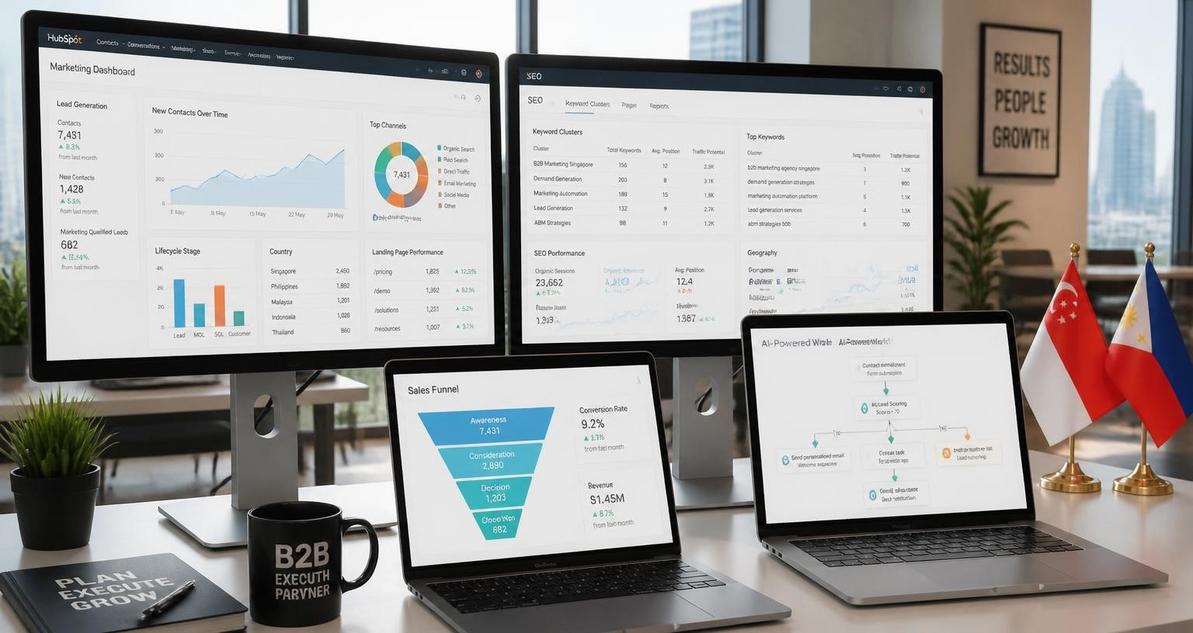
Without a shared measurement model, SEO and sales will continue to operate as separate functions. HubSpot reporting can help teams track the full path from organic visit to deal outcome. At minimum, the dashboard should include organic sessions, keyword cluster performance, landing page conversion rate, contact-to-MQL rate, MQL-to-SQL rate, SQL-to-opportunity rate, and revenue influenced by organic traffic. AI is helpful here because it can surface unusual trends, forecast performance changes, and identify content that drives engagement but not progression.
However, reporting only works when the data model is disciplined. Define what counts as an MQL, when a lead becomes sales-ready, and which pages are considered high-intent. Keep these definitions stable so trend lines remain meaningful. If the same page drives traffic, leads, and opportunities, study the journey mechanics. If a page gets traffic but no pipeline impact, assess whether the offer, CTA, or internal linking structure is misaligned. These are operational questions, not just SEO questions.
Use attribution to inform content investment
Attribution should influence budget allocation and editorial planning. Pages and clusters that assist multiple deals may deserve more expansion and internal linking. Pages that attract traffic but fail to convert may need intent refinement, stronger CTAs, or a different offer. HubSpot’s reporting tools help marketing and sales teams discuss performance with a common language. That shared language is critical when leadership wants to know not only which channels drive traffic, but which assets help create revenue.
For consulting firms, SaaS providers, and B2B service businesses, this reporting layer often exposes the real difference between content that ranks and content that sells. Ranking is only one signal. Revenue contribution depends on message match, form strategy, lead scoring, and sales follow-up. HubSpot’s AI features work best when they support those connected systems rather than trying to replace them.
Technical implementation checklist for aligning SEO and sales funnels in HubSpot
Use this as an operational sequence when building or refining your HubSpot workflow:
- Audit existing blog content, landing pages, and service pages for intent mismatch, weak CTAs, and missing internal links.
- Map keywords and topics to funnel stages using search intent, sales objections, and CRM lifecycle stages.
- Create content briefs that define persona, stage, conversion goal, offer, and target internal links before using AI to draft.
- Review every AI-generated draft for accuracy, terminology, and regional relevance before publishing.
- Set up lead scoring with both fit and behavior criteria, then validate the rules with sales leadership.
- Build segmented nurture workflows based on the content consumed and the actions taken on site.
- Use progressive forms, smart fields, and high-intent CTAs to reduce friction while preserving qualification quality.
- Connect SEO reporting to pipeline reporting so organic traffic can be evaluated through revenue impact, not only visits and rankings.
- Revisit underperforming pages monthly to identify whether the issue is content quality, search intent, offer design, or sales handoff timing.
- Document the SEO and sales definitions for MQL, SQL, and opportunity so all teams work from the same operating model.
When these steps are implemented consistently, HubSpot becomes more than a publishing platform or CRM. It becomes the operational layer that connects search demand, buyer education, lead qualification, and pipeline creation in one system.

I am Tricia Huang Mei, an Advertising Partner in Sotavento Medios with over two decades of experience in the Singapore advertising and business sectors. My career is defined by a commitment to driving high-impact marketing campaigns and fostering sustainable growth for the diverse business portfolios I manage.