The era of traditional SEO, which focused mainly on ranking positions, is ending. We are now in the age of Answer Engine Optimization (AEO), where visibility comes from direct presence in Featured Snippets, People Also Ask (PAA) boxes, and AI-generated search results like Google’s AI Overviews. For corporate websites in Singapore’s competitive current era, AEO is essential. It is the key strategy for achieving high-intent, zero-click visibility and maintaining brand authority.
The Singapore market has high mobile use, with over 90% penetration. Users actively search for specific, localized, and transactional information like “SG60 vouchers,” “mortgage quote,” and “best HR software Singapore.” This requires content that is not just relevant but also easily readable by machine-learning models.
This checklist outlines the crucial technical and content architecture steps needed to make your corporate website a citation-ready Answer Engine authority.
1. Foundational AEO Infrastructure & Crawlability
To be a primary answer source, your site must be readable by search engine crawlers and AI models. This is the essential technical requirement.
1.1. Core Web Vitals (CWV) and Performance
In a fast-paced market with high-speed networks (4G/5G) and low tolerance for delays, CWV is a key ranking and AEO signal.
- LCP (Largest Contentful Paint): Target 2.5 seconds or less. Focus on loading above-the-fold content.
- FID (First Input Delay): Target 100 milliseconds or less. Work on reducing JavaScript execution time.
- CLS (Cumulative Layout Shift): Target 0.1 or less. Ensure no unexpected content shifts during page load.
- Actionable Step: Use a Content Delivery Network (CDN) with regional hubs to cut down latency for Singapore users. Optimize image file sizes and implement browser caching.
1.2. Schema Markup Implementation
Structured data is essential for AEO; it clearly indicates your content’s nature to machines.
- FAQPage Schema: Apply this to all service, product, and content pages that have a dedicated Q&A section. This allows rich results (snippets) for question-based queries.
- HowTo Schema: Use it for procedural content like guides (e.g., “How to register a business in Singapore”). This increases eligibility for rich results and step-by-step summaries.
- LocalBusiness Schema (For Physical Offices): Apply this consistently and include accurate, current NAP (Name, Address, Phone) information. This helps AI models with verifiable location data for local searches.
- Organization Schema: Implement this site-wide to confirm your legal entity and its authoritative social and external profiles.
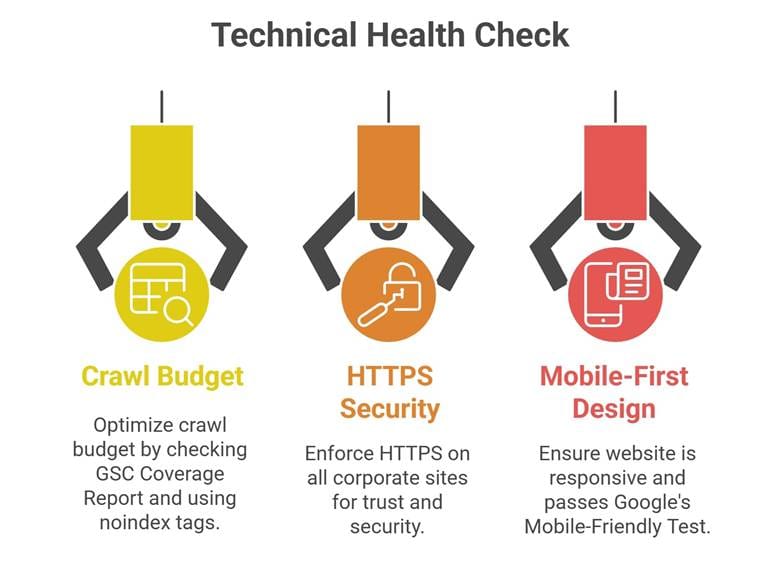
1.3. Technical Health Check
A solid foundation ensures you don’t waste resources on inaccessible pages.
- Crawl Budget Optimization: Regularly check your Google Search Console (GSC) Coverage Report. Make sure only valuable, indexable pages are being crawled. Wisely use noindex tags on thin or non-essential pages (e.g., internal search results, filter pages).
- HTTPS Security: All corporate sites must enforce HTTPS. Google counts this as a trust and security signal.
- Mobile-First Design: Since Singapore is mobile-first, ensure your website is fully responsive and passes Google’s Mobile-Friendly Test. Interfaces should be thumb-friendly, and content must be easy to read on smaller screens.
2. Content Architecture for AI Citation
AEO success depends on creating content that an AI can easily read, extract, and cite as the definitive answer. This requires an “answer-first” structure.
2.1. Conversational Keyword Strategy
Go beyond short-tail keywords to target full, conversational questions your B2B audience is asking.
- Identify PAA Opportunities: Check GSC, AnswerThePublic, and competitor sites for exact People Also Ask questions related to your core services (e.g., “What are the latest changes to Singapore’s GST for businesses?”).
- Question-Based Headings: Use H2 and H3 headings to state the question directly (e.g., ### What is the criteria for corporate tax relief in Singapore?). This aligns the content structure with user intent.
- Answer-First Formatting: Start the section right after a question-based H2 or H3 with a clear, direct answer (ideally 40-50 words). This length works best for a featured snippet or AI overview citation.
2.2. Topical Authority and E-E-A-T Signals
AI and Answer Engines prioritize content from clear authorities (E-E-A-T: Experience, Expertise, Authoritativeness, and Trustworthiness).
- Demonstrate Expertise (E): Organize content into comprehensive Topic Clusters that cover subjects in depth. For instance, a main “Singapore Tax Compliance” hub page linking to sub-pages on “Corporate Tax Filing,” “GST Implementation,” and “Audit Procedures.”
- Establish Trust (T): Include verifiable author bios on all articles, detailing the writer’s corporate role, certifications, and experience. Link to reputable external Singaporean sources (MAS, ACRA, etc.) to support claims.
- Case Studies as Answers: Format local case studies to directly answer high-intent commercial investigation questions (e.g., “How did [Client Name] reduce operational costs in Singapore by 15% using [Your Solution]?”).
2.3. Scannability and Clarity
The goal is to create zero friction for machine processing and human reading.
- Lists and Tables: Use bulleted or numbered lists and comparison tables to break down complex processes. These formats are preferred for snippets and direct AI summaries.
- Concise Paragraphs: Keep paragraphs short—ideally three to four lines—to enhance readability and speed up information extraction.
3. Local and Regional Signal Integration
For corporate websites in areas like Singapore, AEO must include strong local context to stand out against regional competitors.
3.1. Consistent NAP and Local Citations
Ensure your company’s Name, Address, and Phone number are 100% consistent across your website, Google Business Profile (GBP), and key Singapore business directories.
- GBP Optimization: Claim and fully optimize your Google Business Profile. Use the service sections and consistently post updates to keep categories accurate (e.g., “B2B Marketing Agency” instead of just “Marketing”).
- hreflang Tagging: If your corporate site supports multiple languages or countries (e.g., English for Singapore and a separate page for Malaysia), correctly implement hreflang tags to specify language and regional targeting, avoiding indexing confusion.
3.2. Monitoring and Iteration
AEO is an ongoing process, not a static setup.
- Track Zero-Click Visibility: Don’t just monitor clicks. Use GSC to see which queries are getting impressions but no clicks. This often shows that the user found their answer in a Featured Snippet or AI Overview. Use this data to refine your direct, concise answers.
- Competitor Snippet Analysis: Regularly check which competitors are winning the snippets you’re targeting. Analyze their content structure, length, and schema use to improve your own.
The Sotavento Medios AEO Advantage
Implementing AEO is a strategic defense against the decline of click-through rates caused by AI-driven search. By thoroughly applying this checklist, ensuring technical health, structuring content around human questions, and using precise schema, your corporate website will be ready to capture valuable organic visibility in sought-after AI-driven search features. This secures your position not just as a website but as a trusted, cited authority in the Singapore B2B space.

Jeremy Lee is a seasoned digital marketing director and strategist with over two decades of experience in the industry. As the founder of Sotavento Medios, I manage a diverse portfolio of over 50 businesses, helping brands grow through advanced search strategies and digital innovation. My work focuses on bridging the gap between traditional search engine optimisation and the evolving world of AI-driven answer engines.