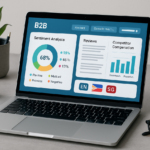
In Singapore and the Philippines, review data now sits at the center of competitive intelligence. Buyers compare SaaS platforms, logistics providers, agencies, healthcare services, fintech apps, and B2B vendors across Google Reviews, Facebook pages, G2, Capterra, and industry directories before they request a demo or sign a contract. A sentiment analysis tool built around competitor reviews gives marketing, product, and strategy teams a structured way to convert unstructured feedback into signals about positioning, service quality, churn risk, feature demand, and market perception. For B2B teams operating in multilingual markets, this matters even more because English, Taglish, Singlish, and code-switched feedback often appear in the same review set, and a manual scan misses tone patterns that are visible only at scale.
This tutorial explains how to design, build, and operationalize a sentiment analysis tool that monitors competitor reviews with enough rigor for business use. The focus is on a production-minded workflow: collecting review text legally and ethically, cleaning multilingual data, selecting the right model architecture, applying aspect-level sentiment analysis, and turning the output into actionable intelligence for leadership and client-facing teams. The goal is not to create a novelty dashboard. The goal is to build a repeatable system that helps you identify why a competitor is losing trust, where customer pain points concentrate, and how your own messaging can exploit those gaps without relying on guesswork.
Define the business question before writing the first line of code
Most sentiment projects fail because the team starts with model selection rather than the business problem. For competitor review intelligence, the question should be narrow enough to measure and broad enough to guide decisions. A strong starting point is: what recurring complaints, praise points, and feature requests appear in competitor reviews, and how do those themes differ by market, platform, and language?
That question becomes more actionable when you map it to business outcomes. If you work in a Singapore-based B2B software company, competitor reviews may reveal implementation delays, weak local support, or poor integration with regional systems. If you serve Philippine SMBs or enterprise accounts, reviews may surface responsiveness, billing clarity, and mobile usability as recurring themes. In both markets, this data can inform your messaging hierarchy, FAQ content, onboarding improvements, and sales objection handling.
Choose the sentiment dimensions you actually need
Sentiment is not a single score in a useful business system. You need a schema that distinguishes overall polarity from aspect-level sentiment. Overall polarity answers whether the review is positive, negative, or neutral. Aspect-level sentiment answers what part of the experience drove that tone, such as pricing, support, product stability, delivery speed, user experience, or documentation quality. If your team sells B2B services, aspect-level sentiment usually matters more than the global label because buyers do not complain in generic terms. They complain about one process, one contact point, or one failed expectation.
A practical schema for competitor reviews includes:
- Overall sentiment: positive, neutral, negative, mixed
- Aspect categories: support, pricing, usability, reliability, onboarding, integrations, compliance, speed, communication
- Language metadata: English, Filipino, Tagalog-English mix, Singapore English variants, or other relevant local languages
- Source metadata: platform, product page, review date, reviewer type if available
- Business relevance score: how closely the review maps to your service category and target segment
Collect review data responsibly and structure it for analysis
The data layer determines the quality of everything downstream. If you scrape or ingest poor-quality review text without metadata, your model may produce technically valid labels that have little business meaning. Start by identifying the platforms most relevant to your competitive set. For B2B companies, that may include Google Business Profiles, Facebook pages, review marketplaces, app stores, and directory platforms such as G2 or Capterra where applicable. Always review platform terms of service and collection constraints before automating ingestion. For public review content, keep the scope to publicly accessible data and preserve source attribution in your internal records.
Build a structured dataset with one row per review and one column per feature. At minimum, store the raw review text, date, source, competitor name, language guess, and rating. If the platform includes review title, business category, or response text from the competitor, capture those too. Response text is particularly useful because it shows whether the competitor acknowledges a problem, repeats a generic template, or offers a persuasive recovery attempt. That can become a useful operational signal for sales and account teams.
Normalization, deduplication, and language handling
Before sentiment analysis, clean the text. Remove obvious duplicates, normalize whitespace, and standardize punctuation. In Singapore and the Philippines, code-switching is common, so language detection should be tolerant rather than rigid. A single review may combine English with Taglish expressions or local colloquialisms. Standard language detection tools can misclassify short text or mixed-language text, so you may need a fallback rule that routes low-confidence detections into a mixed-language bucket.
For text preprocessing, keep negations intact. Do not strip words such as not, never, no, or cannot, because they carry strong sentiment. Avoid aggressive stemming that destroys domain meaning. The phrase does not integrate well is more informative than its stemmed fragments. If you later move into transformer-based models, apply light preprocessing only. Modern contextual models often perform better with cleaner raw text than with over-processed input.
Choose the right sentiment modeling approach for B2B review intelligence
There are three viable approaches, and the best choice depends on scale, language diversity, and how much precision the business requires. Rule-based lexicon methods are easy to deploy but weak with sarcasm, mixed language, and domain-specific phrasing. Classical machine learning using TF-IDF with logistic regression or linear SVM can work well on smaller datasets if you have labeled examples. Transformer-based models usually provide the strongest performance for nuanced review text, especially when reviews contain context-dependent sentiment and domain vocabulary.
For a production-grade tool, a practical architecture often combines more than one approach. Use a lightweight classifier for the first pass, then use a transformer or fine-tuned language model on ambiguous cases. For multilingual environments, consider language-specific models or multilingual transformers such as XLM-RoBERTa or mBERT, then validate performance on your own review corpus. If your data is heavily localized, a fine-tuning stage on in-domain examples usually improves precision more than a generic model trained on broad internet text.
Aspect-based sentiment matters more than simple polarity
Overall sentiment can hide important contradictions. A review may praise the onboarding team while criticizing reporting features and support response times. If you collapse that into one positive label, you lose strategic value. Aspect-based sentiment analysis solves this by linking opinion to subject. In practice, you can implement this using one of three methods: keyword-triggered aspect extraction, sequence labeling with a transformer, or a two-stage pipeline where a topic classifier identifies the aspect and a sentiment classifier scores the attitude toward that aspect.
This is especially useful in competitor analysis because buyers often reveal market gaps indirectly. A recurring complaint about slow implementation might signal an underserved segment that values speed over feature depth. A recurring compliment about reliable billing might show that the competitor has built trust in finance-heavy buyers. If your own offer solves the pain points mentioned in reviews, your positioning can speak directly to the language prospects already use.
Build the pipeline: ingestion, classification, and insight generation
Once the data and modeling strategy are clear, implement the workflow as a modular pipeline. A clean architecture usually includes four layers: ingestion, preprocessing, inference, and reporting. This makes it easier to swap models, add sources, or refine the taxonomy without rewriting the whole system.
For ingestion, create scheduled jobs that pull new reviews at a fixed interval. Store the raw payload separately from the normalized dataset so you can reprocess historical data if your model improves. For preprocessing, apply deduplication, language detection, token hygiene, and entity extraction. For inference, run the sentiment and aspect classifiers and store both scores and confidence levels. For reporting, aggregate results by competitor, platform, month, and aspect category.
Recommended technical stack
A practical stack for many B2B teams includes Python, pandas, scikit-learn, spaCy, Hugging Face Transformers, FastAPI for serving predictions, and PostgreSQL or BigQuery for storage. If your team works in an enterprise environment, add orchestration through Airflow or Prefect. For visualization, use Power BI, Looker Studio, or Tableau, depending on your BI ecosystem. If latency matters, serve the model through an API and cache recent results. If volume is modest, batch scoring may be more efficient and easier to govern.
Labeling deserves special attention. If you manually annotate training data, define clear rules for mixed sentiment, sarcasm, and neutral statements. Use double annotation for a sample of the corpus and measure inter-annotator agreement so you can detect ambiguity in your taxonomy. In practical terms, inconsistent labels create more noise than a slightly smaller dataset. Quality beats volume when you are building a business-facing classifier.
Feature engineering and model evaluation
Even when using transformer models, do not ignore auxiliary features. Star rating, review length, platform, reviewer type, and response presence can improve downstream analysis even if they are not part of the text classifier itself. For evaluation, do not rely only on accuracy. Track precision, recall, F1 score, and confusion matrices for each label. If negative reviews are relatively rare, accuracy can look strong while the model still misses the cases that matter most.
For aspect extraction, evaluate both exact match and partial match if the labeling scheme allows it. A model that detects support issues but occasionally confuses billing with pricing may still be useful if your dashboard groups those under a broader commercial friction category. The key is to align model metrics with how the business will actually use the output. A perfect lab score means little if the sales team cannot interpret the labels quickly.
Turn sentiment signals into competitor intelligence the business can use
A sentiment analysis tool becomes valuable only when the output changes decisions. The most useful outputs are trend lines, heatmaps, and alerting logic. Trend lines show whether a competitor’s reputation is improving or worsening over time. Heatmaps reveal which aspects trigger the strongest negative sentiment across markets. Alerting logic notifies teams when a sudden spike in a complaint category appears, such as repeated mentions of downtime, hidden fees, or poor support responsiveness.
For example, if reviews of a direct competitor in the Philippines show repeated complaints about delayed onboarding and lack of follow-up, your sales team can emphasize implementation speed and customer success coverage in proposals. If Singapore-based prospects see a competitor getting praised for reliability but criticized for expensive add-ons, your pricing narrative should separate value from base cost and make total cost of ownership easier to compare. The point is not to imitate sentiment reports. The point is to use them to sharpen your own market positioning.
You can also route insights to multiple internal teams. Product managers can use them to identify missing features or usability flaws. Marketing teams can use them to identify messaging gaps and keyword opportunities. Sales teams can use them to prepare objection responses that reflect actual market language. Customer success teams can benchmark support expectations against competitor pain points. This cross-functional reuse increases the ROI of the system and makes the data harder to ignore.
Governance, ethics, and operational trust
Competitor review analysis should remain within ethical and legal boundaries. Use public information, respect site terms, and avoid storing unnecessary personal data. Minimize reviewer identity retention unless there is a clear internal compliance reason to keep it. Document your source list, refresh cadence, labeling rules, and model version history so stakeholders know how the outputs are generated. If your team operates across Singapore and the Philippines, align the system with applicable privacy expectations and internal governance controls before putting it into broader use.
Trustworthiness also depends on explaining uncertainty. Do not present every prediction as a fact. Store confidence thresholds and create an “uncertain” category when the model cannot classify with enough reliability. For mixed-language reviews, surface the language mix instead of forcing a single-language label. That kind of transparency helps decision-makers trust the report and reduces the risk of overinterpreting a weak signal.
Implementation checklist for a production-ready competitor review sentiment tool
Use the following checklist to move from concept to deployment without losing analytical rigor:
- Define the exact business use case, such as competitor positioning, product gap analysis, or sales enablement.
- Identify the review sources that are legally and operationally accessible for your market and category.
- Create a structured schema for raw text, metadata, language, aspect labels, and sentiment labels.
- Apply light preprocessing, deduplication, and multilingual handling rules suited to local code-switching.
- Build a labeled training set with clear annotation guidelines and quality checks.
- Compare baseline methods with transformer-based models using precision, recall, F1, and confusion matrices.
- Implement aspect-based sentiment analysis rather than relying only on overall polarity.
- Store model confidence scores and route ambiguous cases into an uncertain bucket.
- Build dashboards that show trends by competitor, platform, aspect, and time period.
- Set up alerts for spikes in negative sentiment around issues that matter commercially.
- Document source handling, refresh intervals, and model versions for governance and auditability.
- Connect the output to sales, product, and marketing workflows so the intelligence drives action.

I am Tricia Huang Mei, an Advertising Partner in Sotavento Medios with over two decades of experience in the Singapore advertising and business sectors. My career is defined by a commitment to driving high-impact marketing campaigns and fostering sustainable growth for the diverse business portfolios I manage.