The choice to work with a digital marketing or SEO agency is a strategic decision, not just a simple purchase. For experienced marketing managers and B2B leaders, the details in the contract, especially regarding its length and termination rules, reflect the real risk of the investment. In a time marked by Generative AI disruption, frequent algorithm changes, and the rise of Social Media as a key search engine, flexibility is crucial. A strict, multi-year contract can quickly turn into a problem if your partner fails to adjust to these major changes.
This overview, from a Sotavento Medios perspective, examines the typical contract structures offered by agencies, points out current trends in flexibility, and highlights the key terms to negotiate for fair control and measurable long-term ROI.
The Standard Spectrum of Agency Contract Lengths
Agency agreements generally fall into three main categories, depending on the work scope and the marketing channel’s nature (for example, SEO usually requires more time than a single PPC campaign).
1. Project-Based & Campaign-Specific (1-3 Months)
This is the shortest and most tactical contract type. It is seldom used for complex SEO or content retainers but is common in specialized projects.
• Typical Duration: 1 to 3 months.
• Common Use Cases: Technical SEO audits, basic keyword research, a single paid media campaign (PPC/Social Ads), or bursts of high-volume content creation.
• Business Value: Low commitment, great for testing an agency’s skills, confirming a specific hypothesis, or delivering a well-defined, quick-win outcome.
• Cancellation/Termination: Usually, there are no cancellation options for the short-term, as the contract is expected to finish upon completing the defined scope (Statement of Work or SOW).
2. The Standard Retainer (6-12 Months)
The 6- to 12-month retainer is the most common model in B2B digital marketing, especially for strategic services like SEO, content marketing, and full social media management.
• Typical Duration: 6 months (minimum) to 12 months (standard).
• Why This Length? This timeframe fits the realistic schedule needed to see measurable, stable results from SEO and content marketing. Search engine algorithms require time to crawl, index, and assign authority, making a shorter commitment risky for both the client and the agency.
o Trend Insight: Most effective SEO strategies need 6-12 months for traffic to stabilize and 12 or more months to prove ongoing ROI.
• Cancellation/Termination: This is where the main negotiation occurs.
o Initial Lock-in: The six- or twelve-month period is often a strict lock-in, which means that early termination usually requires paying the remaining contract value or a significant early termination fee.
o Post-Term Renewal: A common arrangement is for the agreement to automatically switch to a Month-to-Month (M-t-M) basis after the initial period, needing a 30- to 60-day written notice to avoid renewal.
3. Long-Term Strategic Partnership (12+ Months)
Although less common, these multi-year contracts are meant for clients needing deep integration, dedicated in-house resources, or large-scale international expansions.
• Typical Duration: 12 to 24 months.
• Common Use Cases: Enterprise-level content operations, complex website migrations, global SEO strategy, and full-service outsourcing where the agency serves as the client’s main marketing team.
• Cancellation/Termination: These contracts have the strictest clauses, often needing a 60- to 90-day notice even after the initial term, or major penalties for early exit. The benefit is often better pricing and guaranteed resource allocation.
The Crucial Technicality: Cancellation and Termination Clauses
The contract’s Termination Clause is the most important section for a technical marketer who wants flexibility and lower business risk. Understanding the three main types of termination is key.
1. Termination for Convenience (The Client’s Best Friend)
This clause allows the client to end the contract for any reason, as long as they give the agency the required written notice (usually 30, 60, or 90 days).
• Actionable Insight: Always ask for a “Termination for Convenience” clause to be added after the initial minimum term (for example, after the first six months). This flexibility is essential in the fast-changing digital world.
• Financial Ramifications: Typically, the client has to pay for services received up to the termination date but is not required to pay the full remaining contract value.
2. Termination for Cause (The Agency’s Liability)
This allows either party to terminate the agreement if the other party breaks a key term of the contract (such as non-payment, failure to deliver agreed services, or breaching confidentiality).
• Actionable Insight: Make sure the contract clearly states the “Cure Period” (for example, 30 days) in which the breaching party must resolve the issue before termination is enforced.
• SEO Relevance: For SEO and content, “Cause” can be hard to show due to algorithm changes. A strong contract will focus on deliverables (for example, “The agency will provide $X number of blog posts and $Y technical audit fixes per month”) rather than guaranteed outcomes (such as “guaranteed #1 ranking”).
3. Early Termination Fees (The Financial Lock-In)
If you terminate the agreement before the initial term ends (such as terminating for convenience during the twelve-month lock-in), agencies protect their expected revenue through a penalty.
• Typical Penalty Structure:
o Payment of a flat fee (for example, one or two months of the retainer).
o Payment of the remaining fees for the full contract term.
o A percentage of the remaining contract value.
• Negotiation Point: Aim for the lowest early termination fee possible, or a clause that allows departure if mutually agreed-upon, measurable KPIs (such as a specific drop in traffic or rankings) are not met after a reasonable period (for example, nine months).
Current Trends: Flexibility and Ownership (2026 Outlook)
Modern B2B client-agency relationships are shifting towards structures that focus on shared risk and flexibility, recognizing the changing online environment.
| Contract Element | Traditional Model | Modern (2026) Trend | Business Advantage |
| Initial Term | Rigid 12-Month Lock-in | 6-Month Minimum, then Month-to-Month | Minimizes long-term financial risk and rewards performance. |
| Deliverable Ownership | Agency retains rights until final payment. | Client owns all creative assets (Content, Code, Data) immediately upon creation. | Ensures portability and prevents the agency from holding assets hostage upon exit. |
| KPIs/Performance | Vague traffic/ranking goals. | Specific, measurable, and tied to business outcomes (e.g., lead volume, MQLs). | Aligns agency work directly with revenue objectives. |
| Termination Notice | 60-90 days minimum. | 30-day notice after initial term. | Increases agility to pivot strategies or replace underperforming partners. |
Intellectual Property (IP) Ownership is Non-Negotiable
A vital detail in modern contracts is IP ownership. Ensure your agreement clearly states that the client keeps 100% ownership of all deliverables—including content, creative assets, technical code changes, and access to all accounts (Google Analytics, Search Console, etc.)—regardless of the contract’s status. This prevents the agency from deleting or blocking access to your systems after termination, which could harm SEO continuity.
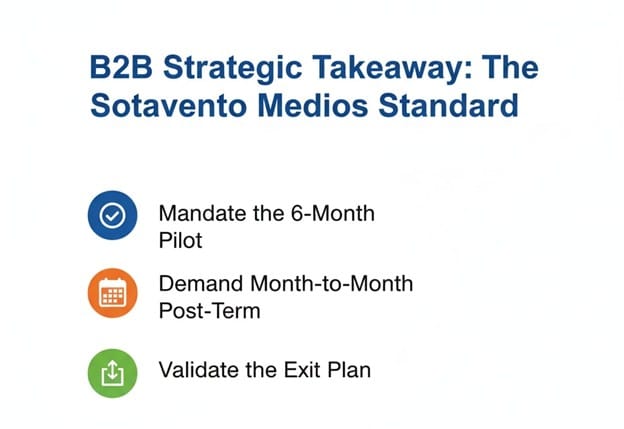
B2B Strategic Takeaway: The Sotavento Medios Standard
When looking for an agency partner, concentrate on creating a contract that encourages a partnership based on performance, not fear of penalties.
• Mandate the 6-Month Pilot: Insist on an initial term of no more than six months for new, complex projects (like SEO). This allows the agency enough time to prove its methods while keeping the client flexible.
• Demand Month-to-Month Post-Term: The contract should clearly specify an automatic shift to M-t-M with a 30-day written notice after the initial period ends.
• Validate the Exit Plan: Before signing, understand the cost and process for an early exit. If the terms are harsh (for example, requiring full remaining payment), it’s a significant warning sign that the focus is on retention rather than results.

Jeremy Lee is a seasoned digital marketing director and strategist with over two decades of experience in the industry. As the founder of Sotavento Medios, I manage a diverse portfolio of over 50 businesses, helping brands grow through advanced search strategies and digital innovation. My work focuses on bridging the gap between traditional search engine optimisation and the evolving world of AI-driven answer engines.