The Singapore B2B landscape is very competitive. It quickly adopts AI-driven search and emphasizes user experience (UX) metrics like Core Web Vitals (CWV). In this context, choosing an SEO agency is not just a buying decision; it is a strategic investment in technical skill and steady growth. As marketing managers and business owners, you should focus on thorough technical assessments of proven ROI rather than just surface-level testimonials.
The challenge is cutting through the “vanity metric” fog impressions, basic traffic volume, and non-competitive keyword rankings to find the real impact on your profits. This article provides a technical framework for evaluating agency case studies and calculating a relevant Return on Investment (ROI) specific to Singapore’s B2B environment.
The Technical Audit of an Agency Case Study
A valuable SEO case study acts as a post-mortem technical audit that shows the agency’s ability to identify problems and implement solutions that yield measurable business outcomes. Don’t accept vague claims; ask for the technical data.
1. Deconstructing the ‘Organic Traffic’ Claim
In B2B, traffic quantity means little without quality and intent.
| Technical Case Study Element | Why it Matters (Singapore Context) |
| Traffic Segmentation | Did the agency only grow overall traffic? Or did they specifically target and increase traffic from Singapore and other SEA markets (using IP filters or GA segments)? Did they grow non-branded organic traffic? This proves new market capture, not just brand searches. |
| Intent Mapping | The case study must detail the shift from informational to commercial/transactional search intent. Did they achieve top rankings for high-intent queries like “ERP system integration Singapore” (B2B) rather than just “what is ERP”? |
| Search Console Data | Demand to see Average Position and Organic Click-Through Rate (CTR) improvement for a targeted keyword cluster. In an era of Zero-Click Searches and AI Overviews, a boost in CTR for a rich snippet or PAA (People Also Ask) ranking is a stronger indicator of technical success than just a position jump. |
2. Validating Technical SEO Implementation
Singapore’s market needs perfect technical execution because of high mobile usage (96% of the population) and Google’s strong focus on UX. Case studies should explain the technical fixes that produced results.
- Core Web Vitals (CWV) Improvement: The agency must show the improvement in Largest Contentful Paint (LCP), First Input Delay (FID) (or INP), and Cumulative Layout Shift (CLS). A successful case study demonstrates a site moving from the ‘Needs Improvement’ to the ‘Good’ category, which directly affects mobile ranking potential.
- Structured Data Implementation: Did they use advanced schema (e.g., Product, Organization, FAQPage, HowTo) to gain Rich Snippets and support increasingly important AI-driven SERP features?
- Crawl Budget Optimization: For large B2B platforms, the case study should illustrate how they optimized robots.txt and internal linking to ensure Googlebot prioritizes high-value pages, showing advanced technical control.
Calculating Predictable and Actionable SEO ROI
The key measure of an agency’s success is not its traffic report, but the net revenue generated compared to the investment. Proving ROI for SEO, an inherently long-term channel—requires a careful, attribution-focused approach, especially in B2B where sales cycles are lengthy.
1. The Core SEO ROI Formula
While simple, the formula is the starting point. Importantly, the revenue figure must be directly linked to organic search.

2. The B2B Attribution Challenge: Beyond Last-Click
In B2B Singapore, where the sales cycle often includes multiple stakeholders and offline interactions, last-click attribution is inadequate and misleading.
- Implement a Data-Driven Attribution Model (GA4): Ensure the agency uses GA4’s data-driven attribution to give partial credit to the initial organic search touchpoint, even if the final conversion (e.g., demo request) came from direct or email. This demonstrates SEO’s value in the discovery and nurture stages.
- Map Organic Leads to CRM Data: The key element is connecting GA4/GSC with your CRM (e.g., Salesforce, HubSpot). A strong case study will show Pipeline Impact and Sales Cycle Velocity metrics linked to organic leads:
- Marketing Qualified Leads (MQLs) and Sales Qualified Leads (SQLs) generated through organic.
- Revenue Pipeline attributed to initial organic touchpoints.
- Average Lifetime Value (LTV) of an SEO-sourced customer compared to other channels.
3. Forecasting and Benchmarking in Singapore
Given that the median monthly SEO investment in Singapore ranges from $2,800 to over $10,000 for comprehensive campaigns, financial planning is essential.
- Payback Period: Instead of just the ROI percentage, ask the agency to model the payback period, the time it takes for the cumulative net revenue from organic search to equal the cumulative SEO investment. A competitive B2B campaign should target a break-even point within 9 to 18 months, with the compounding effect delivering significant ROI thereafter.
- Industry Benchmarks: Compare reported results against local competition. For B2B Singapore, best-in-class performance in Topic Cluster strategies often leads to a 15% to 60% increase in organic traffic and a 25% to 35% boost in lead quality within six months. Case studies should clearly exceed these averages.
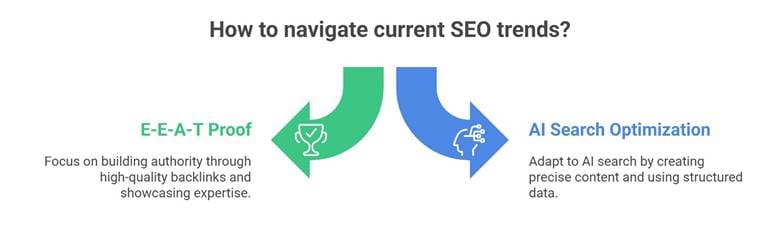
Navigating Current SEO Trends: The E-E-A-T and AI Imperative
The 2025 Singapore SEO landscape is shaped by the E-E-A-T (Experience, Expertise, Authoritativeness, and Trustworthiness) criteria and the rise of Generative AI in search.
- The E-E-A-T Proof: Case studies must show content strategies that built real authority. This includes securing high-quality backlinks from reputable Singaporean or global industry sites (Digital PR) instead of low-quality link schemes. Additionally, content must highlight the client’s expertise and experience—through technical documentation, original research, or case studies with author biographies that clearly outline the technical author’s credentials.
- Optimizing for AI Search: The agency’s approach must reflect adaptability to Answer Engine Optimization (AEO). This entails precise, entity-based content creation and using structured data to position the client’s content as an authoritative source for Google’s Search Generative Experience (SGE) summaries. An effective agency accounts for the risk of zero-click searches in its strategy, concentrating on brand visibility within the SERP ecosystem itself.
The Sotavento Medios Value Proposition
Choosing an SEO partner in Singapore requires a data-focused perspective on technical ability and verifiable business results. If an agency’s case studies can’t survive this thorough, technical audit showing their impact on CWV, high-intent traffic, and CRM-level pipeline metrics, they are focusing on visibility rather than revenue.
At Sotavento Medios, our technical SEO and marketing strategies rest on proprietary audit methods and predictive ROI modeling tailored for the complexities of the Singapore and Southeast Asian B2B markets. We don’t report on vanity metrics; we focus on the net revenue driven by a reliable technical foundation.
Ready to move from vague traffic reports to reliable revenue forecasts? Contact Sotavento Medios today for a complimentary technical SEO pipeline analysis.

Jeremy Lee is a seasoned digital marketing director and strategist with over two decades of experience in the industry. As the founder of Sotavento Medios, I manage a diverse portfolio of over 50 businesses, helping brands grow through advanced search strategies and digital innovation. My work focuses on bridging the gap between traditional search engine optimisation and the evolving world of AI-driven answer engines.