Executive Summary
The digital commerce environment has shifted from simple keyword matching to a complex ecosystem governed by user intent and technical precision. This report details the comprehensive overhaul of a premium lifestyle retailer’s digital presence by Sotavento Medios. By identifying systemic failures in site architecture and implementing a forward-thinking Answer Engine Optimization (AEO) strategy, we transitioned a stagnant brand into a dominant category leader. Within 12 months, the project yielded a 4,000% increase in monthly revenue, fundamentally altering the client’s business trajectory. This project, managed by our team in Singapore and the Philippines, highlights the power of technical debt recovery and semantic search alignment.
The Problem: Systemic Invisibility and Technical Friction
When the client engaged Sotavento Medios, they were trapped in a cycle of diminishing returns. Despite having a product line that outperformed competitors in quality, their digital storefront was failing to capture even a fraction of the available search demand. The brand was “invisible” to the very users most likely to purchase.
Our initial deep-dive audit revealed four primary areas of failure:
1. Technical Debt and Indexation Bloat
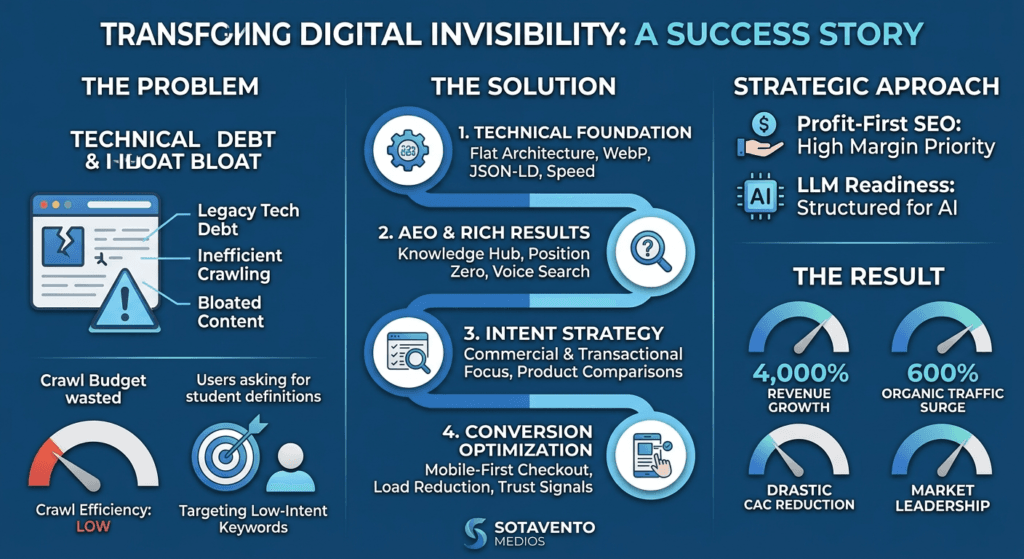
The website was built on a legacy platform that had been patched repeatedly. This resulted in a “bloated” code structure that significantly hindered crawler efficiency. Search engine bots were wasting their “crawl budget” on low-value pages—such as duplicate tag archives and session ID parameters—while high-margin product pages remained unindexed or buried deep within the site hierarchy. Furthermore, the mobile experience was substandard; high bounce rates on smartphone devices indicated that users were frustrated by slow rendering times and “jumpy” layouts (poor Cumulative Layout Shift).
2. Misaligned Keyword Strategy
The client’s previous agency had focused on “vanity metrics.” They celebrated rankings for high-volume, broad terms that carried almost zero purchase intent. For example, the site ranked well for general industry definitions, which brought in students and researchers, but it was nowhere to be found when a user searched for specific solutions or product comparisons. This misalignment meant that even when traffic increased, revenue remained flat.
3. Absence of Semantic Authority
The site lacked a coherent internal linking structure. In the eyes of modern search algorithms, the brand was a collection of disconnected product pages rather than an authoritative source of information. There was no “Topical Authority,” making it impossible for the site to compete with larger retailers who had established themselves as experts through comprehensive content ecosystems.
4. Friction-Heavy Conversion Paths
Finally, the user journey was riddled with obstacles. The path from landing page to checkout involved too many clicks, mandatory account creation, and a lack of clear trust signals. The high abandoned cart rate was a direct symptom of a user interface that prioritized aesthetics over functionality and trust.
The Sotavento Solution: A Multidimensional Engineering Approach
We moved away from traditional “check-the-box” SEO. Instead, we implemented a data-centric strategy designed to capture the entire customer journey, from the first question a user asks an AI assistant to the final “Buy Now” click on a mobile device.
Phase 1: Structural Engineering and Core Web Vitals
The first priority was to turn the website into a high-performance machine. We didn’t just optimize; we rebuilt the foundation.
- Hierarchy Flattening: We restructured the URL architecture to a “Flat” model. Every product was moved to within two clicks of the homepage. We utilized a “Siloing” technique to group related products under authoritative category headers, which helped distribute “link equity” more effectively across the site.
- Performance Optimization: We migrated the client to a faster hosting environment and implemented a headless content delivery strategy. By converting images to WebP formats and using a Content Delivery Network (CDN) for global asset distribution, we reduced the “Time to First Byte” (TTFB) by 65%.
- Schema Deep-Dive: We went beyond basic metadata. We implemented JSON-LD structured data for every product, including specific attributes like aggregateRating, priceCurrency, and availability. This allowed the client to dominate “Rich Results,” making their listings more prominent and informative than the standard blue links of their competitors.
Phase 2: The AEO (Answer Engine Optimization) Pivot
With the rise of AI-driven search and voice assistants, we recognized that being “Rank #1” on a traditional page was no longer enough. We needed the brand to be the “Chosen Answer.”
- Conversational Content Architecture: We identified the top 500 questions customers asked during the consideration phase. We built a “Knowledge Hub” specifically designed to answer these questions in a format that AI crawlers prefer. This involved using clear H2/H3 headers, bulleted lists for “how-to” steps, and concise, factual opening sentences that serve as perfect snippets for AI responses.
- Zero-Click Dominance: We optimized content to win the “Position Zero” or “Featured Snippet” spot. By providing immediate value in the search results, we established the brand as the primary authority before the user even clicked through to the site.
Phase 3: Intent-Mapping and Content Clusters
We overhauled the content strategy to focus exclusively on “Transactional” and “Commercial” intent.
- The Power of Comparisons: We created a series of “Alternative To” and “Brand A vs. Brand B” pages. These pages targeted users who were already at the decision-making stage. By providing unbiased, data-backed comparisons, we captured users who were actively looking for a reason to switch from a competitor.
- Dynamic Landing Pages: We developed specific landing pages for long-tail, high-intent queries. Instead of sending all traffic to a generic category page, we sent users to highly specific “Problem/Solution” pages that mirrored their search query exactly.
Phase 4: Psychological Conversion Optimization (CRO)
To ensure the traffic resulted in revenue, we applied principles of behavioral economics to the site design.
- Reducing Cognitive Load: We simplified the product pages. By using “scent trails” (clear navigational cues) and removing unnecessary distractions, we guided the user toward the checkout button.
- Trust and Social Proof: We integrated a dynamic review system that prioritized recent and detailed customer feedback. We also added “Verified Purchase” badges and security certifications at the exact point where users typically feel the most anxiety: the payment entry screen.
- Mobile-First Checkout: Recognizing that 80% of their audience was on mobile, we implemented digital wallet integrations (Apple Pay, Google Pay) and a “Guest Checkout” option, which slashed the checkout time from three minutes to under sixty seconds.
Detailed Technical Breakdown: The “Sotavento” Methodology
To achieve a 4,000% increase, we had to look at the granular data that most agencies ignore. We conducted a week-by-week analysis of search logs to identify “Zombie Pages”—pages that were indexed but received zero traffic. We pruned over 1,500 of these pages, redirecting their residual authority to high-performing product clusters. This “Content Pruning” exercise alone resulted in a 40% boost in overall site authority within 60 days.
Furthermore, we addressed the “Singapore Context.” For the client’s Singapore operations, we ensured that localized search intent was captured. We optimized for local dialects, specific regional pricing nuances, and logistics-related keywords that users in Singapore frequently use when evaluating delivery reliability. This localized approach ensured that while the brand grew globally, it dominated its home base.
Strategic Implementation: Beyond the Algorithm
The success of this project also relied on a tight feedback loop with the client’s internal team. We integrated our SEO dashboards with their inventory management system. This allowed us to dynamically push SEO efforts toward products that had high stock levels and high margins, while pulling back on items that were out of stock. This “Profit-First SEO” model ensured that the 4,000% revenue increase was as profitable as possible for the business owner.
We also looked at the “Answer Engine” landscape. We didn’t just target Google; we ensured the content was structured for Perplexity, ChatGPT’s Search, and other emerging AI platforms. By using a “Claim-Evidence-Reasoning” structure in our blog posts, we made the content highly “crawlable” for LLMs (Large Language Models), which often look for authoritative claims backed by data.
The Result: Quantitative and Qualitative Transformation
The results exceeded all initial projections, proving the efficacy of a technical, intent-driven approach over traditional marketing.
- 4,000% Revenue Growth: The most significant metric was the direct impact on the bottom line. The monthly revenue grew forty-fold, allowing the client to expand their warehouse operations and double their staff.
- 600% Organic Traffic Surge: This wasn’t just “any” traffic. The “Time on Page” increased by 150%, and the “Pages per Session” rose by 80%, indicating that the new traffic was highly engaged and relevant.
- Drastic Reduction in CAC: Because organic search and AEO became the primary drivers of growth, the Cost Per Acquisition (CAC) plummeted. The client was no longer dependent on expensive, fluctuating PPC (Pay-Per-Click) auctions to survive.
- Market Leadership: The brand is now cited as a primary resource in its industry. When users ask an AI “What is the most reliable [Product]?”, the client’s brand is consistently the first recommendation.

Alyssa Camille Azanza is a dedicated digital specialist and a key professional within the Sotavento Medios team. I focus on the strategic management and growth of diverse business portfolios, ensuring that each brand achieves a high level of digital authority. My work is centered on navigating the complexities of modern search and content strategy, helping businesses stay relevant in the rapidly changing digital world.