As AI-powered search changes how people find information, marketers must optimize for systems that interpret, summarize, and recommend content instead of just indexing it. The urgency of this situation becomes clear when you consider what is already happening. AI engines are starting to reinterpret brand stories, sometimes inaccurately, and share them with wide audiences. The question is no longer whether AI will form an opinion about your brand; it already does. The real concern is whether your website is ready to shape that narrative or if automated systems will define it for you.
This is where the AEO Maturity Model becomes useful. It provides a clear framework to assess readiness, spot weaknesses, and create an action plan for success in generative search.
Author’s Note:
Before we begin, this piece is one chapter in my larger AEO/GEO series, where I discuss how AI is changing the way content is discovered. If you haven’t read the earlier articles, they can help you understand how AI engines interpret and present information.
Foundations of AI Search Behavior
- How AI Overviews Impact CTR and SEO : Understanding how Google’s AI-generated results influence click behavior, user trust, and organic rankings.
- How Generative AI Is Changing Search Behavior :Why people search differently in the AI era and what that means for your content strategy.
- The Psychology of Conversational Search : How users interact with AI assistants and what shapes their expectations.
- Mapping Content to User Goals : How to align your site structure and messaging with user intent to boost engagement and conversions.
AI Retrieval, Ranking, and Synthesis
- How Generative AI in Search Works : A clear breakdown of how LLMs retrieve, interpret, and blend information into AI answers.
- Structuring Content for AI Extraction : Practical techniques for formatting content so AI systems can understand, summarize, and reuse it effectively.
- Using Authority Signals and Schema Markup for AEO Success : Why structured data and expert attributions help AI systems trust and cite your content.
Optimizing for Multi-Turn and High-Intent AI Queries
- How to Structure Content for Multi-Turn Conversations in AI Search : How to design content that stays relevant across follow-up questions and extended AI interactions.
Measuring AI Visibility and Performance
- How to Measure AEO Performance : Key metrics to track your visibility, citations, and representation across AI-powered search environments.
- Building an AEO-Ready Team : How to align SEO, content, analytics, and leadership around an AI-first search strategy.
Together, these articles create a complete framework for understanding the AEO Maturity Model and producing content that performs well in both traditional search results and AI-generated answer engines.
The Shift from SEO to AEO
Search has entered a new era, making the shift impossible to ignore. Instead of typing simple queries, people now interact with AI systems that collect, interpret, and summarize information in seconds. Tools like Google’s Search Generative Experience (SGE), ChatGPT, Gemini, and Perplexity are changing what it means to be visible online.
ChatGPT’s rapid rise to 100 million users in just two months shows how much people prefer quick, personalized answers. More than half of all searches now end with zero clicks, reducing traffic for many brands.
As AI answer engines become the main gateway to information, marketers and SEOs face three challenges:
1. Loss of brand narrative control : AI systems often summarize brands with incomplete, generic, or outdated descriptions. In many cases, they present inaccuracies confidently. Columbia University found that leading models, including ChatGPT and Gemini, provided wrong answers for over 60 percent of queries.
2. Traffic declines but with stronger intent : Zero-click searches continue to rise, leading to noticeable traffic drops across industries. However, users engaging through AI-driven channels tend to convert at much higher rates, meaning the traffic that remains is more qualified and intent-driven.
3. Brands blending into sameness : Many companies rely on similar AI-generated language, making their messaging indistinguishable. When every brand sounds alike, AI has no unique signals to highlight, making differentiation harder than ever.
The AEO Maturity Model
The AEO Maturity Model helps people understand where they are on the journey from SEO optimization to AI readiness. It provides a roadmap to evaluate your technical foundation and data structure.
While interpretations of the AEO maturity model may vary among professionals, one thing is clear: by adopting this model, organizations can:
- Establish a benchmark for their current AEO readiness.
- Identify gaps between what traditional SEO offers and what AI search requires.
- Prioritize steps that enhance generative search performance.
The AEO Maturity Model shifts optimization from the usual set of tactics to an integrated strategy for the future of search.
Levels of AEO Maturity
Moving from SEO to AEO is not a straightforward, step-by-step process. It develops gradually as your organization builds its capabilities and adjusts to new AI-driven search behaviors.
The AEO Maturity Model helps direct this progression. It assesses your website across four key pillars, reflecting how effectively your brand can be understood, represented, and recommended by AI systems.
Level 1: Basics (Fundamental SEO)
At this stage, a brand relies almost entirely on traditional SEO tactics.
- Focuses on keywords and rankings. The strategy targets keywords, improves SERP placement, and publishes blog content that attracts search algorithms.
- Relies heavily on backlinks. Building backlinks is a primary method for increasing authority, often without considering semantic relevance.
- Minimal or no structured data. Pages lack schema markup, making it harder for AI systems to understand context, meaning, and relationships.
- Content optimized mainly for algorithms. Writing focuses on keyword density and technical signals rather than clear entity definitions or genuine user intent.
- No tracking of AI-generated mentions. The brand does not have visibility into how AI systems, like ChatGPT, Gemini, or Perplexity, summarize or describe its content.
This level shows a solid foundation in SEO basics, but the brand is not yet ready for AI-driven search experiences.
Level 2: Structured Optimization (Emerging SEO)
Teams have started to integrate more modern SEO elements while acknowledging early shifts in AI.
- Introduction of schema markup. Structured data begins to appear on key pages, improving machine comprehension.
- Strengthening topic authority. Content becomes more consistent around core themes, establishing subject matter relevance.
- Basic entity consistency. Brand names, product terms, authors, and descriptions become more uniform across pages.
- Growing awareness of AI-driven search. Teams recognize that answer engines influence visibility but have not fully changed their content process.
The organization understands the move toward AI search but has only made foundational adjustments.
Level 3: Contextual (Advanced SEO)
Here, SEO and AEO start to merge into a more sophisticated strategy.
- Entity mapping across knowledge graphs. Brands connect their entities to external sources and industry knowledge, improving AI interpretation.
- Use of AI tools for analysis. Teams use AI for content audits, entity extraction, and detecting semantic gaps in existing pages.
- Consistent brand and author identity across the web. Profiles, bios, citations, and external references are aligned, reinforcing authority signals.
- Focus on semantic depth. Content is structured around ideas, context, relationships, and meaning, rather than just keywords.
This stage marks the transition from traditional SEO to true AEO foundations, where context and meaning drive visibility.
Level 4: AEO Ready
The organization is fully optimized for AI-driven discovery and generative search.
- Content creation at scale. Systems and workflows allow consistent, high-quality content tailored to both humans and AI engines.
- Optimized for both readers and algorithms. Pages are designed for easy interpretation by generative AI, with clear entity clarity and contextual relevance.
- Brand consistently recognized across AI platforms. Answer engines accurately reference the brand with aligned descriptions.
- Real-time monitoring of AI visibility. Teams track AI systems’ responses to queries, summaries, and brand insights.
- Data pipelines for AI insight analysis. Advanced analytics help measure performance, refine entity structures, and improve AI-generated outcomes.
Brands at this level are fully adapted to the AI Search Economy, focusing on how knowledge is synthesized and represented across generative systems, not just how pages rank.
Assessing Your AEO Maturity Level
This AEO maturity assessment shows where your organization stands across all four pillars of the model. You’ll receive clear, actionable recommendations to guide your team toward the next stage of maturity and strengthen your AI-driven visibility.
To evaluate your AEO readiness, consider the following key questions:
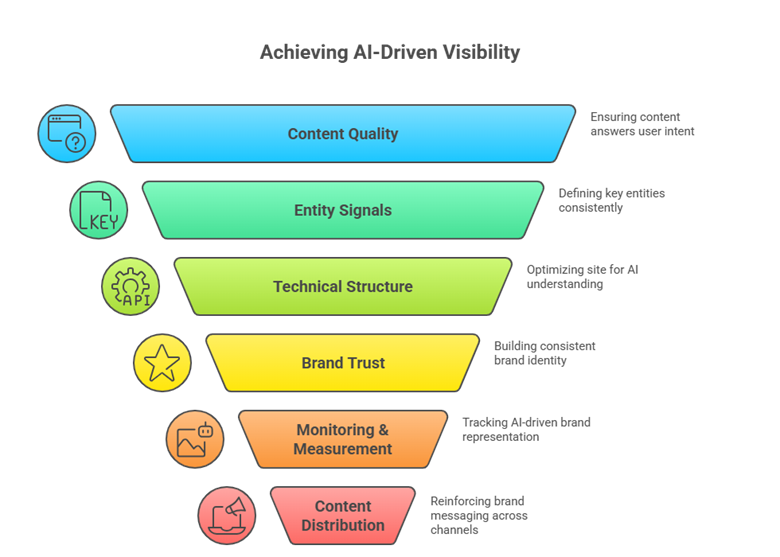
Content Quality & Semantic Structure
- Your content clearly answers user intent, not just keywords
- Articles include entity-rich language (people, products, industries, concepts)
- Terminology is consistent across blogs, pages, and product descriptions
- You maintain pillar pages with well-linked clusters of supporting content
- Pages include semantic formatting (H1/H2 tags, bullet lists, tables, FAQs)
Entity & Knowledge Graph Signals
- Your key entities (brand, people, products) are clearly defined across your site
- Bios, product descriptions, and services are consistent across platforms
- Your brand appears on authoritative third-party sources (e.g., Wikipedia, Crunchbase, industry directories, notable media outlets)
- Google Business Profile is complete and regularly updated
- LinkedIn and social platforms use unified messaging, naming, and descriptions
Technical Structure for AI Understanding
- Site is technically optimized (fast load times, mobile-friendly, clean architecture)
- Schema markup is implemented on all major pages (articles, products, organization, authors)
- URLs are descriptive, logical, and free of unnecessary parameters
- XML sitemaps and robots.txt files are clean and accurate
- Pages avoid duplicate content and ambiguous metadata
Brand Trust & Identity Signals
- Author profiles appear consistently across the web
- Reviews and reputation signals are updated and trustworthy
- Brand messaging is consistent across internal and external channels
- Social proof and expertise signals (testimonials, case studies, credentials) are visible and current
- The brand has a recognizable identity that AI can interpret and reinforce
Monitoring & Measurement
- You track how ChatGPT, Gemini, Perplexity, and SGE describe your brand
- AI-generated summaries are reviewed regularly for accuracy
- You use tracking tools or workflows to monitor AI-driven answer results
- SGE-style visibility is measured alongside traditional SEO metrics
- Log files or analytics pipelines help identify content and crawl gaps
Content Distribution & Reinforcement
- You distribute content across high-authority channels (media, partners, thought leadership, social)
- External sites reflect your brand’s current messaging and positioning
- You regularly earn mentions or citations from credible sources
- You maintain an omnichannel presence that reinforces entity clarity
- Your updated brand story is repeated consistently across the web
AI-Specific Optimization
- You evaluate how your site is represented in AI summaries and answer engines
- Content is written with both humans and AI systems in mind
- You produce content at a pace that keeps information fresh for AI crawlers
- You maintain topic depth to build expertise in knowledge graphs
- AI-specific performance insights inform ongoing content strategy
How to Interpret Your Score
0–15 boxes checked: Level 1–2 (Foundational to Emerging)
Your AEO maturity is just beginning. You’re mainly relying on traditional SEO principles and may be missing critical AI visibility signals.
16–30 boxes checked: Level 2–3 (Emerging to Advanced)
You’re starting to connect with AI-driven search and semantic structure. Some strong fundamentals are in place, but entity consistency and monitoring still need development.
31+ boxes checked: Level 4 (AEO Ready)
You’re well-prepared for the AI Search Economy, with strong entity clarity, technical structure, and real-time monitoring across AI systems.
How to Advance to the Next Level
Advancing through the AEO maturity levels is not as simple as responding to a single algorithm update. It requires a strategic shift that combines technical improvements, teamwork, and a deeper understanding of how AI engines evaluate and synthesize information. Moving from one stage to the next means strengthening the signals that help AI systems trust, interpret, and enhance your brand.
Fix Foundational SEO Gaps Before Scaling AEO
- A strong SEO foundation is essential for any AEO initiative.
- Audit your organic traffic to find weaknesses in authority and relevance
- Improve page-level SEO (titles, meta descriptions, headers, content alignment)
- Strengthen expertise, experience, authority, and trust signals across key pages
- Remove thin or outdated content that weakens credibility
- Ensure mobile performance, page speed, and crawlability are optimized
Why this matters: AI systems rely on the same credibility indicators as Google. Weak SEO leads to weak AEO.
Strengthen Your Structured Data Foundation
Structured data is one of the strongest signals in the AEO maturity model because it helps AI engines interpret your content accurately.
- Add schema.org markup for:
- Articles
- Product pages
- FAQs
- Organization data
- Authors and experts
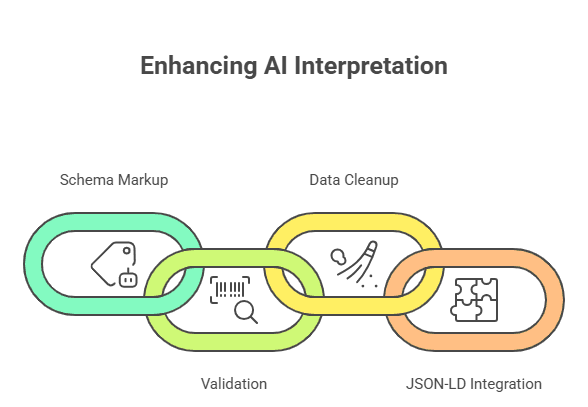
- Validate all schema using Google’s Rich Results Test
- Clean up duplicate or conflicting structured data
- Add JSON-LD to key templates for scalability
Why this matters: Schema helps answer engines understand your entities, relationships, and expertise.
Adopt an AI-First Content Strategy
AI optimization requires content built for comprehension, not just keywords. Semantic structure is the new ranking factor.
- Build topic clusters with pillar pages and supporting articles
- Use entity-driven writing (define people, products, locations, concepts)
- Add semantic depth by answering related questions
- Create content optimized for both readers and AI interpretation
- Incorporate multimedia formats that AI engines can understand (transcripts, captions, structured summaries)
Why this matters: AI systems prioritize content that is conceptually connected and semantically rich.
Measure and Monitor AI Visibility
If you’re not tracking how AI describes your brand, you’re missing key insights.
- Monitor how ChatGPT, Gemini, Perplexity, and SGE summarize your brand
- Perform “brand query” tests (e.g., What is [Brand]?, What does [Brand] offer?)
- Document inaccuracies and trace them back to your content
- Track changes in AI summaries each month to measure progress
- Use analytics tools that reveal zero-click and AI-driven visibility
Why this matters: AEO success depends on shaping AI output, not just search rankings.
Align Teams Across the Organization
AEO is a collaborative effort that requires your SEO, content, and data teams to work together.
- Create shared guidelines for entity consistency across all teams
- Align content, SEO, brand, and analytics teams under one AEO roadmap
- Build workflows to keep author bios, product info, and brand descriptions updated
- Integrate AEO checkpoints into your content creation process
- Use team sprints to improve structured data and semantic architecture
Why this matters: AI engines reward consistency, clarity, and unified signals across your entire digital ecosystem.
Key Takeaway
The shift from SEO to AEO is not a temporary trend but an ongoing evolution that is changing how visibility, authority, and trust are established online. Traditional ranking signals still matter, but AI-driven search determines how your brand is interpreted and presented to users.
The AEO Maturity Model gives organizations a structured way to evaluate their current capabilities, identify blind spots, and prioritize improvements that strengthen both SEO and AI visibility.

Sandamalee is a dedicated digital marketing professional and a core member of the Sotavento Medios team. I work closely with my colleagues to manage daily digital operations, ensuring that every project meets the high standards our clients expect. My focus is on maintaining the technical and editorial integrity of our diverse business portfolios, helping brands stay consistent and impactful in their online presence.