The shift from passive AI tools to autonomous systems is no longer a futuristic concept. I have watched the landscape evolve from simple chatbots to sophisticated entities that can think, plan, and execute. We are entering the era of agentic AI for B2B workflow automation, where the goal is not just to assist humans, but to handle entire processes from start to finish.
The Evolution of Autonomous Operations in ASEAN
The ASEAN region is currently a primary hub for digital transformation. Businesses here are rapidly moving beyond basic digitisation. They are looking for ways to scale without a linear increase in headcount. This is where autonomous operations in ASEAN become a competitive necessity.
I see companies in Singapore and neighbouring markets leveraging these systems to bridge the gap between fragmented legacy software and modern efficiency. The focus has shifted toward agentic systems for zero-click advantage. This means creating environments where a human does not need to initiate every single task. Instead, the system monitors data, identifies needs, and acts on them instantly.
Understanding Agentic AI Workflow Orchestration
To truly harness this power, we must understand agentic AI workflow orchestration. Unlike traditional automation, which follows a rigid “if-this-then-that” logic, agentic systems are goal-oriented.
- They can break down a complex objective into smaller, manageable tasks.
- They can select the right tools for each specific sub-task.
- They can self-correct if the first attempt at a solution fails.
- They can collaborate with other agents to complete multi-layered projects.
This orchestration allows a business to run like a well-oiled machine, even when the underlying tasks are unpredictable.
Your Multi-Agent AI Growth Playbook
Scaling these systems requires more than just one “smart” bot. I believe the future lies in a multi-agent AI growth playbook. In this model, different agents specialise in specific domains, such as lead generation, contract analysis, or customer success.
Specialised Roles in a Multi-Agent System
- The Researcher: Scours the web for market trends and competitor data.
- The Strategist: Synthesises research into actionable B2B growth plans.
- The Executor: Handles the outreach and scheduling through various platforms.
- The Analyst: Monitors performance metrics and suggests real-time optimisations.
By allowing these agents to communicate, you create a feedback loop that constantly improves. This is the cornerstone of using AI agents for B2B growth.
Deploying AI Agents Roadmap: From Pilot to Production
I have found that the most successful deployments follow a structured path. You cannot simply “turn on” autonomy; you must build it on a foundation of trust and data integrity.
Phase 1: Identifying the Friction Points
- Audit your current workflows to find repetitive, high-volume tasks.
- Prioritise processes where delays lead to lost revenue.
- Ensure your data is accessible via API for agent interaction.
Phase 2: Building the Agentic Core
- Select a robust Large Language Model (LLM) as the “brain.”
- Define the specific tools and permissions each agent will have.
- Set clear guardrails to prevent the AI from acting outside of company policy.
Phase 3: Orchestration and Testing
- Implement the agentic AI workflow orchestration layer.
- Run simulations to see how agents handle edge cases.
- Establish a “human-in-the-loop” system for high-stakes decisions.
Mastering Agentic AI for Strategic Advantage
Mastering agentic AI requires a shift in mindset. We must stop viewing AI as a replacement for software and start viewing it as a digital workforce. In Singapore, where talent can be expensive, the ability to deploy a digital team at a fraction of the cost is a massive advantage.
When I look at the financial impact, I always calculate the return in Singapore dollars. A well-implemented agentic system can save a mid-sized firm upwards of S$100,000 annually in lost productivity and manual data entry errors.
The Zero-Click Advantage
The “zero-click” philosophy is about removing the friction of the user interface. If an agent knows a contract is about to expire, it should draft the renewal, check the latest pricing tiers, and present the final version for a single signature. It reduces the “work about work” that bogs down most B2B enterprises.
Overcoming Challenges in Autonomous Operations
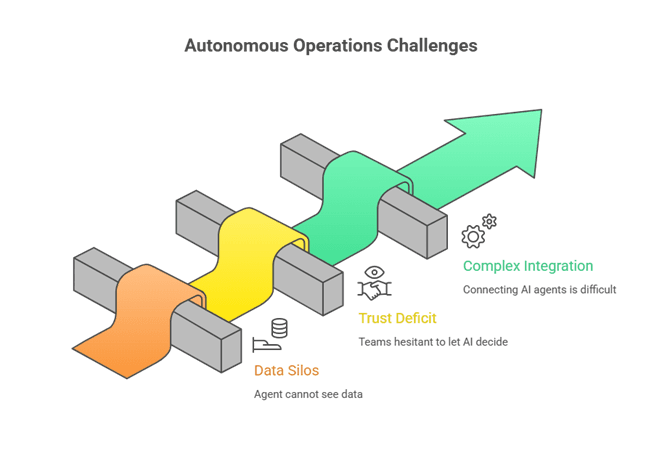
Transitioning to autonomous systems is not without its hurdles. I often see three main roadblocks:
- Data Silos: If an agent cannot “see” the data in your CRM or ERP, it cannot act effectively.
- Trust Deficit: Teams are often hesitant to let an AI make decisions that affect clients.
- Complex Integration: Connecting various AI agents into a cohesive workflow requires technical expertise.
To solve these, I recommend starting with low-risk internal workflows. Once the ROI is proven in S$ and hours saved, you can move toward client-facing AI agents for B2B growth.
The Road Ahead
The era of agentic AI for B2B workflow automation is just beginning. Companies that adopt a multi-agent AI growth playbook today will be the ones defining the market tomorrow. By following a clear deploying AI agents roadmap, you can move from manual drudgery to a state of autonomous operations in ASEAN.
The goal is simple: achieve more by doing less. When you focus on mastering agentic AI, you empower your human team to focus on creativity and relationship building, while the machines handle the heavy lifting.

Sandamalee is a dedicated digital marketing professional and a core member of the Sotavento Medios team. I work closely with my colleagues to manage daily digital operations, ensuring that every project meets the high standards our clients expect. My focus is on maintaining the technical and editorial integrity of our diverse business portfolios, helping brands stay consistent and impactful in their online presence.