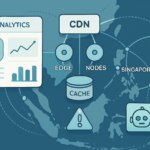
For Singapore and the Philippines, where digital commerce, SaaS, logistics, and fintech teams often operate across multiple countries and networks, technical SEO is no longer only about crawling, indexing, or XML sitemaps. Search performance now depends on how fast a page is rendered, how consistently content is served across geographies, and how precisely bots are allowed to access critical resources. That is why technical SEO tooling is increasingly overlapping with CDN and edge logic management. The modern stack does not treat the edge as a purely infrastructure concern. It treats the edge as part of the discoverability layer, the user experience layer, and in many cases the compliance layer too.
Why technical SEO is pushing into the edge
The shift begins with a simple operational reality: many SEO issues are now created before a page ever reaches the origin server. In an environment where JavaScript frameworks, personalization, A/B testing, security filters, and bot detection operate at the network edge, SEO teams need visibility and control in the same place where responses are being altered. A crawler does not experience your site exactly like a human user, especially if the edge applies geo-routing, device-based rules, bot challenges, or header manipulation. If a critical stylesheet is delayed, if a redirect chain is rewritten incorrectly, or if a country-specific rule blocks a crawler, the issue is no longer just technical debt. It becomes an indexability and crawl budget problem.
CDNs and edge platforms have also become the first layer of performance optimization for distributed markets like Singapore and the Philippines. Users in Manila, Cebu, Singapore, Jakarta, or Kuala Lumpur may all hit the same global property, but the route, latency, and cache behavior can differ materially. Search engines have become more sensitive to real user experience signals such as Core Web Vitals, especially Largest Contentful Paint, Interaction to Next Paint, and Cumulative Layout Shift. Because the edge directly controls caching, compression, image negotiation, early hints, and response shaping, technical SEO tooling is naturally expanding into that control plane.
The overlap between SEO diagnostics and edge decisioning
Traditional SEO tools were designed for audits after deployment. They crawl pages, report on metadata, surface broken links, and flag render issues. That still matters, but it is insufficient when a significant share of site behavior is decided dynamically at the edge. Teams now need tools that can inspect HTTP responses, compare bot and human variants, validate cache keys, and test geolocation behavior at the point of delivery. This is why platforms that began as SEO monitors increasingly integrate with CDNs, reverse proxies, and edge compute frameworks.
Bot-aware rendering and access control
One major reason for this convergence is bot-aware rendering. Many sites use different responses for browsers and crawlers, sometimes intentionally for efficiency, sometimes unintentionally because of WAF rules, JavaScript challenges, or anti-bot systems. If the edge logic misclassifies Googlebot or other legitimate crawlers, indexing can degrade rapidly. SEO tools now need to verify whether robots receive the same essential content, status codes, canonical tags, and structured data as users, while still respecting security and performance constraints. In practice, this means checking headers, cookie behavior, cache variation, and user-agent-based responses at the CDN layer, not just in the rendered DOM.
Headers, caching, and canonical consistency
At scale, a small edge configuration error can create large SEO consequences. Consider a site where HTML pages are cached differently depending on Accept-Language, device type, or campaign parameters. If the cache key is too broad, users may receive the wrong locale or stale canonicals. If it is too narrow, cache fragmentation hurts performance and origin load. Technical SEO tools are increasingly being used to inspect these cache decisions and validate whether the same URL returns consistent canonical signals, hreflang declarations, and structured data across edge nodes. This matters especially for multilingual businesses serving English, Tagalog, Filipino, Bahasa Indonesia, and regional English variants.
Why CDNs have become part of SEO operations
CDNs used to be evaluated mainly on latency reduction and bandwidth savings. Those metrics still matter, but SEO teams now recognize that a CDN can influence discoverability, rendering quality, and content freshness. A fast cache hit can improve page experience, while an incorrect stale hit can hide updated content from both users and crawlers. Edge platforms also shape how quickly fixes are propagated, how redirects are managed, and whether localized pages are served correctly to crawlers from different regions.
Search engines increasingly render pages closer to how users experience them. If your site relies on client-side rendering, delayed API calls, or edge-injected scripts, then the content delivered by the CDN and the logic executed at the edge are part of the crawl surface. SEO tooling that ignores those layers misses the actual source of many performance and indexing defects. As a result, products in the SEO category are borrowing capabilities from observability, CDN analytics, and security tooling, including synthetic testing, request replay, log correlation, and rule-level change tracking.
Geographic routing and market-specific visibility
In Southeast Asia, geographic routing is not a minor optimization. It can determine whether users in the Philippines see a Singapore-hosted page, whether a Japanese visitor receives a localized version, or whether a crawler from a US data center sees the correct default locale. SEO tools that can probe from multiple points of presence expose differences that generic crawlers miss. This is especially relevant for organizations running regional hubs in Singapore while serving customers and prospects in the Philippines. A site may look healthy from one location but break canonicalization, currency display, or internal linking from another.
Edge logic as a governance layer
Another reason the edge is absorbing SEO functions is governance. Enterprises want centralized control over redirection logic, cookie policy, bot handling, security headers, and content transformations. Instead of pushing every change through application code, teams can manage some rules at the edge through configuration, policy engines, or serverless functions. This makes change review faster, but it also means SEO teams need visibility into the rule set. A well-designed technical SEO workflow now includes change audits for edge policies, because a seemingly harmless rule can alter crawlability, duplicate content behavior, or page equivalence.
What advanced SEO tools are now expected to do
Modern SEO platforms are moving beyond page-level reports into edge-aware diagnostics because the old model leaves too many blind spots. The useful toolset now includes log analysis, synthetic crawl simulation, response-header inspection, and deployment-aware monitoring. These capabilities help teams understand not just what the crawler saw, but why it saw it. They also help separate origin problems from CDN problems, which is critical when teams work across development, infrastructure, and marketing functions.
HTTP-level auditing and response diffing
One emerging requirement is response diffing across locations, devices, and user agents. A high-value SEO tool should compare the full HTTP transaction, not just the HTML output. That includes status codes, cache-control directives, vary headers, hreflang markup, canonical tags, robots directives, and timing information. When a page behaves differently for a crawler versus a browser, the issue often sits in edge logic or request classification. Tools that surface those differences can reduce diagnosis time from days to minutes.
Structured data and rendering validation
Structured data is also moving closer to edge management because many teams inject schema markup dynamically. If the markup is added via client-side scripts or edge transforms, it becomes vulnerable to timing issues and cache inconsistencies. SEO tools now need to validate whether JSON-LD is present in the raw response, whether it survives minification and rewriting, and whether it remains stable across page variants. This is particularly important for ecommerce, job listings, local businesses, and event-driven sites, where rich results depend on accurate markup delivery.
Log analysis meets cache intelligence
Search log analysis has always been useful, but its value increases when paired with CDN logs and cache intelligence. Raw server logs may show Googlebot hits, but CDN logs reveal whether those requests were served from cache, passed to origin, challenged, or redirected. That distinction is essential for troubleshooting crawl efficiency and for understanding whether the crawl budget is being consumed by low-value URLs. In enterprise environments, this combined view can also reveal whether edge rules are causing repeated fetches of duplicate URLs or blocking important assets like CSS and JavaScript.
Practical examples from enterprise and regional deployments
A multinational publisher operating across Singapore and the Philippines may rely on edge routing to deliver the nearest copy of content and to manage paywall rules. If the edge serves a cached HTML shell without updating metadata quickly enough, crawlers may index stale titles or incomplete article bodies. Technical SEO tooling with CDN integration can detect that mismatch before it impacts organic performance. The same tooling can verify whether bot access is being handled consistently during paywall transitions, login prompts, or consent changes.
For a regional SaaS company, the risk is often different. The product marketing site may be built on a modern frontend framework with partial rendering at the edge. A deployment can inadvertently alter redirect behavior for non-canonical paths, such as trailing slashes, UTM-tagged URLs, or locale prefixes. Because the issue happens in the CDN ruleset rather than the application code, a standard crawl may only show symptom-level errors. An edge-aware SEO workflow can identify the exact rule causing the loop, the cache variation causing duplicate pages, or the rewrite rule causing a canonical mismatch.
In ecommerce, especially for brands serving the Philippines through regional warehouses and Singapore as a commercial hub, product freshness and inventory visibility are often handled by API calls and edge caching. If the CDN caches product pages too aggressively, stock status, pricing, or shipping messaging can lag behind reality. That has obvious conversion implications, but it also affects SEO if search engines crawl outdated product data or inconsistent structured markup. Here, technical SEO tools need to monitor cache TTLs, origin fallback logic, and freshness headers alongside crawlability.
Implementation patterns that make the stack work
Teams do not need to replace their SEO stack overnight. They need to connect SEO analysis to the edge with clear operational patterns. One effective pattern is to treat edge rules as deployable assets with version control, peer review, and rollback plans. Another is to feed CDN logs into observability platforms that SEO specialists can query without waiting for engineering triage. A third is to include SEO validation in release checks, especially for paths that affect indexing, localization, and content rendering.
Where to place control
Not every SEO rule belongs at the edge, but the edge is the right place for high-frequency, low-risk decisions such as redirects, bot allowlists, geo-routing, and header normalization. Deeper content decisions, such as editorial templates or product data logic, should stay closer to the application layer. The goal is not to move all SEO into the CDN. The goal is to place the right controls where they can be enforced consistently and measured accurately.
How to avoid new technical debt
Edge logic can create new debt if teams manage it informally. If multiple departments edit rules without ownership, the result is inconsistent behavior across markets. If cache policies change without testing, stale content and crawl anomalies follow. If security teams deploy bot protections without SEO review, legitimate crawlers may be blocked. Mature organizations establish shared governance between SEO, infrastructure, security, and engineering so that edge changes are tested against both performance and discoverability requirements.
Technical implementation checklist for SEO and edge alignment
- Audit all canonical URLs, redirects, and locale-specific paths at the CDN layer, not only from the origin.
- Verify that Googlebot and other legitimate crawlers receive the same essential HTML, status codes, and structured data as users.
- Review cache keys, Vary headers, and TTL settings to prevent duplicate content and stale metadata.
- Test edge behavior from Singapore, the Philippines, and other target regions using synthetic probes and multi-location crawls.
- Correlate SEO crawl data with CDN logs to identify whether issues originate in cache, rewrite rules, or application responses.
- Validate that robots directives, canonicals, hreflang annotations, and schema markup survive edge transforms and minification.
- Include SEO sign-off in deployment workflows for any change affecting redirects, localization, bot rules, or HTML rewriting.
- Document ownership for edge policies so marketing, SEO, security, and platform engineering do not create conflicting rules.

I am Tricia Huang Mei, an Advertising Partner in Sotavento Medios with over two decades of experience in the Singapore advertising and business sectors. My career is defined by a commitment to driving high-impact marketing campaigns and fostering sustainable growth for the diverse business portfolios I manage.