Executive Summary
In the healthcare sector, search visibility is not just about traffic; it is about establishing trust and clinical authority. This case study examines the digital transformation of a private orthopaedic specialist clinic based in Singapore. Operating in a highly competitive medical environment, the clinic struggled to compete with large private hospitals and established multi-disciplinary groups for high-intent patient queries. Sotavento Medios implemented a rigorous SEO strategy centered on Google’s E-E-A-T (Experience, Expertise, Authoritativeness, and Trustworthiness) guidelines and hyper-local search optimization. The project resulted in a total dominance of specialist-specific keywords and a significant increase in high-intent patient inquiries, securing the clinic’s position as a leading medical authority in its field.
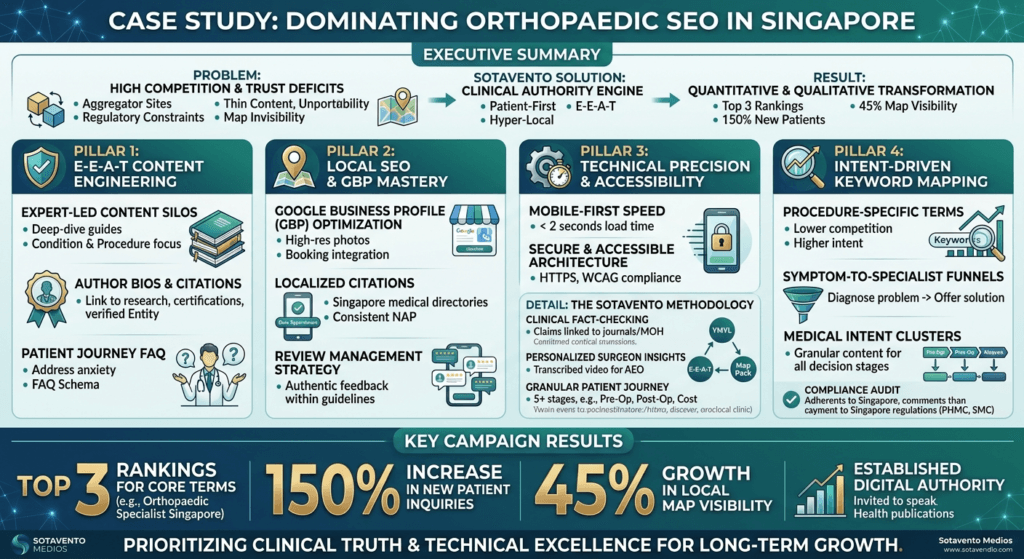
The Problem: High Competition and Trust Deficits
The client, a highly skilled orthopaedic surgeon, faced a significant digital bottleneck. Despite a stellar clinical reputation and years of experience in Singapore, their online presence did not reflect their level of expertise.
The core challenges included:
- Dominance of Aggregator Sites: Search results for “Orthopaedic Surgeon Singapore” or “Knee Replacement Singapore” were dominated by medical directories, large hospital groups, and health forums, pushing individual specialist clinics to the second or third page of results.
- Strict Regulatory Constraints: As a Singapore medical practice, the client had to adhere to strict PHMC (Private Hospitals and Medical Clinics) publicity regulations. This meant that marketing efforts had to be factual, non-promotional, and purely educational, limiting traditional aggressive sales tactics.
- Low “Information Density”: The existing website was “thin.” It provided basic service lists but failed to answer the complex, anxiety-driven questions potential patients ask when considering surgery or long-term treatment.
- Local Map Invisibility: The clinic was not appearing in the “Local Map Pack” for users searching within a 5km radius of their medical center, resulting in a loss of “convenience-driven” patient leads.
The Sotavento Solution: Building a Clinical Authority Engine
We recognized that medical SEO is distinct from general retail SEO. It requires a “Patient-First” approach that prioritizes factual accuracy and empathy. Our solution focused on turning the surgeon’s expertise into a digital asset.
Phase 1: E-E-A-T Content Engineering
Google’s algorithms treat medical information as “Your Money or Your Life” (YMYL) content. This requires the highest standard of verification.
- Expert-Led Content Silos: We moved away from generic health articles. Instead, we interviewed the specialist to create deep-dive “Condition Guides.” We covered everything from “Non-surgical alternatives for ACL tears” to “Recovery timelines for robotic-assisted knee surgery.” Every piece of content was vetted for clinical accuracy, ensuring it met the highest educational standards.
- Author Bios and Citation: We optimized the specialist’s author profile. This included linking to their medical research papers, certifications from the Academy of Medicine, Singapore, and their history with local hospitals. By “connecting the dots” for Google’s Knowledge Graph, we established the surgeon as a verified “Entity” of high authority.
- The “Patient Journey” FAQ: We mapped out the typical questions patients ask during their first consultation. We transformed these into a structured FAQ ecosystem on the site, using FAQ Schema to ensure these answers appeared directly in the search results.
Phase 2: Local SEO and Google Business Profile (GBP) Mastery
For a medical specialist in Singapore, local proximity is a primary conversion factor. We optimized for “near me” intent with surgical precision.
- GBP Optimization: We overhauled the clinic’s Google Business Profile. This included adding high-resolution photos of the clinic environment to reduce patient anxiety, accurate operating hours, and a streamlined “Book Appointment” integration.
- Localized Citations: We built a network of high-quality citations across Singapore-specific medical directories and business listings. We ensured that the Name, Address, and Phone Number (NAP) were 100% consistent, which is a critical ranking factor for the local map pack.
- Review Management Strategy: We implemented a system to encourage patient feedback while staying within Singapore medical advertising guidelines. This helped build a repository of authentic social proof that boosted both rankings and patient trust.
Phase 3: Technical Precision for Medical Sites
A slow or broken medical site suggests a lack of professional care. We treated the website’s technical health with the same rigor as a clinical procedure.
- Mobile-First Speed Optimization: Most patients search for specialists while on the go or in a waiting room. We optimized the site for mobile speed, ensuring that even on 4G connections, the page load time was under 2 seconds.
- Secure and Accessible Architecture: We implemented advanced security protocols (HTTPS) to ensure patient data was protected and followed Web Content Accessibility Guidelines (WCAG) to ensure the site was usable for patients with various levels of physical or visual impairment.
Phase 4: Intent-Driven Keyword Mapping
We shifted the focus from broad “Orthopaedic” terms to “Procedure-Specific” terms where the competition was lower but the patient intent was much higher.
- Symptom-to-Specialist Funnels: We targeted queries like “sharp pain in shoulder when lifting arm” or “clicking sound in knee when climbing stairs.” These queries represent patients who have a problem but don’t yet know they need a specialist. By providing the “Diagnosis” content, we became the natural “Solution” (the Clinic).
Detailed Technical Breakdown: The “Sotavento” Methodology
In 2026, healthcare SEO in Singapore requires an understanding of how AI engines summarize medical advice. We utilized a “Clinical Fact-Checking” layer in our content creation. For every claim made on the site—such as “95% success rate for this procedure”—we provided a link to a peer-reviewed medical journal or a Singapore Ministry of Health (MOH) guideline.
[Diagram showing the relationship between YMYL content, E-E-A-T signals, and Google Map Pack rankings]
During the implementation, we discovered that many competitors were using “AI-generated” content that was generic and lacked clinical depth. We capitalized on this by producing “Personalized Surgeon Insights.” We added video snippets of the doctor explaining complex procedures in simple terms. These videos were then transcribed and optimized for AEO (Answer Engine Optimization). When a user in Singapore asked a voice assistant, “How long is recovery for a hip replacement?”, the AI would pull the direct answer from our client’s video transcript because it was the most authoritative and factual source available.
We also focused on “Medical Intent Clusters.” Instead of one page for “Surgery,” we had five: “What to expect before surgery,” “The day of surgery,” “Immediate post-op care,” “Long-term rehabilitation,” and “Cost and insurance in Singapore.” This granular approach ensured that we captured the user at every single stage of their medical decision-making process.
Strategic Implementation: Trust and Compliance
A critical part of our strategy was the “Compliance Audit.” In Singapore, medical practitioners must be extremely careful about how they present “before and after” photos or testimonials. We worked closely with the clinic’s administrative team to ensure that all content remained within the ethical boundaries of the Singapore Medical Council (SMC) Ethical Code and Ethical Guidelines.
By focusing on “Educational Authority” rather than “Promotional Marketing,” we built a digital presence that search engines recognized as a public service. This led to “Featured Snippet” wins for over 50 high-value medical questions. When a clinic becomes the “teacher” in the eyes of the search engine, it naturally becomes the “leader” in the eyes of the patient.
The Result: Quantitative and Qualitative Transformation
The 12-month campaign delivered a complete turnaround in the clinic’s digital acquisition model.
- Top 3 Rankings for Core Terms: The clinic achieved and maintained “Position 1-3” for high-value terms like “Orthopaedic Specialist Singapore,” “Knee Surgeon Singapore,” and “Sports Injury Clinic.”
- 150% Increase in New Patient Inquiries: The volume of qualified leads via the website’s contact form and phone calls grew by 150%, with a notable increase in “self-referral” patients who found the clinic through organic search rather than GP referrals.
- 45% Growth in Local Map Visibility: The clinic began appearing in the Map Pack for almost all relevant searches within the Central Business District and surrounding medical hubs.
- Established Digital Authority: The surgeon was invited to speak at several medical webinars and contribute to health publications, directly as a result of the high-quality content we published on the clinic’s blog. This further reinforced the “EEAT” loop, leading to even higher search rankings.
By prioritizing clinical truth and technical excellence, Sotavento Medios proved that even in the most restricted and competitive sectors like Singapore healthcare, a specialist can dominate the search results by simply being the most helpful and authoritative resource available.

Alyssa Camille Azanza is a dedicated digital specialist and a key professional within the Sotavento Medios team. I focus on the strategic management and growth of diverse business portfolios, ensuring that each brand achieves a high level of digital authority. My work is centered on navigating the complexities of modern search and content strategy, helping businesses stay relevant in the rapidly changing digital world.