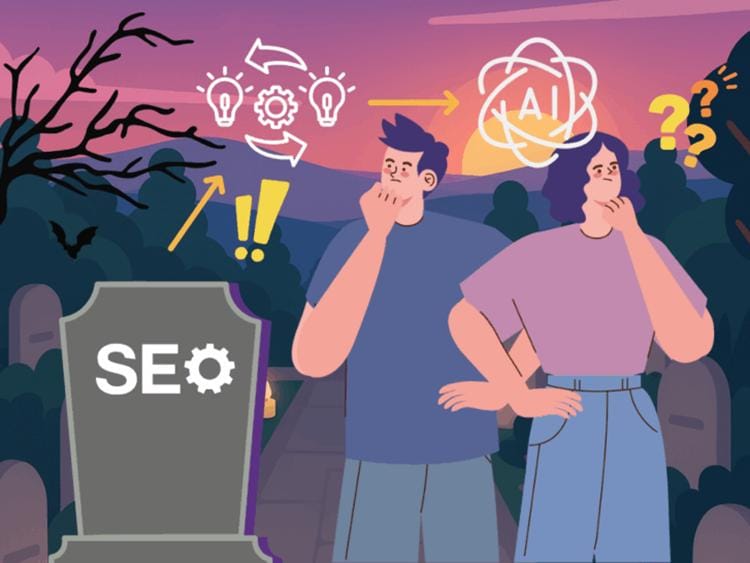
Every few years, the same question pops up in the digital marketing world. Something significant happens in search, people panic, and suddenly everyone wonders if SEO is dead. But 2025 brought a different kind of disruption. With AI Overviews, ChatGPT Search, and Perplexity becoming part of our search routines, the question grew louder.
Let’s clear this up. SEO is not dead. It is changing. We need to change with it.
The Real Story: SEO Is Evolving, Not Dying
People tend to ask if SEO is dead when their old strategies start to weaken. Keyword targeting, heavy link building, and cranking out articles just to meet a publishing quota used to work. Then AI changed the game.
So no, SEO is not dead. But it is evolving, and it’s happening quickly. As more users turn to AI assistants to skip the traditional search process, older strategies naturally lose some effectiveness. Still, “less effective” does not mean obsolete.
Search engines are still the largest source of organic traffic by a wide margin. SEO also decides whether your content gets indexed at all, which directly affects whether GenAI platforms can find, interpret, and cite your work.
In this way, SEO is becoming the foundation that makes your brand discoverable to GenAI systems. Earning citations from these platforms is quickly becoming the new way to rank in top SERP positions, even if the interface looks different.
Claiming SEO is dead misses the bigger picture. There is a fundamental shift in how search works. Generative AI is changing how information is gathered and delivered. To grasp the upcoming changes, check out how generative AI in search operates. This is a transformation, not an ending.
What We Need To Let Go Of
Let’s address the part people often ignore. Some tactics simply don’t work anymore, such as:
- Low Value Link Building: Getting links just to boost numbers won’t suffice. AI can easily tell which links are real and which are not.
- Keyword Stuffing: Repeating a keyword ten times in a paragraph isn’t optimization; it’s just noise.
- Thin Content: If your content seems copied from several other sites, AI will overlook it. Depth and originality are the new standards. Learn more about structuring content for AI extraction; I’ve linked a guide of mine to help you get started.
- Chasing Rank 1: With AI Overviews taking the lead in SERP results, the traditional race for Rank 1 matters much less than before. Google has been moving toward a zero-click landscape for years, and AI is speeding up that transition. The real goal now isn’t to win a position; it’s to become the source AI trusts and references. That’s why authority signals and schema markup for AEO are so important.
What Still Matters (Even More Now)
Despite all the changes, the purpose of SEO hasn’t changed. We still aim to connect people with the best information. The approach is evolving.
- Entities, Not Just Keywords: Google understands topics and concepts, not just exact terms.
- Authority Over Volume: Publishing twenty mediocre articles will never outperform one authoritative, well-researched, and structured piece.
- Trust Signals: Links still count, but now as credibility markers rather than votes you can easily gather.
The New Skill Set for Modern SEO
To remain competitive in an AI-first search environment, we need to upgrade our skills.
Content Engineering
AI relies on structure. The clearer your content, the easier it is for AI to extract your value. Check out my post on structuring content for multi-turn AI conversations for practical tips to apply to your content strategy. To summarize my points in that post:
- Understand the new user language around search.
- Answer the question right away.
- Break ideas into clear, single-purpose paragraphs.
- Use a variety of content types, like diagrams, labeled images, step-by-step visuals, or data tables.
- Use schema to show AI how your content connects.
Technical SEO That Actually Guides AI
Technical SEO now plays a greater role in comprehension, not just crawling.
- Build strong internal linking so AI understands your topical ecosystem.
- Control what gets indexed.
- Keep your site fast and user-friendly.
Real Data And Unique Insights
AI can summarize the entire internet, so to stand out, you need to publish something it can’t find anywhere else. This is where real data and original insights become your strongest advantage. Learn how to build authority signals in your content.
- Unique statistics or findings from your own experiments aren’t available elsewhere, increasing your chances of being cited by AI systems.
- Case studies add context and credibility.
- Original testing leads to fresh, authoritative content that stands out.
- Expert commentary provides depth that generic summaries lack; this is far more likely to be included in AI-generated answers.
Adapting to a Shorter Customer Journey
GenAI tools have shortened the customer journey by compressing all stages into one session. Users no longer move step by step through awareness, consideration, and conversion. Instead, they ask more questions in less time and expect quicker, clearer answers.
To adjust to this shift:
- Optimize content for quick consumption by front-loading value since users now spend less time per session.
- Anticipate multi-intent behavior by addressing discovery, evaluation, and decision-making needs.
- Structure pages so users can quickly find what they need.
- Combine broad context with specific, actionable insights and include clear calls to action.
Attribution and Performance Tracking
Creating the right structure and content is only half the battle. To improve AEO, you must understand how AI search engines find, interpret, and attribute your content, then track how often you appear in their answers. There are LLM-visibility tools that can assist with AEO attribution and performance tracking.
Monitor and measure:
- How frequently your brand, URL, or insights appear in AI-generated responses across platforms.
- When AI systems reference your data, case studies, or explanations (similar to tracking organic rankings).
- Click-throughs, dwell time, and actions taken after users land on your site from AI-driven traffic.
The Human Advantage
As AI content fills the internet, genuine human expertise becomes more valuable.
- Bring real experience into your content.
- Write with empathy for the person behind the search.
- Consider building an AEO-ready team to manage AI-first SEO effectively.
The Updated SEO Playbook
To summarize:
| Skill Area | Core Focus | What It Requires |
| Content Engineering | Structuring content so AI can understand and extract value | Using user-friendly language, answering questions immediately, keeping paragraphs focused, using multimodal content, and applying schema for clarity |
| Technical SEO | Helping AI comprehend site context beyond basic crawling | Strengthening internal linking, managing indexation, schema markups, and maintaining fast, user-friendly site performance |
| Real Data and Unique Insights | Publishing information AI cannot find elsewhere to build authority | Creating first-party data, case studies, original testing, and expert commentary that attract AI citations |
| Adapting to a Shorter Customer Journey | Meeting all user intents within a compressed search session | Front-loading value, addressing discovery through decision-making in one place, structuring for fast scanning, and offering clear next steps |
| Attribution and Performance Tracking | Understanding how AI finds and cites your content and measuring visibility | Tracking AI-driven citations, appearance frequency, user engagement, and attribution using LLM-visibility tools |
| The Human Advantage | Offering what AI cannot replicate | Providing authentic experience, empathetic writing, and building teams equipped for AI-first SEO |
Where the Opportunity Really Is in 2025 and Beyond
Here’s the part most people overlook. Every major change in search has always created a new wave of winners. When mobile-first indexing rolled out, businesses that adapted quickly thrived. When content marketing became mainstream, those who focused on quality built massive authority. The same trend is happening now with AI-first search.
The current opportunity is larger than anything we’ve seen in SEO for the past decade. AI may change how search results appear, but it also levels the playing field. Brands that emphasize clarity, structure, expertise, and real value can surpass competitors who have relied on shortcuts for years. You no longer win by publishing the most or getting the most links. You win by being the clearest and most trusted source of truth in your niche. AI is simply the new distributor of that truth.
Key Takeaway
SEO is not dead. It is evolving into something more strategic and more reliant on genuine expertise. The old shortcuts are fading, but the core of SEO is stronger than ever. Quality, authority, clarity, and trust are the new must-haves.
We are not seeing the end of SEO. We are witnessing its next chapter. Those who adapt early will shape the narrative while others play catch-up.

Sandamalee is a dedicated digital marketing professional and a core member of the Sotavento Medios team. I work closely with my colleagues to manage daily digital operations, ensuring that every project meets the high standards our clients expect. My focus is on maintaining the technical and editorial integrity of our diverse business portfolios, helping brands stay consistent and impactful in their online presence.