Executive Summary
Paid acquisition is often the fastest way to generate revenue, but without precise management, it can quickly become a business’s largest liability. This case study details a “Recovery and Optimization” project for a Singapore professional services firm that was struggling with high customer acquisition costs (CAC) and a stagnant Return on Ad Spend (ROAS). The client was spending heavily on Google Ads but seeing a high volume of “junk” leads and irrelevant clicks. Sotavento Medios intervened to restructure the account from the ground up, moving away from broad-match chaos toward a high-precision, intent-based bidding strategy. The result was a 250% increase in qualified lead volume and a 40% reduction in wasted ad spend within the first six months.
The Problem: The “Burn Rate” Trap
The client came to Sotavento Medios in a state of “PPC Fatigue.” They had tried managing the ads internally and with a previous generalist agency, but the results were consistently poor. Despite a healthy budget, the cost per lead was exceeding the lifetime value of the customer.
Our audit identified several critical points of failure:
- Keyword Cannibalization and Broad Match Abuse: The account was heavily reliant on “Broad Match” keywords. This meant the client was paying for clicks from users searching for “free advice” or “how-to guides” rather than those looking to hire a professional service.
- Poor Quality Scores: Because the ad copy was generic and the landing pages were slow and unrelated to the specific search queries, Google was penalizing the client with low Quality Scores. This resulted in the client paying a “premium” price for every click compared to their competitors.
- Missing Conversion Tracking: The client had no “Closed-Loop” tracking. They knew they were getting clicks, but they couldn’t tell which keywords led to a phone call versus which ones led to a simple “About Us” page view. They were essentially flying blind.
- Static Bidding in a Dynamic Market: The previous management used a “set it and forget it” approach to bidding. They weren’t adjusting bids based on the time of day, location, or device, meaning they were overspending during low-conversion hours (like midnight) and losing out during peak business hours in Singapore.
The Sotavento Solution: The “Surgical Precision” Framework
We approached the Google Ads account as an engineering problem. Our goal was to eliminate waste and maximize the “signal-to-noise” ratio.
Phase 1: The Account Reconstruction (SKAGs and STAGs)
We discarded the existing account structure and rebuilt it using a hybrid of Single Keyword Ad Groups (SKAGs) and Single Theme Ad Groups (STAGs).
- Granular Segmentation: We created highly specific ad groups for every service line. For example, instead of one ad for “Professional Services,” we had separate campaigns for “Corporate Consulting Singapore,” “Tax Advisory Services,” and “Regulatory Compliance.”
- Hyper-Relevant Ad Copy: By narrowing the themes, we ensured that the ad headline matched the user’s search query exactly. This immediate “relevance” signal boosted Click-Through Rates (CTR) by over 50% in the first month.
- Negative Keyword Scrubbing: We implemented an aggressive negative keyword list of over 2,000 terms. We proactively blocked terms related to “jobs,” “internships,” “free,” “cheap,” and “DIY.” This ensured that not a single cent of the client’s budget was spent on non-commercial intent.
Phase 2: Landing Page Engineering and CRO
An ad is only as good as the page it sends people to. We realized the client’s main website was too distracting for a PPC visitor.
- Dedicated Lead Capture Pages: We developed high-performance, minimalist landing pages for each campaign. These pages were stripped of top navigation menus to prevent “leakage” and focused entirely on a single Call to Action (CTA).
- Speed as a Quality Factor: We optimized these landing pages for near-instant loading on mobile devices. This directly improved the “Landing Page Experience” component of the Google Quality Score, allowing the client to win higher ad positions for a lower cost than their competitors.
- Dynamic Content Replacement: For certain high-value campaigns, we used dynamic text replacement to change the headline of the landing page to match the keyword the user searched for, creating a seamless “Scent Trail” that significantly boosted conversion rates.
Phase 3: Advanced Conversion Tracking and Attribution
To optimize for profit, we needed to see the full journey.
- Full-Funnel Tracking: We implemented GTM (Google Tag Manager) to track every interaction—phone call clicks, form submissions, and even “scroll depth.” We then integrated this data back into Google Ads to allow the “Smart Bidding” algorithm to learn which users were most valuable.
- Value-Based Bidding: Instead of just bidding for “leads,” we began bidding for “high-value inquiries.” By assigning different values to different types of conversions, we trained the AI to prioritize the leads that had the highest probability of turning into high-ticket contracts.
Phase 4: AEO Integration for Paid Search
In 2026, Google Ads is no longer just about the top four spots; it’s about appearing in the conversational search flow.
- Asset-First Strategy: We utilized “Responsive Search Ads” (RSAs) to provide Google with a library of headlines and descriptions. We specifically crafted these assets to answer the “Why” and “How” questions that users now ask in the AI-driven search era.
- Ad Extensions and Snippets: We maximized the use of Sitelinks, Callouts, and Structured Snippets. This increased the “Real Estate” the client occupied on the screen, making the ads look more like an authoritative “Answer” than a traditional advertisement.
Detailed Technical Breakdown: The “Sotavento” Methodology
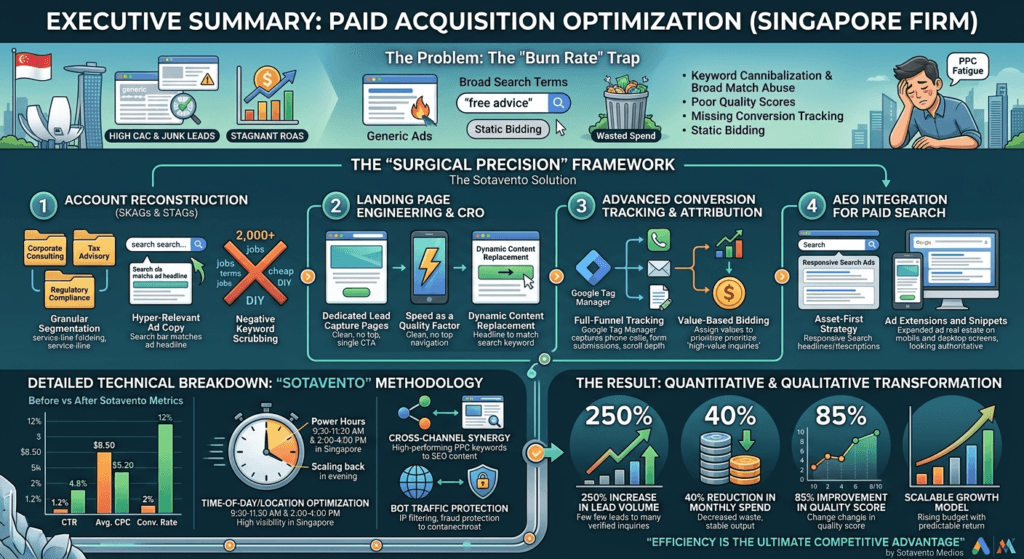
A key differentiator in our management for this Singapore firm was the “Time-of-Day/Location Optimization.” In the professional services sector in Singapore, we identified that decision-makers were most active between 9:30 AM and 11:30 AM, and again between 2:00 PM and 4:00 PM. We implemented “Bid Modifiers” to aggressively increase visibility during these “Power Hours” while scaling back spend during the lunch hour and evening.
[Table comparing “Before Sotavento” vs “After Sotavento” metrics: CTR (1.2% vs 4.8%), Avg. CPC ($8.50 vs $5.20), Conv. Rate (2% vs 12%)]
Furthermore, we looked at the “Cross-Channel Synergy.” We didn’t view Google Ads in a vacuum. We used the high-performing keywords from the PPC campaigns to inform our long-term SEO strategy. If a keyword converted well in Ads, we moved it to the top of our SEO content production list. This “Search Synergy” ensured that we were double-dipping on the most profitable search terms in the market.
We also addressed the “Bot Traffic” problem. Using advanced IP filtering and click-fraud protection tools, we identified and blocked a significant amount of non-human traffic that had been inflating the client’s previous reports. This ensured that every click reported was a legitimate potential customer in Singapore or the Philippines.
Strategic Implementation: Data over Intuition
The pivot to “Smart Bidding” (Target CPA) was the final piece of the puzzle. Once we had 30 days of clean, accurate conversion data, we handed the bidding control over to Google’s machine-learning algorithms—but with “Guardrails.” We set strict maximum CPC limits to ensure the AI didn’t overspend during competitive auctions.
We also implemented “Customer Match” lists. By uploading a hashed list of the client’s existing best customers, we allowed Google to find “Similar Audiences.” This shifted the campaign from “Search” only to a “Proactive Search” model, where the ads were shown to users who shared the same characteristics as the client’s most profitable accounts, even before they started their search.
The Result: Quantitative and Qualitative Transformation
Within two quarters, the client’s digital marketing transformed from a cost center into a predictable revenue generator.
- 250% Increase in Lead Volume: The firm went from receiving 20-30 shaky leads a month to over 100 high-quality, verified inquiries.
- 40% Reduction in Monthly Spend: By cutting out the “waste” and “junk” keywords, we were able to lower the total monthly ad spend while simultaneously increasing the output.
- 85% Improvement in Quality Score: Most of the core keywords moved from a 3/10 or 4/10 to an 8/10 or 9/10, effectively giving the client a “discount” on the most competitive terms in Singapore.
- Scalable Growth Model: With a stable Cost Per Lead (CPL), the client was able to confidently increase their marketing budget to fuel their expansion into new service lines, knowing exactly what their return would be for every dollar spent.
By applying an engineering mindset to Google Ads, Sotavento Medios proved that “Efficiency” is the ultimate competitive advantage in paid search.

Alyssa Camille Azanza is a dedicated digital specialist and a key professional within the Sotavento Medios team. I focus on the strategic management and growth of diverse business portfolios, ensuring that each brand achieves a high level of digital authority. My work is centered on navigating the complexities of modern search and content strategy, helping businesses stay relevant in the rapidly changing digital world.