The current internet generation in Singapore is a fierce competition, which is mainly a result of high internet penetration and a government that is very supportive by pushing for SME digitalization. Small businesses’ success metric will be beyond just being visible in 2026. It will be about generating sustainable and measurable leads that come from technical authority and user experience.
Hiring the right SEO agency is not a purchase decision; rather, it is a strategic partnership that impacts your long-term organic profit. Singaporean SMEs, in particular, are the ones for whom this statement holds most true as they have to compete with enterprises which have significantly larger marketing budgets. A definite list may be short-lived, but a strategic selection framework based on 2026 search trends will always remain.
Being a Technical SEO Expert at Sotavento Medios, my main concern is to provide you, the seasoned marketing manager or B2B owner, with the criteria by which you can judge the agencies regarding their technical skills, openness to data, and being in line with the major changes in Google’s algorithm, especially the rise of Generative AI in SERPs (Search Generative Experience, or SGE).
The 2026 SEO Mandate: Beyond Rankings to Authority
The search results page (SERP) is not just a straightforward list of 10 links anymore. The reason is that Google’s SGE is giving AI-generated answer summaries at the top and, besides that, the company is putting more and more emphasis on E-E-A-T (Experience, Expertise, Authoritativeness, and Trustworthiness). As a result, the factors for getting free traffic from search have changed in a very profound way.
Technical Prowess: The Foundational Requirement
By the year 2026, knowing how to do technical SEO correctly will be the barest necessity that cannot be done without, rather than a luxury. It is imperative that an agency shows greatly skilled command in those areas that can very much influence the crawl budget as well as the stability of the indexation, thus these issues are becoming of the greatest importance since Google is anticipated to be lessening the crawling frequency.
Evaluating an Agency’s Technical Audit Depth
When vetting potential partners, demand to see a sample audit focused on Core Web Vitals (CWV) metrics and Generative AI Readiness.
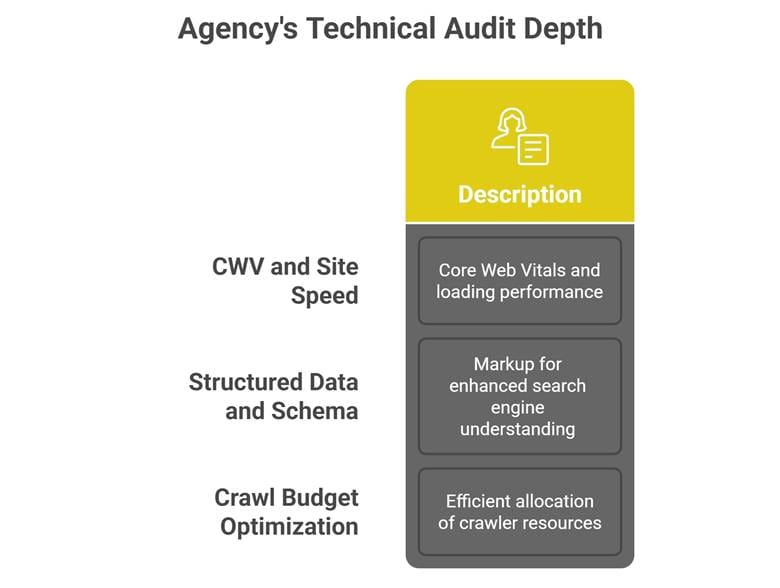
- CWV and Site Speed: Speed is a direct ranking factor and a critical component of user experience (UX). The agency must show they can address metrics like Largest Contentful Paint (LCP) and Cumulative Layout Shift (CLS), particularly under mobile-first indexing constraints.
- Structured Data and Schema: SGE and voice search rely heavily on machine-readable data. Does the agency specialise in advanced Schema Markup implementation beyond basic local business tagging to help your content be used in rich snippets and AI answers?
- Crawl Budget Optimization: The agency working on a significant SME website (e-commerce, directories) needs to explain in detail their plan of how they will use Google’s limited crawl resources to the most valuable, high-conversion pages. This is usually done by efficient internal linking and the smart use of noindex/nofollow directives.
Local SEO in a Hyper-Personalized Market
Singapore is a city-state where everything is tightly connected and location purpose matters a lot. For SMEs, Local SEO is the channel with the highest return on investment.
The Shift to Conversational and Visual Search
An agency’s local SEO strategy should not just revolve around the management of a Google Business Profile (GBP) and must be different.
- Conversational Keyword Strategy: Nowadays users tend to search by using very specific, long-tail, and voice-activated queries (for example, “Hey Google, where is the best halal cafe near Bugis that serves specialty coffee?”). The agency should show the capability of researching and targeting those conversational keywords by adjusting the site content to be more in line with natural language patterns.
- Video and Visual Optimization: The popularity of such platforms as TikTok Search and Google Lens makes visual disclosure the main thing. An up-to-date agency will have the client strategies for the optimization of product photos through the use of the descriptive Alt Text, the embedding of product videos, and the tagging of the content for the consumption of the platform users who are not the standard SERP.
The Strategic Selection Framework for Singapore SMEs
To confidently choose the right partner, use a framework that prioritises transparency, customisation, and quantifiable B2B metrics.
| Agency Vetting Criterion | The 2026 Technical SEO Standard | Red Flags to Avoid |
| Strategy Focus | Actionable Business KPIs (Leads, Revenue, ROI) linked directly to organic traffic quality. | Vanity Metrics (Total keyword rankings, overall traffic volume without conversion context). |
| Reporting & Transparency | Daily/Weekly Granular Reporting on rank volatility, technical health, and clear action items. Access to raw data. | Vague monthly reports; relying on inaccessible proprietary dashboards; guaranteeing Page 1 rankings. |
| Content Strategy | Focus on E-E-A-T; content audit to update old, non-performing content; demonstration of expert-driven authorship. | Relying heavily on purely AI-generated, thin content without human editing or technical optimisation. |
| Local Expertise | Proven experience with Singaporean consumer behaviour, language nuances, and leveraging government/local directories for authoritative links. | Generic, template-based backlink strategies or partners who cannot name specific competitive SG industries they have succeeded in. |
The Sotavento Medios Advantage: A Technical B2B Focus
Many top agencies (like MediaOne, First Page Digital, and Impossible Marketing) have a wide range of services, however, their high-end solutions usually have a top-tier price that can be out of a growth-focused SME’s budget or might not be technically suitable.
At Sotavento Medios, we are intentionally redefining our position to be able to take into account the local Singaporean SME’s challenging situation both from the financial and technical aspects:
- Technical Precision for Cost-Efficiency: Initially, we perform a detailed technical audit to locate the changes that will have the greatest impact with the least cost. For SMEs, this is a very important step, making sure that valuable budget is not spent on content creation before the website’s technical base is perfectly stable.
- Affordable, Transparent Packaging: Our organized packages are meant for a predictable, high-ROI investment, concentrating on a limited set of high-intent keywords (e.g. $1,400 SGD/mo for a solid small business package). Thus, the cost overruns typical of large, multi-service retainer models are completely avoided.
- Measurable First-Page Dominance: Our methods are designed for very rapid and significant rank improvement, most of the time aiming at Page 1 of the search results within a short 3-to-6-month period. For a small business, such speed to market represents a very important competitive advantage.
The top SEO company for your small business in 2026 won’t be the most famous one, but rather the one that integrates its technical strategy with your business goals, maintains absolute transparency, and knows the changing digital consumer in Singapore. Keep foremost a collaborator who regard your site not only as a technical asset but also as a viable way to continually generate leads.
Next Step: Secure Your Technical Foundation
In a market where being digitally visible is the main way to compete, putting off a professional SEO audit is just postponing your growth. Definitely, before you commit to any long-term retainer, it is absolutely necessary to have a clear and data-driven guide which shows the technical deficits of your site along with the highest-impact keyword opportunities.
Do you want Sotavento Medios to start a free 30-minute technical SEO risk assessment for your Singapore-based small business in order to benchmark your current E-E-A-T score and SGE readiness for 2026?

Jeremy Lee is a seasoned digital marketing director and strategist with over two decades of experience in the industry. As the founder of Sotavento Medios, I manage a diverse portfolio of over 50 businesses, helping brands grow through advanced search strategies and digital innovation. My work focuses on bridging the gap between traditional search engine optimisation and the evolving world of AI-driven answer engines.