The digital marketing landscape in Singapore, a city known for its fast adoption of technology, is changing rapidly. For B2B firms and experienced marketing managers, the rules for search visibility are evolving. The focus on traditional SEO, which is primarily about building links, is merging with a new priority: Answer Engine Optimization (AEO).
AEO is not just a new version of SEO; it is a unique strategy developed in response to the rise of AI-driven search tools like Google AI, Bing Copilot, and ChatGPT Search, along with the growth of zero-click searches. While traditional SEO aimed for clicks, AEO aims to provide the most reliable and cited answer. For Singapore businesses in a highly competitive, mobile-first market, grasping this shift is essential for maintaining digital authority and generating leads.
The Fundamental Divergence: Goal, Format, and Metric
The main distinction between traditional SEO and AEO lies in their ultimate goals. This difference shapes everything from content structure to technical implementation.
1. Primary Goal: Clicks vs. Citation
The main goal of traditional SEO has always been to get a web page to the top of the Search Engine Results Page (SERP), specifically in positions 1 to 3, to attract traffic. This enhances the Awareness and Consideration stages of the funnel by widening organic reach.
AEO’s Goal: The key aim of AEO is to be the cited source in AI-generated answers, Featured Snippets (Position Zero), and voice search results. It emphasizes gaining brand visibility and authority by delivering a direct, concise answer to user questions, even if this means a zero-click interaction.
AEO ensures that when a buyer asks an AI tool about your category, competitors, or pricing, it shares your perspective instead of your competitors’. This builds trust and positions your brand as a subject matter expert.
2. Content Format: Depth vs. Structure
Traditionally, SEO preferred long, keyword-rich articles (often over 1,500 words) to show topically relevant authority. While depth is still vital, AEO introduces a new requirement: machine-readability.
| Feature | Traditional SEO Content | Answer Engine Optimization (AEO) Content |
| Focus | Comprehensive topic coverage; broad keywords. | Specific, direct answers to conversational questions. |
| Length | Typically long-form and detailed. | Prioritizes a concise answer (30–60 words) placed upfront. |
| Structure | Flowing prose, optimized for human reading. | Structured Q&A format, bulleted lists, numbered steps, and tables that are easily extractable by AI/LLMs. |
| Language | Formal, keyword-dense. | Natural, conversational language that mirrors user voice queries. |
3. Key Metrics: Traffic vs. Authority
Another important difference is how success is measured. Relying only on Google Analytics for organic traffic will give an incomplete view of AEO performance.
- Traditional SEO Metrics: Organic Traffic Volume, Keyword Ranking Position, Click-Through Rate (CTR).
- AEO Metrics: Ownership of Featured Snippets, Frequency of AI Overview/LLM Citations, Selection in Voice Search Results, and presence in zero-click searches.
Singapore businesses must monitor how often their brand is mentioned in AI responses and which queries lead to citations. A valuable AEO citation, even without a click, significantly boosts brand recall and strengthens E-E-A-T (Experience, Expertise, Authoritativeness, and Trustworthiness).
The Technical Requirement: Structured Data and E-E-A-T
The convergence of SEO and AEO occurs at the technical level, particularly in how we help search engines and AI models comprehend content context.
The AEO Requirement for Structured Data
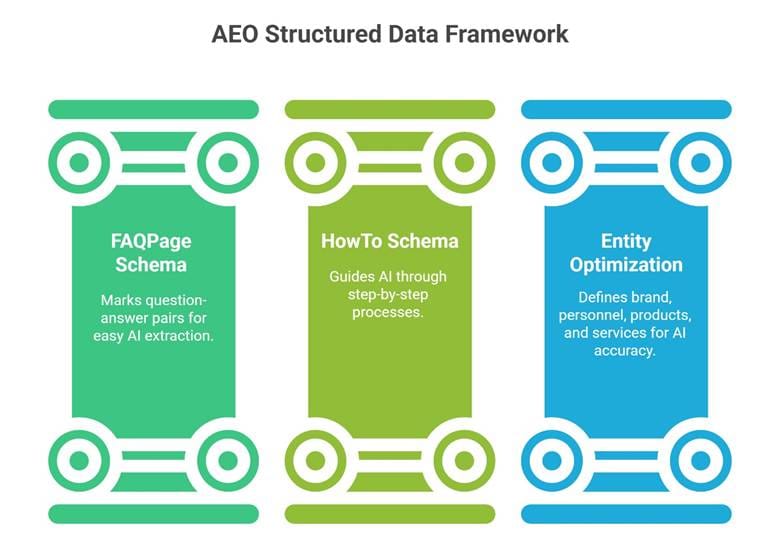
While Technical SEO has always involved using Schema Markup for elements like “LocalBusiness” or “Product,” AEO makes using specific schemas essential.
For Singapore B2B companies, this means consistently applying:
- FAQPage Schema: Important for clearly marking question-answer pairs, making it easy for AI to extract.
- HowTo Schema: Useful for guiding AI through step-by-step processes (e.g., “How to register a company in Singapore”).
- Entity Optimization: Clearly defining your brand, key personnel, products, and services as entities with consistent naming and relevant schema (e.g., Organization or Person). This helps AI make accurate connections about your offerings.
Strengthening E-E-A-T: The Trust Signal
In the era of AI-generated content, Google’s focus on E-E-A-T is more crucial than ever. AI models prioritize information from authoritative and high-quality sources.
For Singapore firms, AEO relies on E-E-A-T by requiring:
1. Experience: Content should reflect real-world, localized experience (e.g., referencing Singapore-specific regulations like PDPA or IRAS taxes).
2. Expertise: Clearly linking content to named industry experts or accredited professionals within your firm.
3. Authoritativeness & Trustworthiness: Earning quality backlinks, ensuring content accuracy, and maintaining a strong off-site reputation.
Actionable AEO Strategies for the Singapore Market
Singapore’s current internet generation, marked by high mobile usage and multilingual queries (English, Mandarin, Malay, Tamil), makes AEO especially effective.
1. Optimize for Conversational and Voice Queries
Considering Singapore’s mobile-first users, conversational search is becoming more common. Users are shifting from typing shorthand keywords (“SEO agency SG”) to asking full questions (“Who is the best B2B SEO agency in Singapore and what are their rates?”).
- Strategy: Align your content with long-tail, question-based keywords that reflect natural speech. Use tools to find “People Also Ask” (PAA) queries relevant to the Singapore market and create sections that answer them clearly.
2. Prioritize Localized Entity and Schema Optimization
For B2B services like corporate law, finance, or logistics, local intent is essential. AEO for Singapore means providing direct, local answers.
- Strategy: Consistently use LocalBusiness and Service schema. Ensure your Google Business Profile (GBP) is thoroughly updated and links directly to optimized, answer-focused landing pages for services (e.g., a page titled: “What is the process for company liquidation in Singapore?”).
3. Embrace Multimodal Content for AI Extraction
AI Overviews and answer engines are increasingly incorporating multimedia. A clear graphic, video, or table often serves as a better source than dense text.
- Strategy: Break down complex B2B topics (e.g., a SaaS implementation process or a financial modeling method) into a visually appealing infographic or short video. Ensure all multimedia has informative captions, accurate file names, and suitable schema to help AI understand.
Conclusion and B2B Call-to-Action
Answer Engine Optimization is the vital evolution for Singapore businesses in the AI-driven search economy. It is not about replacing traditional SEO; it focuses on developing a second layer of optimization that ensures your brand’s expertise is cited by the platforms that modern, savvy buyers rely on for instant, credible answers.
Not implementing AEO means giving away zero-click visibility, brand authority, and a significant part of early-stage buyer conversations to competitors who have adjusted. The shift is technical, strategic, and immediate.
Are you ready to ensure your brand narrative is cited by leading AI models, positioning your firm as an authority in the Singapore B2B market? Sotavento Medios offers technical AEO audits and strategic content development to connect your SEO foundation with the future of AI search.
Jeremy Lee is a seasoned digital marketing director and strategist with over two decades of experience in the industry. As the founder of Sotavento Medios, I manage a diverse portfolio of over 50 businesses, helping brands grow through advanced search strategies and digital innovation. My work focuses on bridging the gap between traditional search engine optimisation and the evolving world of AI-driven answer engines.