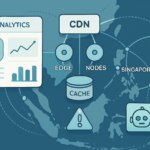
Singapore and the Philippines are approaching smart city development from very different starting points, yet both markets are converging on the same operational challenge: how to make urban infrastructure more resilient, more responsive, and less dependent on manual intervention. In Singapore, the conversation has moved beyond connectivity and into orchestration, where transport, utilities, public safety, and environmental systems are expected to act as a coordinated digital layer. In the Philippines, the pressure comes from rapid urban growth, infrastructure fragmentation, weather volatility, and the need to modernize legacy systems without disrupting essential services. By 2026, the most competitive smart city programmes will not simply connect more devices. They will use 6G-ready architectures and IoT telemetry to detect faults, predict failures, isolate incidents, and trigger automatic remediation across roads, grids, water systems, and public assets.
The shift toward self-healing urban infrastructure is not a futuristic concept. It is a practical response to the limits of conventional reactive maintenance, where city operators wait for a breakdown, dispatch a crew, and then restore service after disruption has already affected residents and businesses. A self-healing model combines edge computing, AI-driven analytics, digital twins, private wireless, and interoperable IoT device fleets to create a closed feedback loop. For business decision-makers and technical leaders in Singapore and the Philippines, that means a new operating model for urban reliability, one that can reduce downtime, improve safety, and support sustainability goals while meeting strict governance and cybersecurity requirements.
Why 6G and IoT will define the next generation of urban resilience
IoT has already proven its value in smart lighting, traffic management, environmental sensing, and predictive maintenance. The real change coming in 2026 is not just the number of connected endpoints, but the quality of the network fabric supporting them. 6G is expected to extend the capabilities of 5G with sub-millisecond latency targets in some use cases, integrated AI at the network edge, better support for massive machine-type communications, and more deterministic performance for critical workloads. That matters for urban systems where milliseconds can influence safety, congestion, or equipment protection.
For self-healing infrastructure, bandwidth alone is not enough. Cities need ultra-reliable low-latency communications, network slicing, and trustworthy device identity at scale. A flood sensor in a drainage canal, a vibration sensor on a bridge girder, and a distribution automation controller in a power substation each have different latency, availability, and security requirements. A 6G-oriented architecture supports this heterogeneity by allowing traffic to be separated logically and prioritized according to service class. That is particularly relevant in dense urban areas such as Singapore, where critical systems must coexist with consumer broadband and enterprise workloads, and in Metro Manila or Cebu, where network congestion and uneven infrastructure coverage can affect service continuity.
From connected devices to autonomous response loops
Most IoT deployments stop at monitoring. Self-healing infrastructure goes further by linking telemetry to orchestration. A sensor detects an anomaly, the analytics layer classifies the event, the control plane determines an action, and the system executes a response automatically or with human approval depending on risk threshold. For example, if a smart water network detects pressure loss in a district metered area, the platform can correlate flow patterns, isolate the suspected segment, reroute supply where possible, and dispatch a work order to the field team with geotagged diagnostics. That is materially different from a dashboard that simply shows a red alert.
This model depends on event-driven architecture, real-time stream processing, and rules engines that can incorporate both deterministic logic and machine learning outputs. It also requires semantic interoperability, so that devices from different vendors share a common data model. Without that layer, cities end up with disconnected pilot projects rather than a resilient digital operating system.
Self-healing urban infrastructure across transport, utilities, and public assets
The strongest business case for self-healing cities comes from systems where failure has immediate operational or financial consequences. Transport networks, energy distribution, drainage systems, and public facilities can all benefit from predictive and autonomous intervention. The exact design will differ by market, but the underlying principles remain the same: instrument critical assets, normalize telemetry, infer risk early, and automate containment before a fault escalates.
Transport systems that reroute before congestion becomes disruption
In a smart transport environment, cameras, inductive loops, radar, connected signage, and vehicle-to-infrastructure messaging can be combined to identify queue formation, signal drift, lane incidents, or equipment malfunction. A self-healing traffic control system can respond by adjusting signal timing, changing variable message signs, and coordinating with enforcement or emergency services. In Singapore, where road pricing, mass transit, and traffic control are already highly integrated, the opportunity is to increase system autonomy and prediction accuracy. In the Philippines, the most immediate gains are likely in corridor management, terminal operations, and incident response on major arterials where delays can cascade quickly across the network.
Digital twins play an important role here. A city can simulate how changing a signal plan, closing a lane, or redirecting buses will affect travel time, emissions, and emergency access. When live telemetry is continuously compared against the twin, operators can test intervention strategies virtually before applying them to the physical network. This reduces the risk of unintended side effects and improves confidence in automation.
Utilities that isolate faults and restore service faster
Energy and water networks are strong candidates for self-healing because many faults are local and can be contained with the right automation. In a distribution grid, smart meters, feeder sensors, reclosers, and substation devices can work together to detect a line fault, isolate the affected section, and restore power to unaffected customers through alternate paths. This approach is often described as fault location, isolation, and service restoration. It is not new, but 6G-era connectivity and edge AI can improve the speed and precision of the response.
Water utilities can apply similar logic to leakage detection, pump failure, and contamination risk. Acoustic sensors, pressure monitors, and water quality probes can identify abnormal patterns long before a visible service problem emerges. In coastal cities and flood-prone areas, drainage systems can also become self-healing by adjusting sluice gates, pump activation, and retention basin operations based on rainfall forecasts and real-time level data. For the Philippines, where typhoons and seasonal storms place extreme stress on urban drainage, this is a significant resilience opportunity. For Singapore, the focus may be on precision water management, asset efficiency, and climate adaptation.
Public infrastructure that maintains service continuity
Street lighting, elevators in public buildings, rail station equipment, and municipal facilities may seem less critical than power or water, but they create broad operational impact when they fail at scale. Smart lighting networks can detect power degradation or device malfunction and automatically reroute maintenance priorities. Building management systems can identify abnormal HVAC energy consumption, filter issues, or sensor drift and trigger optimization or service tickets. In high-density civic environments, the cumulative effect of these small failures can meaningfully affect safety, energy use, and public confidence.
Technical architecture for a self-healing city platform
A credible self-healing architecture does not depend on a single platform vendor. It requires a layered design that separates device management, data ingestion, analytics, orchestration, and governance. The most durable implementations are built on open standards where possible, with clear interfaces for data exchange and control. Cities and their integrators should expect to combine private 5G or emerging 6G testbeds, LPWAN technologies such as NB-IoT or LoRaWAN for low-power assets, edge gateways for local processing, cloud analytics for fleet-wide intelligence, and digital twin models for simulation and planning.
At the device layer, asset identity and secure onboarding are essential. Every sensor, camera, actuator, and controller should have a unique cryptographic identity and a lifecycle management process that covers provisioning, firmware updates, certificate rotation, and decommissioning. At the connectivity layer, deterministic routing and service assurance matter more than raw throughput for critical applications. At the edge layer, local inference reduces latency and can preserve operations during backhaul interruptions. At the platform layer, event correlation, anomaly detection, and policy-based orchestration turn raw data into actions.
Interoperability and standards are not optional
Smart city programmes fail when each department buys its own stack and no one can reconcile the resulting data silos. Technical leaders should anchor architecture decisions in open protocols and recognized frameworks. MQTT remains widely used for lightweight telemetry. OPC UA is important for industrial and utility environments. RESTful APIs and event streams help integrate enterprise systems. For data modelling, semantic consistency should be enforced through common taxonomies and asset registries. In the broader governance layer, frameworks such as ISO 37120 for city indicators, ISO 27001 for information security, and IEC 62443 for industrial cybersecurity provide useful reference points.
Using standards does more than improve compliance. It lowers integration cost, preserves vendor flexibility, and reduces lock-in risk. That matters in public-sector environments where procurement cycles are long and infrastructure must remain operational for decades. A city that designs for interoperability from the start is better positioned to add new sensors, new AI models, or new network capabilities without rebuilding the entire stack.
Cybersecurity and trust must be built into the control loop
As infrastructure becomes more autonomous, the attack surface expands. A malicious actor who compromises an edge gateway or manipulates telemetry can trigger false alarms, disrupt operations, or hide a real fault. Self-healing systems therefore need zero-trust principles, strong segmentation, anomaly detection for command traffic, and immutable audit logs. It is also critical to separate advisory analytics from actuation authority. Not every model output should trigger an automated response. Risk-based policy should determine when the system acts autonomously, when it requests human approval, and when it simply raises an alert.
For cities handling sensitive public data, governance also includes data minimization, retention controls, and transparency about automated decisions. This is particularly important where computer vision, mobility data, or utility consumption patterns could reveal personal or commercial behaviour. Trust is not a communications exercise after deployment. It is an architectural property that must be engineered from day one.
Practical deployment patterns for Singapore and the Philippines
Singapore is well placed to pursue advanced self-healing city use cases because it already has mature digital infrastructure, strong regulatory coordination, and a track record of integrated urban planning. The opportunity is to move from connected systems to autonomous orchestration across transport, estate management, utilities, and climate resilience. Pilot programmes can be designed around clearly bounded domains such as road corridor monitoring, public housing asset maintenance, or water quality assurance. These use cases allow the city to validate data quality, latency, failover behaviour, and human oversight models before scaling wider.
In the Philippines, practical deployment should prioritize high-impact zones where infrastructure stress is most visible. Flood-prone districts, transport corridors with recurring congestion, and utility nodes with high service interruption risk are strong candidates. Because city environments vary widely across regions, a modular deployment model is usually better than a monolithic platform. Local governments can start with a narrow asset class, such as drainage monitoring or streetlight management, then expand as operational maturity and network coverage improve. The best projects will combine public funding, private operator participation, and telecom partnerships that support low-latency connectivity at the edge.
A useful pattern for both markets is phased autonomy. Phase one digitizes assets and establishes a clean data model. Phase two adds predictive analytics and fault classification. Phase three introduces guided automation, where the system recommends actions and operators approve them. Phase four enables bounded autonomy for low-risk events, such as rerouting traffic signals or isolating a minor utility fault. Full autonomy should only be considered where system confidence, cybersecurity, and regulatory oversight are strong enough to justify it.
Implementation checklist for 2026 smart city programmes
- Map critical urban assets by failure impact, not by department ownership, so that transport, utility, and public facility priorities align around service continuity.
- Establish a citywide data model for asset identity, telemetry, maintenance history, and incident classification before scaling sensors.
- Use edge processing for time-sensitive workloads and reserve cloud analytics for longitudinal pattern detection and digital twin simulation.
- Design connectivity with service classes, network slicing, or equivalent priority mechanisms for critical control traffic.
- Adopt open protocols and standards to reduce integration friction and preserve vendor flexibility over the asset lifecycle.
- Implement zero-trust controls, certificate-based device identity, and secure update pipelines for all IoT endpoints.
- Define automation thresholds for each use case, including when the system can act, when it must ask for approval, and when it should only alert.
- Start with high-value pilot zones that have measurable operational pain, such as flood corridors, congestion hotspots, or utility fault clusters.
- Validate the architecture against resilience events, including connectivity loss, sensor drift, false positives, and partial subsystem failure.
- Build governance around auditability, incident response, and human oversight so automated remediation remains explainable and accountable.

I am Tricia Huang Mei, an Advertising Partner in Sotavento Medios with over two decades of experience in the Singapore advertising and business sectors. My career is defined by a commitment to driving high-impact marketing campaigns and fostering sustainable growth for the diverse business portfolios I manage.