The digital marketing environment in the Philippines is fundamentally changing. Earlier traditional Search Engine Optimization (SEO) metrics were more focused on clicks and rankings but now due to the rise of Generative AI which is majorly led by platforms like Google’s AI Overviews and sophisticated LLMs (Large Language Models), the focus has to be shifted to Answer Engine Optimization (AEO). Hence, it is no longer enough for B2B businesses and their agencies in the Philippines to just rack up the traffic volume. To successfully handle this setting they need to have a new reporting framework that measures authority, visibility, and the direct answer placement.
At Sotavento Medios, we understand that the answer is the new zero position. The top Philippine agencies are going beyond just reporting on organic sessions; they are creating detailed dashboards that not only reflect traditional SEO performance but also show the real business impact by including AEO-specific Key Performance Indicators (KPIs).
The Integrated AEO Reporting Framework: Beyond the Click
Philippine agencies at the forefront of the AEO transition are no longer thinking in terms of mere impressions or rankings only. Instead, they are emphasizing a single framework that measures not only the quantity of visibility but also the conversion impact, which is a reflection of the social media, mobile, and conversational trends that are highly localized but still very much a part of the market.
1. Visibility Metrics: Quantifying Answer Dominance
While Traditional SEO tracked impressions, AEO is more focused on citations and the placement of the answer. This is very important in the Philippines because that is where the mobile and voice search are the main factors for the growth and they depend a lot on direct answers and snippets.
Core AEO Visibility KPIs
- AI Answer Inclusion Rate: It indicates the proportion of high-intent, question-based target queries, where a brand or content of yours is directly mentioned in an AI-generated summary (for instance, Google’s AI Overview or a conversational LLM response). In other words, this metric demonstrates that your brand is considered one of the main sources of information by the AI.
- Actionable Insight: A low rate signals a need for better content structure (FAQ, How-To schema) and stronger topical authority.
- Featured Snippet Capture Rate (Position Zero): Even though it is an old SEO feature, the Featured Snippet is still the main and most direct way to AI answer training and voice search results. Agencies should keep an eye on how many of the target keywords are causing a snippet and what fraction of those snippets are from the client’s domain.
- People Also Ask (PAA) Appearance Frequency: PAA boxes are essential for defining topic clusters and monitoring nearby visibility. A high frequency in this context is a strong indication of deep and thorough content that effectively corresponds to the related user intent, thus it considerably enhances your entity signal for AI engines.
2. Authority Metrics: Building AI-Recognized Trust
AEO revolves mainly around EEAT (Experience, Expertise, Authoritativeness, and Trustworthiness). As AI models generally select sources based on the authority they perceive, companies need to present figures that confirm this trust.
Technical and Semantic Authority KPIs
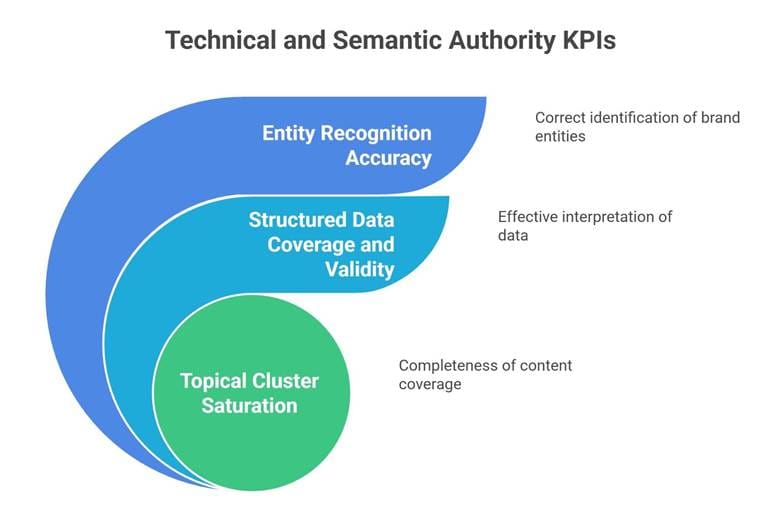
- Entity Recognition Accuracy: This essentially measures how correctly the search engines and AI comprehend your brand and the main figures of your brand as separate, clearly identified entities. The agencies keep a tab on this by checking the brand’s presence in the local knowledge panel and the uniform implementation of Organization and Person schema throughout the website.
- Technical Focus: Monitoring the consistency of brand name, addresses (LocalBusiness schema), and personnel bios across the web.Tools like Kalicube Pro or Google’s own Natural Language API can assist with this B2B intelligence.
- Structured Data Coverage and Validity: The AI engine’s capability to quickly and effectively interpret your data is a major factor. There should be a mention of how much of the key pages (FAQs, Services, Products) are equipped with valid and complete Schema Markup, with a particular emphasis on the schema types that are directed towards giving the most concise answers.
- Topical Cluster Saturation: The completeness is what AI rewards. This indicator shows to what extent the client has covered the subtopics of a main topic with their content. The higher the saturation score, the more the client is perceived as the most comprehensive authority on that subject, thus becoming the source of the preferred answer.
3. Business Impact Metrics: Conversions in the AI Era
While AEO is mainly focused on enhancing the visibility, B2B performance in the Philippines is still largely dependent on lead generation and revenue. The reports ought to illustrate how AEO actions have led to the bottom-line results, in other words, they should make a clear connection between the final commercial outcomes and AEO activities taking into consideration the complicated, frequently indirect, conversion path of an AI-driven user.
Conversion and Engagement KPIs
| Metric | Definition & AEO Relevance | Business Value |
| Micro-Conversion Rate from AI-Influenced Sessions | Tracking actions like PDF downloads, whitepaper sign-ups, or demo requests where the session path included an AI-driven click (e.g., from a Featured Snippet). | Measures the quality and commercial intent of the AI-referred user. |
| Branded Search Demand Growth | The increase in organic searches for the client’s brand name. | High AI visibility and citation (winning the answer) often bypasses a direct click but drives massive brand awareness, leading to later, higher-intent branded searches. This is a crucial proxy for AEO ROI. |
| Assisted Conversions via AI Channel | Using sophisticated attribution models (e.g., Google Analytics 4) to show when AI-referred traffic served as an early touchpoint in a long B2B sales cycle. | Demonstrates the full funnel value of AEO, proving it builds trust and starts conversations before the final conversion. |
| Voice Search Traffic & Engagement | Tracking sessions, queries, and time-on-page from voice-driven platforms, which are inherently AEO-optimized. | Essential for Philippines’ mobile-first market; validates content is optimized for conversational, natural language queries. |
The Sotavento Medios Synthesis: A Call to Strategic Action
The top Philippine digital marketing agency in the country no longer sees SEO and AEO as two different areas. Instead, they are one, integrated strategy aimed at leveraging both traditional organic traffic and non-click answer visibility to the fullest. The reporting framework is the key instrument that brings these technical initiatives in line with tangible B2B goals: lead generation, brand authority, and market share.
Not changing your reporting to cover AI Answer Visibility and Entity Recognition is like ten years ago when a company would report only on impressions and ignore conversions. It hides the real worth of your digital assets in the current, generative-first online ecosystem.
Next Step: Audit Your Agency’s AEO Readiness
Are you receiving these advanced, full-spectrum AEO reports from your current marketing partnership? Are you measuring your brand’s power as an AI-recognized entity?
Sotavento Medios is a company that specializes in technical audits and the creation of strategies that are specifically suitable for the generative AI era. We are capable of evaluating your existing content structure, making your entity schema more efficient, and creating a consolidated reporting dashboard to not only assure that your brand ranks, but that it is the one that is most frequently referred to as the authority in the Philippine B2B space.

Jeremy Lee is a seasoned digital marketing director and strategist with over two decades of experience in the industry. As the founder of Sotavento Medios, I manage a diverse portfolio of over 50 businesses, helping brands grow through advanced search strategies and digital innovation. My work focuses on bridging the gap between traditional search engine optimisation and the evolving world of AI-driven answer engines.