The changes in Google Ads have been a major factor in how budgets are distributed across the digital scene. Most notably, Performance Max (PMax) has been the main driver to shift the focus from a mere channel-driven way of working to a goal-aware, AI-powered one. This change makes it a question of how to strategically fuel Google’s automation rather than micromanaging bids on specific keywords for marketing managers, SEO specialists, and B2B owners.
The situation in 2026 demands that the budget be very flexible and be mainly driven by the demand. In such a case, the investment would be continuously optimized based on real conversion results and not on the fixed annual allocations. Sotavento Medios’ technical framework for budget allocation is a very effective way of ensuring that each campaign type Search, Display, and Performance Max is well integrated in the whole customer acquisition funnel thus achieving maximum efficiency.
The Strategic Role of Each Campaign Type
Responsible financing of the marketing budget is first of all accompanied by measuring the value of the investment in the different types of campaigns. Besides, they are not tracks competing against each other but rather complementing each from a single, full-funnel united strategy.
1. Search Campaigns: The High-Intent Anchor
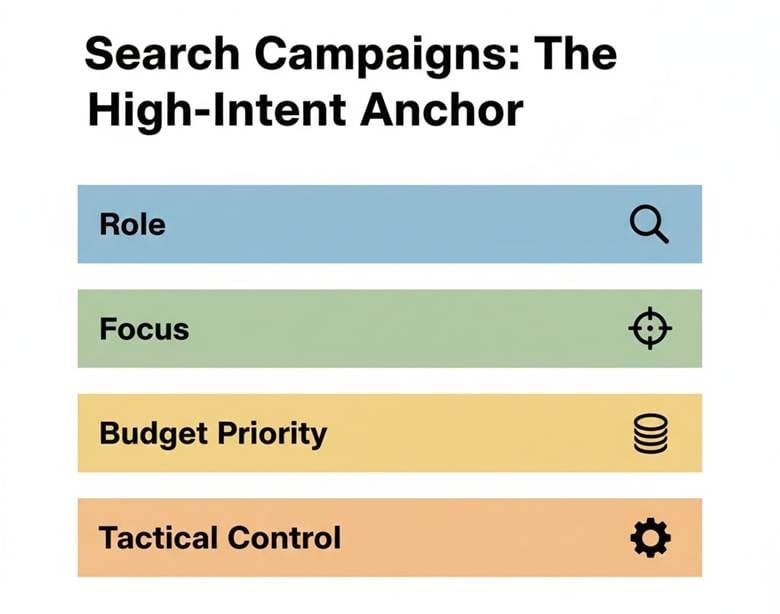
- Role: The prime aim of the enterprise is to seize existing, high-intent demand the furthest bottom-of-the-funnel (BOF) defense as well as the most dependable origin of good-quality, traffic that has been pre-qualified.
- Focus: Users who are probably going to take the final step can be addressed with exact-match and long-tail broad-match keywords (e.g., “[Product Name] pricing,” “[Service] consultant Singapore”).
- Budget Priority: In general, it is advisable that the search campaigns will be granted the highest priority, or at least the most stable, non-negotiable portion of the budget. They are the most useful in defending your brand and ensnaring the most profitable and immediate demand. For B2B, Search campaigns are the ones that usually lead to lower Customer Acquisition Cost (CAC) as a result of accurate control of the message that is in line with the complex intent.
- Tactical Control: Here is where you put into practice the most rigorous negative keyword lists (mainly for PMax to avoid budget waste) and keep close control of the ad copy to specifically point out the buyer’s problems.
2. Display Campaigns (Standard/Retargeting): The Precision Reinforcer
Role: Display campaign helps to retarget and deepen the relationship with high-value prospects, making sure these never slip away from the radar. In addition, while PMax comprehensively provides for a great part of open Display inventory, a dedicated Display campaign gives freedom for absolute precision in retargeting and exclusion.
- Focus: Retargeting audience (e.g. abandoned cart, specific content engagers) and selectively prospecting managed placements (e.g. specific, high-quality industry websites or apps) that correspond to B2B behavior and a longer sales cycle.
- Budget Priority: A small, stable percentage (e.g., 10-20%) should be set aside mainly for the pools of remarketing. Such an investment works to keep the brand at the top of the customers’ minds during the consideration stage.
- Tactical Control: Use exclusions with great force. Do away with mobile apps, irrelevant websites, and non-performing demographics so that your budget will be spent on high-value impression volume.
3. Performance Max (PMax): The Growth Engine
Role: PMax is the main driver to accomplish large-scale operations, produce incremental conversions, and discover new, high-value audiences to complement the existing ones across the entire Google network (Search, Display, YouTube, Gmail, Discover).
- Focus: Full-funnel reach driven by strong first-party Audience Signals (Customer Match lists, high-value audiences). In fact, PMax is very good at attracting new users in an efficient way once the core high-intent Search demand has been fulfilled.
- Budget Priority: To be able to go beyond the learning phase and optimize adequately, PMax needs to be endowed with a sufficient budget (usually 3x Target CPA/CPL minimum). It should mostly perform the role of a complement by targeting incremental reach that Search campaigns cannot achieve. The remainder or scaling budget is most likely to be directed there.
- Tactical Control: The main factor determining your success will be your resources: top-notch creative assets, very clean conversion tracking (with values), and well put negative keywords (especially if branded terms are used in a separate Brand Search campaign).
The Dynamic Budget Allocation Framework
The idea of fixed percentage splits is abandoned by Sotavento Medios in favor of a Value-Based Pacing Model that is directed by real-time conversion data and Customer Lifetime Value (CLV).
1. Establish the Foundation: Value-Based Measurement
Apart from that, the very first step to efficient budget allocating is dollar revenue alignment of the system.
- Implement Enhanced Conversions: This is the must for business-to-business (B2B) lead generation, since it allows for accurate tracking of the entire lead flow, from the click to the closed-won opportunity in CRM.
- Assign Conversion Value Rules: Start distinguishing the value of a qualified demo request ($X) from that of a simple newsletter sign-up ($Y). This conversion helps the AI system to place the most aggressive bids on the actions that lead to the highest revenue, thereby making efficient Target ROAS bidding possible.
2. The Core Allocation Principle (The 60/30/10 Rule for Starting):
Though it is a dynamic one, having the starting point is necessary for both control and structure:
| Campaign Type | Starting Allocation (Goal) | Function in the Funnel | Risk/Control Profile |
| Search (Non-Brand & Brand) | 60% – 70% | Capture Imminent Demand & BOF Conversions | High Control, Lower Risk |
| Performance Max | 20% – 30% | Drive Incremental Scale & Prospecting | Low Control (High Automation), Moderate Risk |
| Display/Video/Retargeting | 5% – 10% | Nurture, Branding, and Precise Remarketing | High Control (Retargeting), Lower Intent |
Technical Note: This is an initial structure. Budget allocation should directly follow performance. In case PMax regularly achieves a lower CPA/CPL for new, incremental customers than Search, then the share of its budget has to be raised.
3. Governing the Interaction: Cannibalization Control
The major risk of a mixed environment is cannibalization, in which case PMax just takes the conversions that your Search campaigns would have generated.
- PMax and Search Overlap: When deciding on a campaign, Google considers an Exact Match Search campaign over PMax if the search query exactly matches a live keyword. However, you shouldn’t depend only on that rule.
- Brand Exclusions: To get the maximum control and accurate increment measurement, create a separate, low-cost Brand Search Campaign. While using negative keywords in your PMax campaign, exclude your brand terms. By doing this you stop PMax from targeting your own branded traffic and make it look for truly new customers.
- Keep Up with Search Insights: It is very important to constantly look into the Search Term Report and PMax Search Insights so you can be sure that PMax is not spending its budget on irrelevant informational queries or competing when it’s not necessary. Be very active in excluding those places that perform badly.
Looking Ahead: Optimizing for the AI-Led Future
The main trend for 2026 is that this leads to a significant speed-up of AI Overviews (AIO), which is most likely the reason behind the switch from informational search traffic to the hyper-focused, bottom-of-funnel conversion intent.
- Refine Search: Put more effort into commercial, purchase-intent queries. Allow AIO to take care of the top-of-funnel informational queries.
- Feed the PMax Beast: Nothing makes PMax thrive other than top-notch input. Keep refreshing and updating your creative assets especially video and high-quality images—so that you can maintain a high Creative Quality score, which is a new key factor in Ad Rank.
- Employ Total Budgets: Use the recently introduced Total Campaign Budget option most effectively for PMax, e.g., in case of promotional or fixed-flight campaigns. This not only gives the boundary control, which B2B finance teams require, but also stops the overspend from being not only unpredicted but also of great magnitude during the peak demand days.
B2B Call-to-Action (CTA)
The intersection of machine learning and human strategy is a puzzle of many pieces. To really grow your multi-channel budget of revenue, rather than just CPA of the superficial kind, you are in need of a thorough technical audit and a data pipeline that links Google Ads with your CRM. Can your present campaign frameworks survive Google automation’s next wave?
Definitely, we should do this! Call a Sotavento Medios Technical SEO & Marketing Strategist and conduct a deep-dive investigation of your campaign structure, conversion tracking, and budget allocation model.

Jeremy Lee is a seasoned digital marketing director and strategist with over two decades of experience in the industry. As the founder of Sotavento Medios, I manage a diverse portfolio of over 50 businesses, helping brands grow through advanced search strategies and digital innovation. My work focuses on bridging the gap between traditional search engine optimisation and the evolving world of AI-driven answer engines.